
Exciting news! After Inland Empire Chapter’s Alan Wardsworth rescued a 1951 Ventnor runabout from a barn where it had sat since 1985, Paul Rodkey agreed to take on this hand-on learning opportunity as the official Inland Empire Chapter project boat. Inland Empire members and students from the local Central Valley High School are gaining experience in varnishing, painting, production, engines, and the art and craft of classic boat restoration.
Now, you might be wondering: does this mean Paul is getting a free restoration? Not exactly. Anyone who has worked with kids (or adults, for that matter) knows that projects like this involve a lot of trial and error. Things will need to be done, redone, and redone again before they’re right.
Paul started removing all interior parts and everything loose. Then cleaned interior with bilge clearer. Alan sent donation letters to business that might be able to help with project. Numerous local sponsors are supporting the project’s various needs, from automotive to epoxy, to paint and compounds. Learn morea bout the IEACBS project sponsors on the Inland Empire Chapter’s website.
The boat’s salvaged automotive gas tank was described as “kinda installed” and appeared to be a gravity feed from the back of the boat. But, with the fuel pump laying on the floor and no discernable place to connect it to the engine, the team wasn’t sure what kind of engine it was. All those who know about engines were scratching their heads. However, after the engine was pulled (in about an hour with no issues!) they determined it to be a Chrysler marine engine model 6-105 serial 1109 with dual down draft Holly 847 carbs.
Students will help take on work on the fiberglass hull, below water and above water paint, varnish stain decking, bilge paint, electrical, etc. As the fiberglass did not appear to be orginal, it was determined the restoration would be more of a more classic build with matching art deco theme colors simular to other Ventnors of the period.
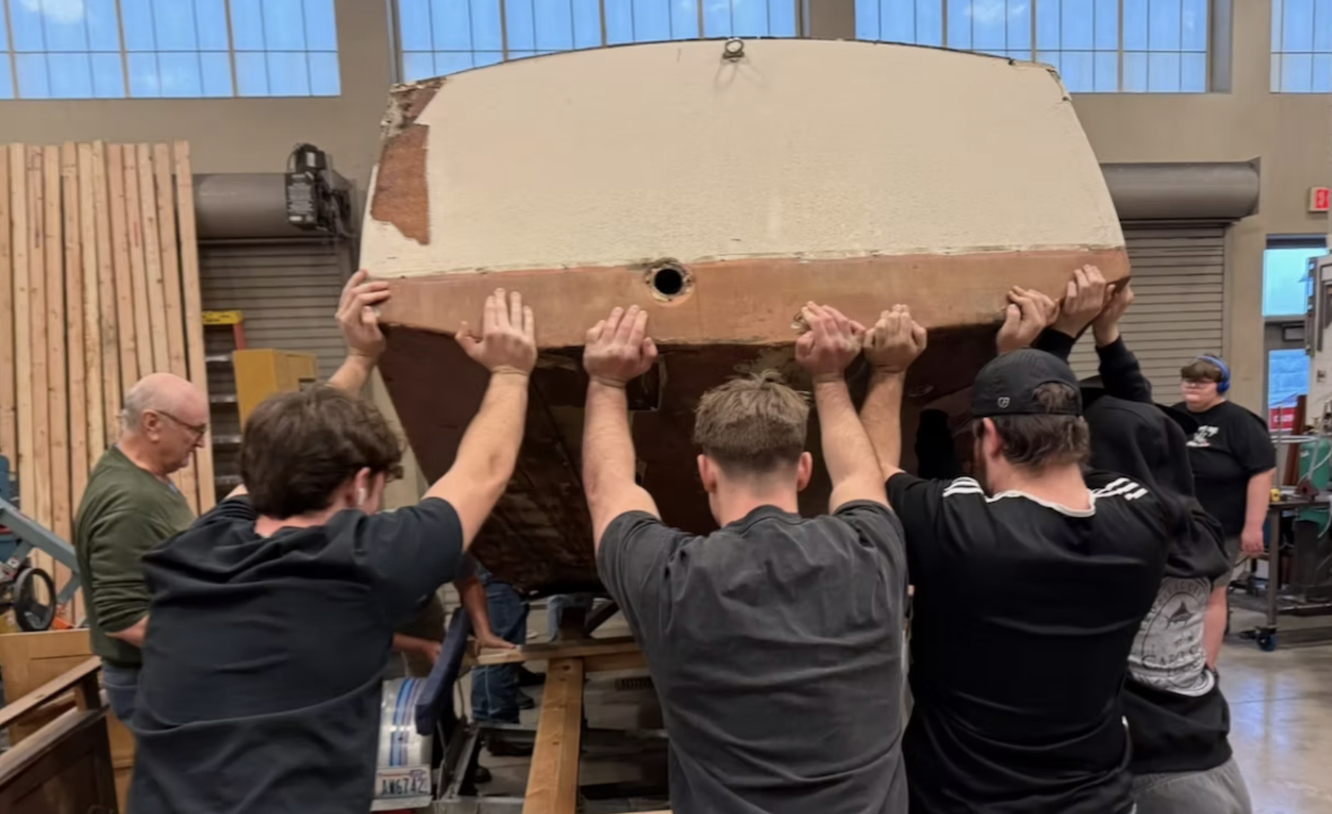
 The project really kicked off into high gear once the Central Valley students were back from their winter break. Paul Rodkey—project manager and owner—had plenty of decisions ahead of him. First on the list was flipping the Ventnor on its trailer. They wanted to keep the option open to move the boat in and out of the shop, or even back to Paul’s house if needed. The boat is estimated to weigh around 1,100 pounds, but with enough hands on deck, flipping the 17-footer wasn’t really isn’t a big deal. Under the watchful eye of Central Valley High School’s teacher Ron Beard, the students slid a few 2x6s under the trailer and rolled the boat right over onto it. Job #1—done.
Next came the bottom evaluation, and this is where things got interesting. To their surprise, the old Ventnor has a double-layer bottom and dual semi-tunnels that flow into a V at the transom. No wonder this boat had a reputation for speed. According to period publications, it could hit 45 mph with just 105 horsepower, powered by a 1942 Ford six-cylinder—likely military surplus after WWII.
The students jumped right into removing the bottom planking, which consisted of ⅜-inch mahogany over cloth, followed by ⅛-inch plywood. Everything was fastened with 1½-inch brass slotted screws and heavily soaked in oil. One advantage of having a large crew of high schoolers—especially ones who don’t mind tearing things apart—is that a bottom came off in just a couple of class periods. Job #2—done.
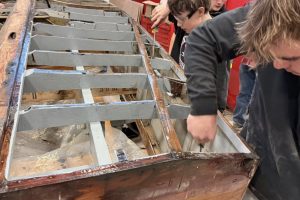
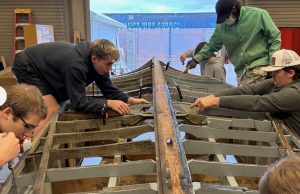
With the bottom off, they moved on to evaluating the frames. Overall, they looked good. There were a few loose and cracked frames near the bow, likely from an impact—confirmed by some fiberglass repairs we uncovered—but otherwise there was no rot. The real mystery showed up where the engine sits. Those frames were pushed up about a half inch from where they attach to the sides, almost floating inside the boat.
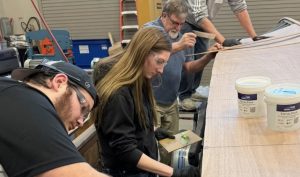 Job #3 involved sanding, cleaning, scraping, and “toothpicking” the bottom—perfect tasks for high school students. The plan is to repair or replace the cracked forward frames and reattach the frames around the engine, shimming them so everything sits fair with the bottom. One particularly suspicious frame, located directly under the engine, was only about an inch tall. To address that, they plan to reinforce it with an aluminum cross member, similar to the brass structural supports already in place on either side.
The big question, of course, was what to do about the new bottom. They decided to start by coating the existing frames with CPES (Clear Penetrating Epoxy Sealer) to ensure a solid mechanical bond with the new ⅜-inch subfloor. While replacing all the frames with fresh wood would be ideal, this approach strikes a good balance. Next, the plan is to plank the bottom with ⅜-inch marine plywood, similar to the original solid mahogany planks, and then fiberglass it.
More updates to come! Follow the progress on the Inland Empire Chapter’s website, or better yet, join our Chapter and join in on the fun!