
By Lew Dobbins, Northern California/Lake Tahoe Chapter
Most of our club members are familiar with Chris-Craft, Century, Hacker Craft and GarWood boats, being the most common in our boating world. And a few are familiar with some of their engines. But even as common as these engines are, the varied model names, numbers and letters often confuse the most experienced of us. So let’s concentrate on a couple of engine manufacturers and their Alphabet Soup.
A, B, C, H, K, L, M and W, a goofy sequence of letters? Indeed! Chris-Craft was in business building boats long before they decided to enter into the engine building game. Prior to the late 20s, Christopher Columbus Smith and Sons built boats with the best engines they could find. The race for speed via horse power was evolving at a rapid pace. And many of the marine engine companies were evolving to supply boat builders like Chris-Craft.
The boats built by Chris Smith in the late teens and 1920, back in the day when Garfield Wood was in control, used anything they could find for higher horse power and more speed. WWI was over and they purchased the early converted Grant- Liberty V-12. These were soon followed by Gar’s own converted Liberty, but most of these engines were used in his boats, built by Smith, and eventually GarWood production boats. An example of this would be Gar Wood’s own Miss America I and II of 1921. Miss America II had 4 of GarWood’s V-12s for a short time.
 The first production boats from Chris Smith, with his name on them, were aimed at the pleasure boat market. These showed up in 1922 and used the surplus Curtiss OX-5 aircraft V-8 engine. This water cooled, 90 horse power at 1,400 RPM, aluminum case engine was the perfect size and power for his new 26’ runabout. These engines were marinized by the Smiths by the addition of water cooled exhaust manifolds, a water suction pump and an electric starter. They fitted a flywheel and a Joe’s reverse gear transmission to the crankshaft snout facing aft. This engine suited them for several years of production as they were able to acquire a sizable quantity at a desirable price. True marine engines of the day cost considerably more than the Curtiss V-8. An example of this early 26’ runabout with a Chris marinized OX-5 is “Godfather”, owned by the Tahoe Maritime Museum in Homewood, CA on Lake Tahoe.
As the Chris-Craft line of boats was expanding and the new 22’ Cadet and the 24’ Model 3 were being built (1927- 1931), more engines were needed in quantity. Chris Craft turned to Scripps, Chrysler and eventually Kermath in the mid to late 20s. The Scripps F-6 engine was offered and used but not in great quantity. More commonly used in these 1927 boats were the Chrysler Imperial series with models: EM (100 H.P.), JM (82 H.P.) and LM (106 H.P.). Kermath 6 cylinder engines were offered for the larger boats but in fewer quantities.
By 1926 and 1927, the Curtiss OX-5 engines were running in short supply. And as they were only rated for 90 H.P at 1,400 RPM, they were limited in performance compared to the engines in current production. Chris Craft did not want to be a slave to engine builders and their higher costs, so the Smith family business decided to create their own V-8 engine. This seemed like a natural direction as Chris’ son, Jay W. Smith, was an engineer. The Chris Craft A-70 was born, shortly followed in 1929 by an improved version, the A-120 that lasted into 1941. These V-8s were not light engines, but at 1,640 lbs, their 824 cubic inches produced solid horse power ranging from 200 to 350 H.P. at 2,300 RPM depending upon version and year. Other than electrics and fuel system parts, these engines were entirely of Chris Craft design and manufacturing, including the reverse gears. These engines were optional to be used in anything from 26’ and up, runabouts, commuters and cruisers. It is reported that some 356 of the A-70 engines, in all varieties, were produced prior to being discontinued in 1931.
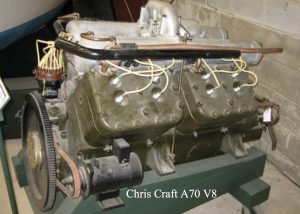 The 5” bore by 5.25” stroke was used throughout the run of all of the variations of both the A-70 and A-120 with the exception of the A-120A of the mid to late 1930s. The bore had been increased by a sixteenth of an inch to a displacement of 845.4 cubic inches. The A-70A and A-120A also used higher compression heads of aluminum but some later heads were built of copper. Carburation was increased and the use of the newer Holly DD-5 became common. Lighter flywheels and “racing” cams allowed these engines to spin up a little faster to 2,850 RPM and produce the additional ponies. There were 249 of the A-120 engine built between 1928 and 1941.
With mass produced boats and larger quantities being built, Chris Craft needed more engines for the smaller runabouts and utilities. Chris partnered in the early 30s with Hercules En- gine Company of Canton, Ohio. They were an industrial and tractor engine builder. Their robust and strong engines were designed to run long hours and usually at high RPMs making them perfect for boat usage. Each of their 6 cylinder engines were built with a main bearing between each cylinder. Thus a six cylinder engine has seven large main bearings for strength. Chris Craft would have Hercules build their engine to the CC specs and the Chris Craft engine department would build the water cooled manifolds, cast iron oil pans and install the water pump and plumbing, the oil cooler and Paragon reverse gear.
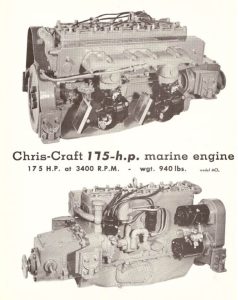 Marine engines historically have run “right-hand” rotation where industrial and automotive engines mostly run left- hand. By turning the engine around to flywheel forward, the industrial engine does not need modification as the propeller will turn clockwise as viewed from the transom. All of the Chris Craft engines built on Hercules engines ran flywheel forward with the reverse gear attached to the “front” or crankshaft snout end of the engine. Oiling systems were modified to provide adequate lubri- cation to all required hardware. This was different from the industrial applications where an engine ran flat or level in its installation. But in a boat, the engines ran at an incline of as much as 18 degrees from level! Oil also had to be fed to the Paragon reverse gear as it used the same 30 or 40 weight oil that was used in the engine. The answer came in drilling the crank- shaft snout along the centerline for a few inches with a small bit until it hit the hollow pressure fed oil galley inside the crank that was used for lubricating main and connecting rod bearings. This provided just enough oil to lubricate the transmission, fill the transmission case up to about 2” before flowing forward, back into the engine pan and the oil pump pickup. This 2” of oil in the transmission case allowed the planetary transmission drum to sit in oil and throw it all around when running.
The first Hercules/Chris Craft engines built were small (456 pound) 4 cylinder flat head engines. This engine, the Model B, would have a long life with Chris Craft being built form 1934 and finally discontinued in the late 1960s! This engine had a bore of 3.25” and stroke of 4” for a displacement of 132.73 cubic inches with only 3 main bearings. An interesting note is that this engine was advertised as having 134 inch displacement until 1936 when the error was corrected in much of the advertising material. This engine started the alphabet soup by having 3 and possibly more model variations. The model B is built on the Hercules Model IXC series block. Hercules engines are quite easily identified from their stamped block model raised land. This can be found at the top of the block deck at the middle cylinders on the non-manifold side. All of the Hercules Chris Craft engines are easily dated as well. They were very good at adding a raised date of manufacture on the head and reverse gear housing and sometimes the block. The dates are not coded and an example from my 1956 Capri with a KBL appears as: 8 2 55 with a screw head on each end. This of course is the casting date or the day the part was poured, being August 2nd, 1955.
 The straight B had a direct 1:1 Paragon reverse gear where the model BR had a reduction gear of 2:1. The model BS also had a reduction gear of 1.5:1. A 2.16:1 ratio was listed in 1936 as well. In 1938, the model B was modified to increase the power from 55 to 60 H.P. at 3,200 RPM. The old 55 H.P. Model B became the new model A but this engine rarely shows up in any documentation or offerings. The Model C also made a short appearance in the mid 30s. Using the same block and 1.25” Zenith updraft as the Model B, it was rated at 45 H.P. at 3,200 RPM. While torque ratings were not commonly used until the 1960s, marine engines were often rated by High speed (often referred to as just Speed), Medium Speed and Heavy Duty. The advertised horse power ratings would decrease as you went from speed to heavy duty while the torque usually increased for slower speed working force.
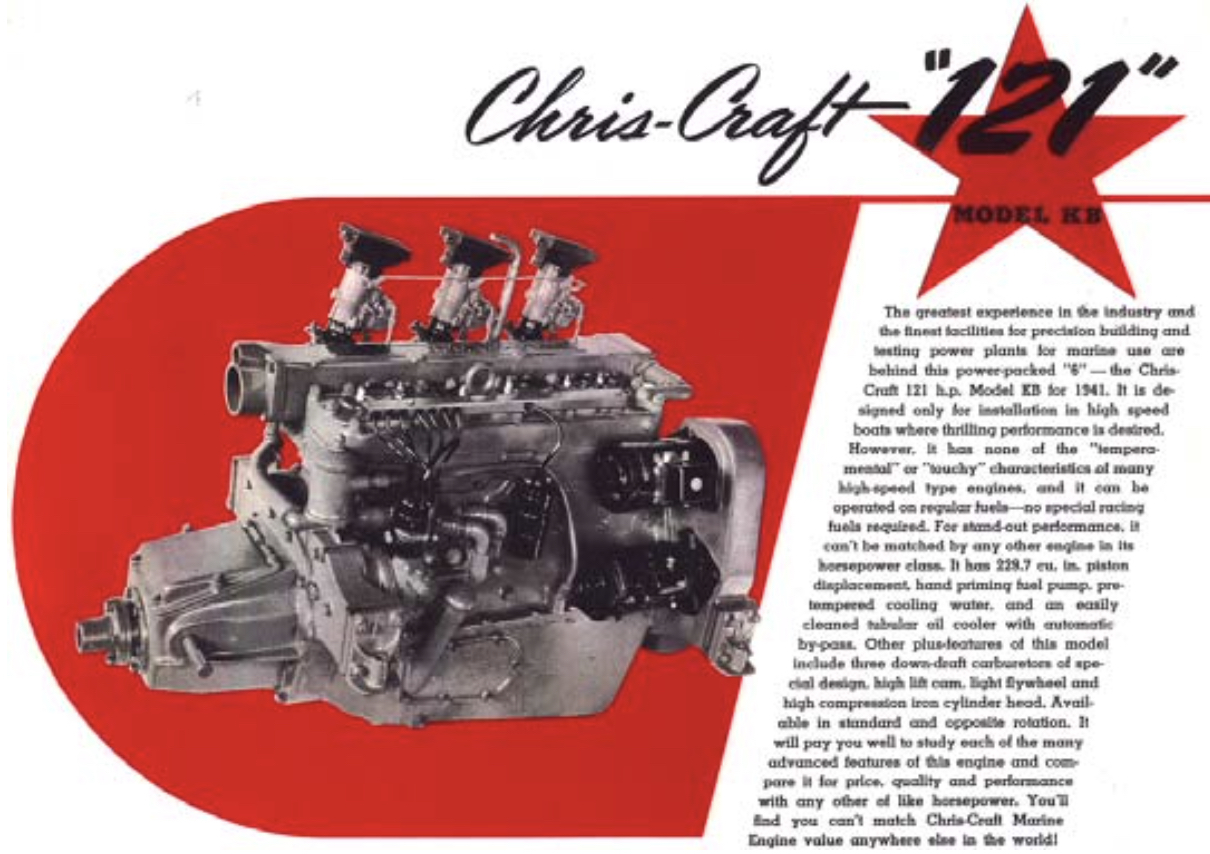
A couple of very short lived engines are the Models H and L. These engines were available in the mid to late 30s but were replaced by the new Model K family and it’s long lived performance. The six cylinder flat head Model H developed 75 H.P. at 3,400 RPM from its 3.25” bore by 4.125” stroke (205.32 CID). The Model H was available before the Model K was developed. This was a compromise then between the Model B and the new 85 H.P. Model K. But being close to the Model K in performance, it was soon discontinued. The Model L was another six cylinder rated at 110 H.P. when introduced in 1937 and raised to 115 H.P. in 1939. This Hercules engine’s displacement was 263.18 cubic inches from it 3.625” bore by 4.25” stroke. Again being close to the new Model K and variants, it was discontinued in 1939.
Originally printed in the winter 2014 edition of Western Wood, the chapter newsletter for Northern California/Lake Tahoe Chapter.
Additional credits:
- Misc. Chris Craft documents, ads & pamphlets.
- The Legend of Chris-Craft, Jeffrey L. Rodengen Ph.D., 1993.
- Chris Craft Boats, Anthony S. Mollica Jr. & Jack Savage, 2001.
- Motor Boating Magazine, Annual “Show Number” (January and February issues from 1918 to 1954) and many misc. issues.
The most comprehensive article on Chris Craft engines I have ever seen. Thank you for sharing!
Thanks for the detailed and excellent coverage of early Chris Craft engine development. It would be fantastic to see a “chapter 2” to review the many improvements to the K, M and W engines over the years.
Nice article Lew! Is there a followup with later engines?
Part 2 will be coming out in next week’s Weekly Web Watch.
I didn’t see this in 2014, but enjoyed reading it in 2026! Thanks, Lew, excellent job!
In 1938 Chris Craft offered aluminum heads on the Model B and Model K. I have a Model BA in a 1938 17′ Deluxe Runabout. The aluminum heads were not very successful and were only used in 1938.
Very well researched and written. Thank you.
Thank you Lew. Very informative!