
By Lew Dobbins, Northern California Lake Tahoe Chapter
Warning: Once again you are entering “The Gear-Head Zone”. Not recommended for the faint of heart. Clean finger nails not guaranteed!
Hot Tanking parts: A caustic hot bath that cleans and eats paint, grease sludge etc. This leaves the engine internal and external surfaces almost ready for machine work. The engine must be disassembled so each major part is cleaned. This can’t be done to any aluminum parts as the solution will eat the metal. Other cleaners are used for other materials.
Acid Dipping parts: If the castings are rusted, the acid bath removes the rust and scale to further prepare for machine work.
Steam Cleaning: The use of high pressure and high temperature steam with a detergent to remove any remaining contaminants on the engine or in the ports and galleys. This finishes removing everything from the surface and prepares for primer paint and/or engine assembly.
Magnaflux Testing: Once a block, head or crank shaft is clean, looking for cracks or flaws may need to be performed. This is crack testing of crank shafts, blocks, heads, almost any ferrous part in the engine. Fine magnetic particles suspended in a thin liquid are constantly sprayed over a part being checked for cracks or irregularities. The part is clamped into place and a magnetic field is passed through the part under test. Using a black light, the magnetic particles will find and stick to fine cracks that the naked eye can’t see. The black light will make them glow. There are similar process for testing aluminum parts that are not subject to magnetic testing.
Cylinder Sonic Testing: This is a glorified Ultra Sound. This is a device that slides down the cylinder walls and allow us to measure the cylinder wall thickness at various positions within the cylinder. Our car engines run water and antifreeze all the time. There is little wear from the inside of the block to the cylinder castings. But our boats run in water that is constantly changing depending upon where we are. A boat that runs on Lake Tahoe for its entire live is probably safe like most of our car engines. But a boat that has run in salt water or other un-pure water locations, will have faster or more wear or rotting/rusting of the water jackets, thus making the cylinder walls thinner. If they become to worn or thin, we risk a cylinder collapse when boring and making it thinner. Or it may collapse after being rebuilt and under load of speed may fail. This test tells us if the block is safe to machine and use.
Measurements: All of these parts require making measurements before and after machining. This is critical to the success of an engine restoration. There are pages of specifications for every part of the engine. Most of these measurement specs are measuring down to a thousandth of an inch, or .001 inches. In many cases down to one ten-thousandth of an inch,
or .0001 inches. To put this into relatable terms, one human hair has a thickness or diameter of approximately three-thousandths of an inch or .003”. Now that we know we have a good block, crank and heads, we can start the machining processes.
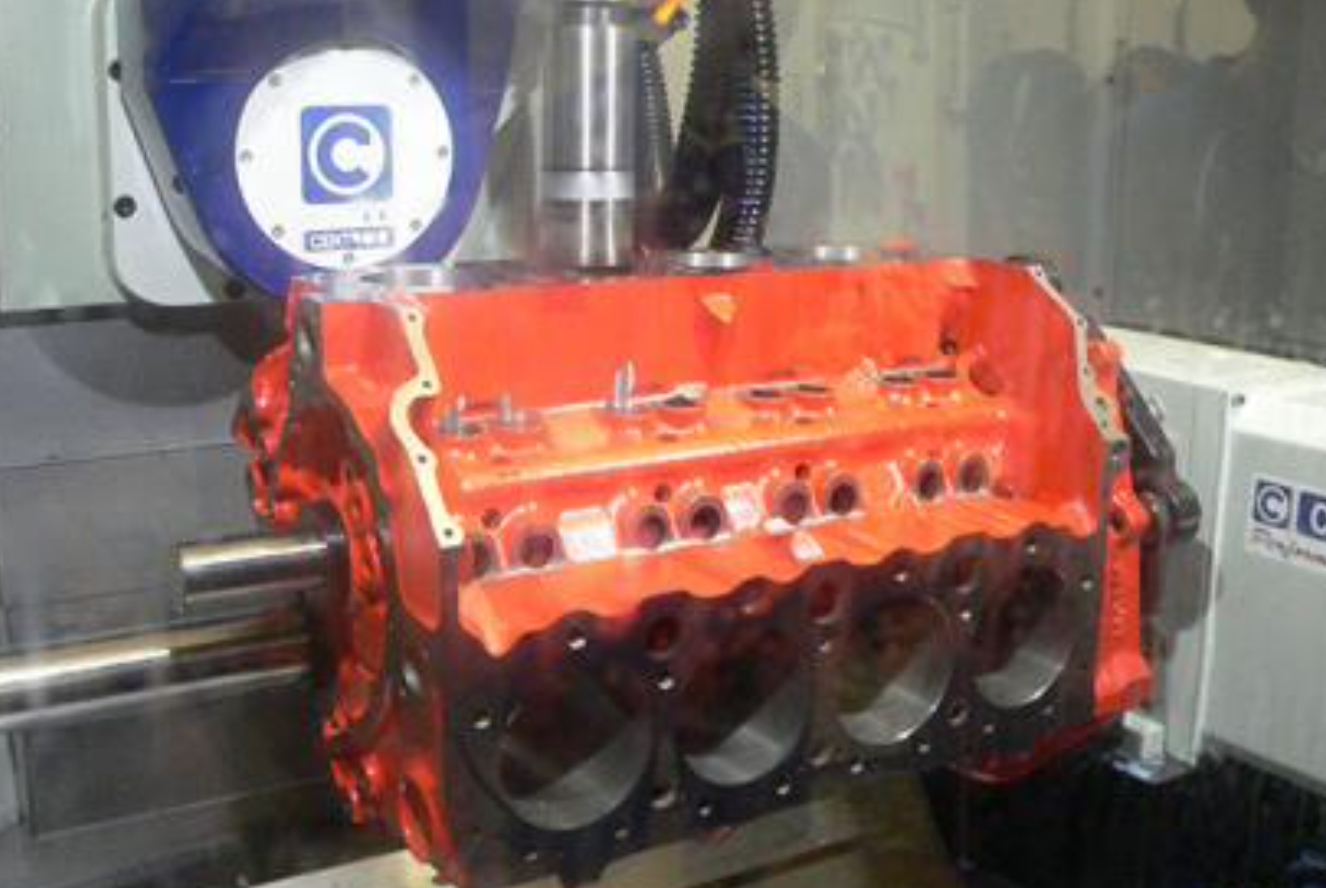
Block and Head Decking or Surfacing: When a block deck (the flat top of the cylinder block) or head flat mating surface is worn or is out of perfectly flat where the head gaskets mate them together, we need to re-surface or grind them. This makes the mating surfaces perfectly flat and ensures that the head gaskets will seal correctly.
Cylinder Boring: To CUT material out of the inside of the cylinder using a Boring Bar (machine) and cutting heads. This removes material increasing the cylinder bore (diameter). This also removes the wear from use and makes for a perfect geometric cylinder. Normal boring or “Oversize” dimensions are to increase the cylinder diameter by increments of .010” (Ten Thousandths of and inch). “Thirty over” (stock bore plus .030”) is a common size for purchasing new pistons and rings.
Back in the day (I will leave it to your imagination) it was common to take the engine apart while the block is still mounted in the car. If the cylinders were worn, not round or had too much taper, the mechanic would set a portable boring bar on the top of the block, clamp it down and center it in the bore. Then, the boring bar would increase the diameter and at the same time remove the cylinder taper caused by wear. That is mostly when cars had straight 4 and 6 cylinder engines.
With modern machine shops and for cleanliness, engine blocks are placed in a large machine, locked down and a “Head Plate” bolted to the block. This replicates what the engine head does to hold things. And keeps the actual block metal from moving or shifting even one thousandth of an inch. The cutting and then the fine honing (for finish) is done with lubricating fluid bathing the tools. These new machines are computer controlled and give amazing high precision results.
Cylinder Hone: To use a set of stones to polish and leave a specific pattern inside of an already cut (bored) straight cylinder. This is the finish after boring. The cylinder wall finish is critical for the correct seating of new piston rings and control of oil consumption.
Piston Fitting: Pistons must have a required amount of clearance to the cylinder wall. Each engine specifies how many thousandths of clearance of “Skirt” Clearance is required. This is measured during the honing process. The final cylinder hone diameter is based upon fitting or measuring this clearance.
Connecting Rod Reconditioning: To re-machine each end of the connecting rod. This may require a honing process and or pressing out and installing new bushings. The big end that is secured to the crank shaft will have the parting surfaces ground flat. This will make for an oblong or out of round surface. Then it is honed round again and brought to correct diameter to accept bearings.
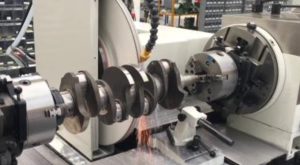
Crank Shaft Grinding: When the crank is worn more than a couple thousandths of an inch and/or has been damaged or become out of round, it needs to be reconditioned. Using a crank grinder, each of the main and rod journals are ground down or undersized to the next bearing over size.
Crank Shaft Polishing: When the Crank Shaft Journals are only worn very slightly or lightly scratched, they can be polished with a high-speed abrasive cloth belt. Thus giving an extremely smooth finish to not prematurely wear the surface of new bearings.
 Engine Block Crank Saddle Line Boring: When the main bearing saddles (where the crank shaft sits and rotates in the block) have become worn, or if there has been any block movement and the saddles are not perfectly in line, it must be corrected. The bearing cap parting surface is ground down slightly creating an oblong or out of round surface. A boring mandrel with cutting heads will be inserted through all of the journals and run back and forth cutting the correct amount of material from all of the caps and ensuring that they are in perfect alignment and that they are round and the same size.
Engine Block Crank Saddle Line Hone: If the crank saddles have been ground/bored or if the saddles are in good shape, then running a set of stones on a long mandrel through all of the saddles will just polish the already perfectly round surfaces. At this point they are ready to accept new bearings and the crank shaft should turn easily with one finger’s light pressure.
Valve Job: This is a generic term that covers many different aspects of work. Not all aspects are required every time, but may be depending on age or damage and wear.
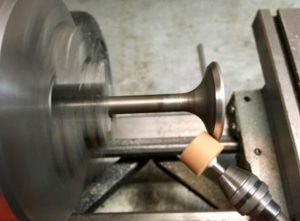
Valve Grinding: Using a rotary diamond dust stone, the mating face of the valve is re-surfaced flat to correctly mate with the valve seat.
Valve Seat Grind: This is the surface that is either part of the block (flat head engines) or head that has a contour ground and polished to correctly mate with the valve face. The valve seat that mates with the valve may be ground out of the block or head directly or a round hole cut into the head or block and have a hardened replacement valve seat pressed into the cut hole. We need these hardened valve seats for slowing down wear and better transfer of heat now that we no longer have lead in our fuel. The grind is a 3-angle contour that has one very steep angle at the bottom or throat. The middle angle that is very narrow but not a knife edge that mates with the valve face. And the top angle is very flat allowing gasses to flow easily. Rotary stones are used to cut these angles and fine stones to polish each of the 3 angles.
Valve Guide Work: The valve guide is the tube in the block or head that the valve stem slides through. Like everything else, this has a specified clearance between the stem and guide. Like everything else, wear is natural. When the clearance becomes too large or out of spec, we may need to replace the valve or the guide or both. The Valve Guides may be pressed out and new ones pressed in. Or cut out and new ones pressed in. In some cases the guide may be internally knurled to save the guide but actually decrease the internal clearance.
 Block and Head Decking or Surfacing: When a block deck or head flat surface is worn or out of perfectly flat where the head gaskets mate them together, we need to re-surface or grind them. This makes the mating surfaces perfectly flat and ensures that the head gaskets will seal correctly.
Precision Balancing: There are a lot of parts moving all around inside your engine. In a modern V-8 engine, we have 8 pistons, 24 piston rings, 8 connecting rods etc. This process is similar to balancing your tires. They look for heavy parts and add weights to make them roll smoothly. In the engine, we do a precision weight measurement of each of these parts. We find the part that is the lightest and then measure all of the other same parts and weigh them down to a gram. If some are heavier, we grind metal off of them until they all weigh exactly the same. Anything that rotates in the engine should be balanced. This helps the engine run smoother and will last longer.
There are many more things we should look at and take action on if out of manufacturer’s tolerance. The below list are subjects for a future chapter if my readers are so interested: Cam Shaft Grinding & Parkerizing; Cam Shaft Lobe Overlap; Valve Guide Measurements; Reaming or Replacing; Better Description of the 3-Angle Seat; Surface Lifters or Tappets; Hone Tappet Bores.
Here is a small list of items to be measured during engine tear down and again at the reassembly. During tear down, these measurements are the diagnostics showing us why and where the failure occurred and what needs to be done to correct this condition: Cam chain or gear slack or play; Main bearing clearance; Connecting Rod bearing clearance; Piston installation / thrust offset; Cylinder bore diameter top & bottom & ring ridge; Crank Main journal diameter; Crank rod journal diameter; Crank Shaft End Play; Valve stem diameter; Valve head margin; Valve guide ID.
This article was originally printed in the winter 2024 issue of the Northern California Lake Tahoe Chapter newsletter.
Very nice and informative writeup Lew!