
By Frank Robinson, Columbia Willamette Chapter
If you’ve seen a gleaming 1928 Dodge Watercar at the docks, it just might be a boat with a long history in Frank Robinson’s family that started when his father purchased it from his boss for twenty-five dollars in September 1937. Here’s Frank’s story…
The new watercar didn’t have a working engine when Dad bought it. My dad was a true product of the Depression era, and not having much money to spend on a hobby like boating, he went straight to a wrecking yard and bought a Pontiac straight-8 engine complete with 3-speed transmission for another twenty-five dollars. Of course not being a marinized engine, and since he was in the refrigeration business, his answer to cooling it was to make a copper coil to run water through in the oil pan, run copper tubing in several rows to jacket the exhaust manifold, and tap and inject water into the exhaust manifold at each end. Hey, it worked!
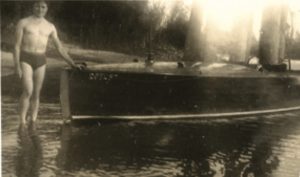
Dad and the Dodge.
When I was a kid, I thought that all boats had a clutch! Our boat sure did. Dad used third gear and reverse on the automotive transmission and the boat seemed to go just fine (better forward than reverse because of the gear reduction in reverse gearing). The boat being such an early model, it was not equipped with a tachometer, so Dad had a hand held-tachometer (which I still have in the metal container it was sold in) that he used to
figure out about how fast the engine was turning and how that sounded. Then he would run the boat by ear, listening to the pitch of the engine. He always figured he was turning about 2400 rpm when we were on plane; I thought it felt like we were really moving, even though it was probably only 25 mph.
Launching the boat was a big job. Once again, having little extra money, Dad and my uncle took the body off of my uncle’s old Hudson convertible and used the frame as the base of a trailer of sorts. The Hudson had a solid front axle so they bolted an agricultural trailer tongue to the front axle, stripped everything off of the frame, added some 4×4 lumber, and with sections of tires in strategic places had what passed for a trailer. If you have ever towed a four-wheeled contraption like this, you will appreciate that when I moved the boat from Portland, Oregon, to my home in Newberg, Oregon, in 1983 behind my Chrysler Cordoba, the top speed was about 25 mph. Any faster and it would start to wander and weave rather dramatically. The good thing was there was no tongue weight!
Our family moored the boat on the Columbia River for many years during the summer, as that was only a few miles from our home. We would run up to one of the islands for a day of picnicking and swimming, which was great fun. A few years later, as I got old enough to help out, I really came to hate that boat. Every time we used it my job was to carry the battery up and down the ramp from the car to the boat because we took the battery home after every use. I also had to pump the boat out with the manual bilge pump (a galvanized funnel/pipe affair with a broom handle and leather cup on the end to draw out the water) since there was no electric bilge pump in the boat. I thought that boating was more effort than it was worth during that period of my life.

I wanted to start preserving the boat about in the early 2000s, so the first thing I had to do was build a garage, because the single garage with a shed bumped out in back where it was stored was not adequate. That new garage cost as much as I had paid for my house. I didn’t realize when I was starting the project that, since my house is on the local historic register, I would have to build a garage that matched the house in roof line, siding, etc. What a pain in the you-know-where.
I finally got down to working on the boat. The local ACBS chapter members helped me turn the boat over during a garage tour and I started taking the bottom off. By the time I was finished, all bottom frames, knees, chines, chine caps, battens, stem, and bottom planking had been replaced. The boat was built with only engine bed logs and very light frames in the aft half, so I did modify the boat by putting full-length stringers in for added strength.
All side battens were replaced and the original side planks were refastened; butt blocks replaced and re-riveted. The batten screws for the Dodge are all done from the inside so there were plenty of screw holes in the planks that had to be filled before they could be put back on the boat.
In February of this year, the local ACBS crowd came back to turn the boat right side up (a biscuits-and-gravy breakfast was used to entice their help). I had previously been working on cutting replacement floor boards (total replacement), and reconstruction of the seats (some boards original, others had to be replaced), and polishing brass (there is no chrome on the boat). So then it became a race to see if I could get the boat finished before the Idaho events.
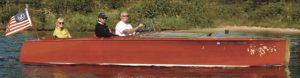
The great thing to me about the boat is that every plank above the water is the original wood. There are some spots, splits, and stains (original deck was fastened with steel screws). As far as I am concerned, however, this whole thing was about the journey to preserve my family boat, so even as it is a fairly rare boat, at this point in my life, preserved is much more satisfying that restored. My oldest son and I did all of the work on the boat, but as I was running out of time to get it done for the Idaho pre-events I hired out the varnishing of the hull.
The boat was finished on the afternoon of September 7, 2013 (we left for the Coeur d’Alene show in Idaho the next day). The evening of the 7th when I went to put together a little history to have with me at the show, I realized that my Dad’s receipt to buy the boat was dated September 7, 1939. So seventy-four years to the day after he bought the boat and fifty years since it had seen water, the Dodge was back.
I just wish my Dad was still living to enjoy it with me.
This story was originally published in the Winter 2014 issue of ACBS Rudder.
A wonderful story!
The ingenuity and creative engineering that your family put into that boat is to be congratulated. Now enjoy her. I think your dad is with you on every ride!
Frank,
Hopefully you have a better trailer, bilge pumps and leave the battery in during the season! The Dodge Wasserautos have great lines and always attract attention wherever they go. The updated the GM 350 engine and presumably non-clutch transmission likely make this a more reliable experience. I agree with Greg, your Dad’s with you on every ride! Sounds like you have a great support group there with the Willamette Chapter. Thanks for sharing the story and try to take a kid for a ride whenever possible!
A fabulous and funny story! Your dad was a true Depression Era survivor, much like my dad, who could fix anything. Enjoy your heritage, as it’s part of your family’s generation as much as your parents!!!