
Will you be attending the Chesapeake Bay Chapter’s boat shows this season? If so, you may be interested in a two-part story on the history of the John Trumpy & Sons Boat Company that for decades graced the shores of the Eastport peninsula, not far from Annapolis.
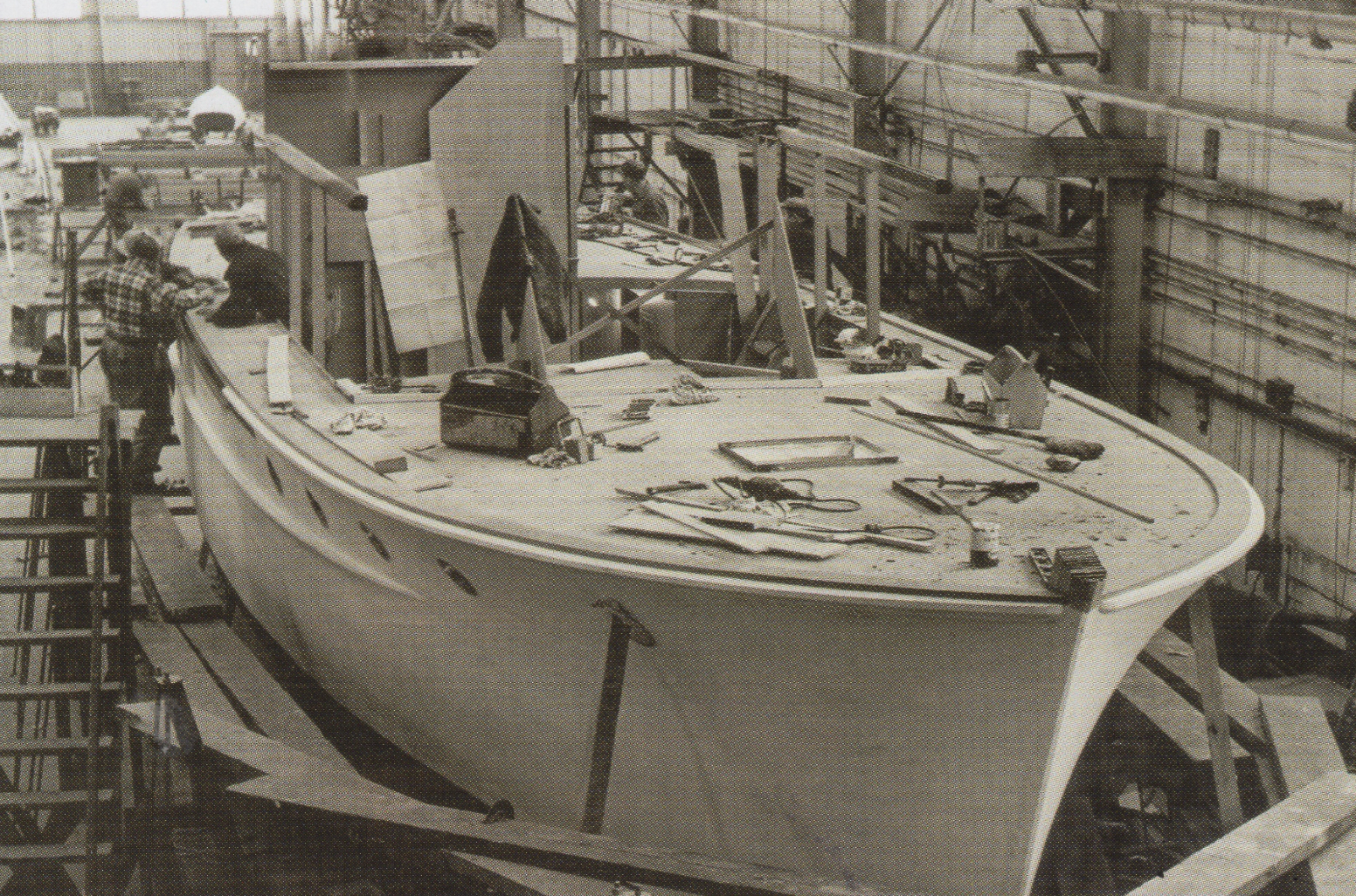
For more than a century beginning in 1868, the Eastport peninsula, across Spa Creek from Annapolis, flourished with a diversity of boatyards. Surrounded by water, this unpretentious community gave life to an industry now gone, but by no means forgotten. The men who worked there were the heart and soul of these boar yards. Through the generations of families who have lived in Eastport, many good memories keep the history alive. It continues to be part of Eastport’s maritime heritage.
Two world wars, the Korean Conflict and the Vietnam War brought the U.S. Navy contracts to some of the boatyards to design and build vessels of war. For others, the simple method of building workboats to oyster and crab in the Chesapeake Bay was a mainstay business. For still others, building, repairing and maintaining yachts for recreational use was their backbone.
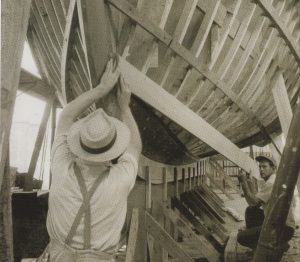 The history of this boatyard is unique. Nowhere along the waterways of the Chesapeake Bay or in any waterfront towns across America is a maritime heritage quite like Eastport’s. Within a one-mile stretch of shoreline, twelve family-owned and operated boatyards spanned a one hundred-year period. Three of the boatyards occupied the same site for more than 75 years.
“I had quite a few younger men who wanted to learn from me. I was willing to teach them.” With these words, Werner Schnoor, a man who worked as a carpenter, cabinetmaker and shipwright at the Annapolis Yacht Yard during World War II and later at John Trumpy & Sons in Eastport, echoed other voices in a lost legacy.
The boatyards along Spa Creek provided a place for men to express their passion for wooden boat building. That willingness to teach was passed along through several generations of men who worked in the boatyards in Eastport. Older men taught younger men the art, craft and skills of design and construction when it came to building wooden boats.
A charismatic leader who guided many of these men was John Trumpy Sr. He was barely 23 years old when he finished his training as a naval architect at Die Technische Hochshule in Berlin, Germany. He came to America in 1902 and worked for the New York Shipbuilding Co. in Camden, New Jersey. Six years later, the Mathis Yacht Building Co. employed Trumpy as a yacht designer. By 1917, he had designed more than 47 yachts that set an industry standard in the United States. His clients included the DuPonts, the Guggenheims and the Dodge and Chrysler families, to name a few. He designed the Sequoia in 1925, which later served eight U.S. Presidents beginning with Franklin Roosevelt.
In 1939, John Trumpy Sr. became president of Mathis Yacht Building Co. His sons Donald and John Jr. soon joined him in the business. The name was changed to Trumpy & Sons Inc. and the new family-owned company moved to Gloucester, New Jersey. More than 300 luxury yachts were designed, built and launched under the Mathis-Trumpy signature.
In 1947, the Trumpy family relocated its company to Eastport. The family bought the Annapolis Yacht Yard, a three-acre parcel of property that houses a collection of buildings. Some dated back to the turn of the century when the Chance family built them. John Trumpy Sr. also inherited an assemblage of men – talented masters of their craft – the great boat builders of Eastport.
 Many of these men learned their craft from older men who grew up in the boatyards in the area such as Chance Marine Construction Co., Owens Yacht Company and the Annapolis Yacht Yard.
Lyle Gaither became the general superintendent of the Trumpy boatyard and later, vice-president of the company.
It was at Chance Marine Construction Co. in Eastport during the 1930s where Gaither, as a 20-year old, learned wooden boat building from some of the older men who worked for Charlie Chance. Later he became a mentor to a younger man from Eastport, Charles “Frizzy” Atwell whom he had hired. Gaither and Frizzy developed a friendship that endured for more than 50 years.
Gaither, in particular, had a gift. He not only knew the skills of wooden boat building, but also learned how to manage men in the yard. His knowledge of wood and his sensitivity to others earned him the respect of all his fellow workers. He was a perfectionist in his work, which he extended to every detail of the construction plans.
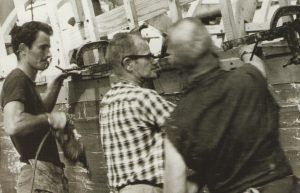 Lillian Atwell, Lyle Gaither’s daughter, remembers her father: “My dad was the type of person who no matter how hard he worked, he did not want to be praised for his work. He loved his job, and he did it. That’s what it was all about in his mind. He was a quiet man, and not one to boast about his accomplishments.”
Although only in his later 20s at the time, Frizzy Atwell learned the skills of boat building from his father, Robert, who had been a boat builder in Shady Side, Maryland. The family moved to Eastport when Atwell was only 15 months old. His father built a house on Boucher Avenue near the site of the Owen’s Yacht Company on Spa Creek. The elder Atwell worked at Chance’s Marine building subchasers for the U.S. Navy during World War I.
Robert Chance remembers his uncles, Blanchard and Charlie Chance, who started the boatyard. “It was my uncle Blanchard who taught Lyle Gaither and Frizzy Atwell everything they knew. He taught them carpentry and how to lay boats. They were good carpenters, and if you were building a yacht, you had to be a fine cabinet maker.
As Atwell was growing up, he sometimes wondered why other men called his father “Cap’n Bob”. He learned later in life it was an expression of respect only applied to older men – the mentors who worked around the water for the most of their life because of their knowledge and their ability to teach younger men the skills they learned from their fathers and grandfathers.
This story, written by Mike Miron, was originally published in the Summer 2000 issue of ACBS Rudder.
Hello: my father (S. Walter Joyce,
as assistant engineer) and my grandfather (Caleb Wood Joyce as Chief Engineer) on Remington Rand’s Trumpy yacht, Pegasus, thru the 1930’s. She was powered with a pair of Winton air started, direct reversing oil engines. Pegasus was a documented vessel that was given to the government during WW Ii, where she was assigned to coastal patrol off the US eastern seaboard. My father saw her in Marine basin NY during her fitout with deck guns. Her beautifull, book matched bright work all painted battleship Grey, it broke his heart to see her in that condition, but it was wartime. No one seemed to know what became of Pegasus after the war. Walter Joyce , ACBS member, Smith Mountain Lake chapter.