
By Mark Manes, Northern California/Lake Tahoe Chapter
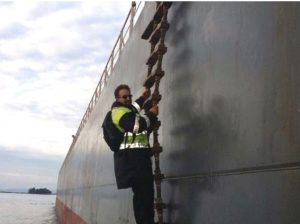
As a child, I knew that I wanted a job that I would truly enjoy, and I think I found it. Many of you may have no idea what a San Francisco Bar Pilot even is…basically we drive ships for a living! A Marine Pilot is essentially a local expert in their given region for the navigation of vessels in that port. We board the ships via a rope ladder up the side of the ship, a traditional method that has been used since pilotage began (and if you are wondering, no, we don’t harness in).
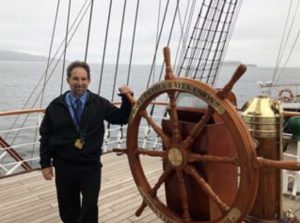 As a young child, I found a love for boats and all things that floated. I would spend hours upon hours working on old outboard engines, and docking my father’s 1979 22’ Marquis Wahoo on the Finger Lakes in Upstate New York. You would have found me rowing around in rowboats, canoes, Hobie Cats,
and Sunfish sailboats. I learned how to waterski and ended up teaching all of those skills at a summer camp for disadvantaged youth on Keuka Lake during the summers of my high school and college years.
That love of boats carried me through the California Maritime Academy in Vallejo, CA where I met my wife, Heather, and eventually received a degree in Marine Transportation and a 3rd Mates Unlimited License. I spent the next 15 years working first on dinner cruise boats, then crew boats, and finally on tugboats in the SF Bay while upgrading my license to a 1600GRT Master. I have been everywhere in the bay from Tracy (where the Delta-Mendota canal starts, next to Hammer Island) to Alviso Slough, and all water in between. I worked on almost every bridge project including the new Benicia, Carquinez, San Mateo, and Bay Bridges, and have run tugs from 500HP to 6500Hp Tractor tugs. During that time, I made many friends (some are even members here), and have had many exciting and interesting experiences. All of this experience led me to the training program at the San Francisco Bar Pilots, where I have been an active pilot since 2012.
And now for a little history lesson: In 1835, a man named Capt. William A. Richardson (Richardson Bay is named after him) piloted the British Brig “Ayacucho” to anchorage in Yerba Buena Cove by contracting with the Mexican Authorities to provide pilotage service to the waters around the
Golden Gate. Capt. Richardson started out with am 8-oared whale boat and added and trained experienced American ship masters to his company whenever they could be found. In 1848, a man named James Marshall would forever change the history of SF Bay by finding gold in Sutter’s Mill in  Coloma, CA. People came by ship in droves and there was a greater demand for pilotage service. In 1849, 10 active pilots and the first active sailing wood pilot schooner, the “Anonyma” went on station outside of the sand bar that marks the entrance to the SF Bay (hence SF Bar Pilots). By December of 1849, the newly formed California State Legislature held its first session in San Jose, and Act #3 gave official sanction to the pilotage system and brought it under CA state authority. The CA State Pilot Commission was established by Act #18 in 1850 and both are still in effect today. It is believed that the pilotage system in SF Bay is the oldest continuous service organization in California with the pilotage laws predating the judicial system. The first licensed pilots were actually licensed by the Mexican government, and the pilotage system operated under the Bear Flag Republic and US Federal Govt. before statehood in 1850.
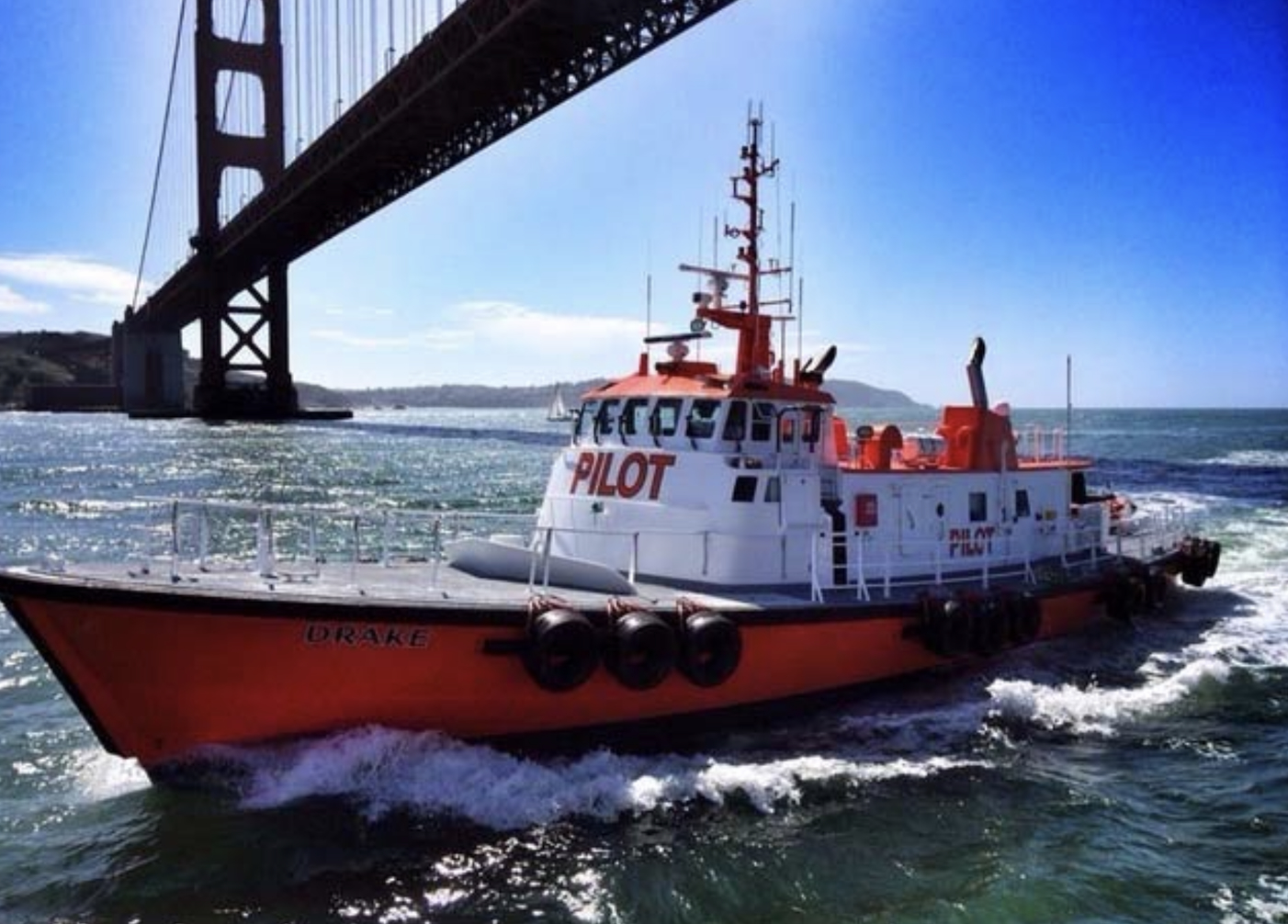
The pilotage service maintained wooden pilot schooners and motorized launches until 1973, when the schooner California was retired from 42 years of continuous service. Those were replaced by diesel powered steel boats up to 85 feet in length that maintained station 11 miles outside of the Golden Gate Bridge to board and disembark pilots from every ship that enters and exits the SF Bay.
 Today there are 60 licensed pilots in the organization, and we work on a rotating schedule with typically 7 days on and 7 days off. We have three newer 104’ Station class boats (California, San Francisco, and the Drake), one 65’ run boat (the Golden Gate), and a 40’ small run boat (Pittsburg) for our river work. The station boats have three captains and a cook that are union employees of our organization. The boats stay on station 11 miles outside the gate in all weather for 6 days at a time, and then the crews rotate in with another boat. Our pilotage grounds stretch from Monterey to every point East of the Golden Gate including the Ports of Stockton, Sacramento, and Redwood City. Last year we moved about 9,000 ships total, the largest being about 1206’ long, 158’ wide, 150,000 tons, carrying 14,000 shipping containers.
FAQ:
How long is your shift? Typically, we work 7 days on and 7 days off and usually work a maximum of 12 hours in one shift with a minimum of 12 hours between assignments.
What is the coolest thing that you have ever piloted? I have piloted many interesting things over the years, but there are a few that really stick out. During the America’s Cup in 2013 in San Francisco, I was fortunate enough to pilot several mega yachts including the $45 million dollar, 200’ yacht “M/Y
Senses” that is owned by Larry Page who founded Google. Last year, I piloted the 380’ four masted Peruvian Naval training ship “BAP Union” on its’ first trip to the United States, and also the 500’ WWII Victory Ship “S/S Red Oak Victory” with member Layne Davis and his Sea Scout troop aboard from Cal
Maritime to Richmond.
What is it like boarding the ship up a rope ladder? It can be quite challenging in rough weather. I have personally boarded ships in almost 20’ seas and 60 knots of wind. It is all about the timing of the ship’s roll and the small boat movement with the ladder. It can be really dangerous when the
weather is bad.
What is the hardest part of your job? Honestly it is small boat traffic. I can manage wind, tide, current, fog, and the handling of the ship. The one thing I cannot predict is what a mariner is going to do with their small craft, and in my experience, they never fail to do the wrong thing.
Originally printed in the winter 2020 issue of NorCal/Lake Tahoe chapter newsletter, Western Wood.
Wonderful story and a great life!
Interesting story Mark. Thanks for sharing.
Fantastic and interesting. Thanks for sharing this Mark. It was nice to learn more about you in this line of work.