
Story by Clay Thompson, Photos by Forrest Bryant, Heartland Classics Chapter
We all seem to love to document things, the highest, the cheapest, the best, the biggest, most expensive, and even who did it first! I think we all just adore the guy who thought of it first, So for today, let’s entertain ourselves with some firsts, and don’t be too surprised if you find that what you thought was the first of something, was already done before! So read along, and I know, it’s a lot of information, but it will be entertaining, I hope. To keep things 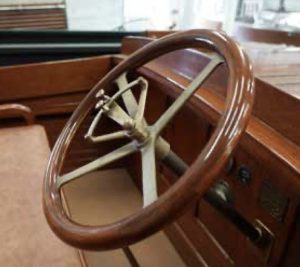 interesting, we shall have a look at mostly cars and boats. Most of the automobile information was provided by others, an older article in Hemmings Motor News, so that credit goes there.
Inventors are everywhere and, most times, it starts with a problem, and some heavy thinker solves it with a new way to do a given task. Sometimes companies have whole departments to improve products, having an edge on the competition. The great Packard automobile company gave us several firsts over the years, such as, well, the tail lamp. Packard came out with it in 1900, that was when cars didn’t even have windows, but they were also the first to give us power windows in 1940. And of all things first, the steering wheel. It was seen on a few French race cars, but Packard first used it on a passenger car. One day, out for a test drive in their horseless carriage, the Packard brothers hit a pothole and the steering TILLER swung and bashed James’s knee. They knew then that something needed to be done, and the steering wheel was the result. Amazingly, it did not meet with immediate success, but caught on nicely.
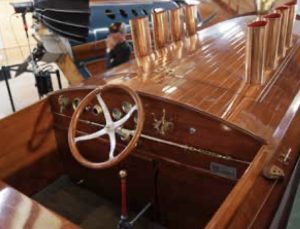
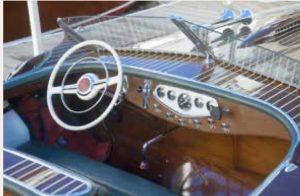
Early boats also had tillers for the rudder. The rudder offered directional control, and soon the steering wheel followed suit on boats, with most all boat builders adapting car steering wheels, columns, and gears to watercraft.
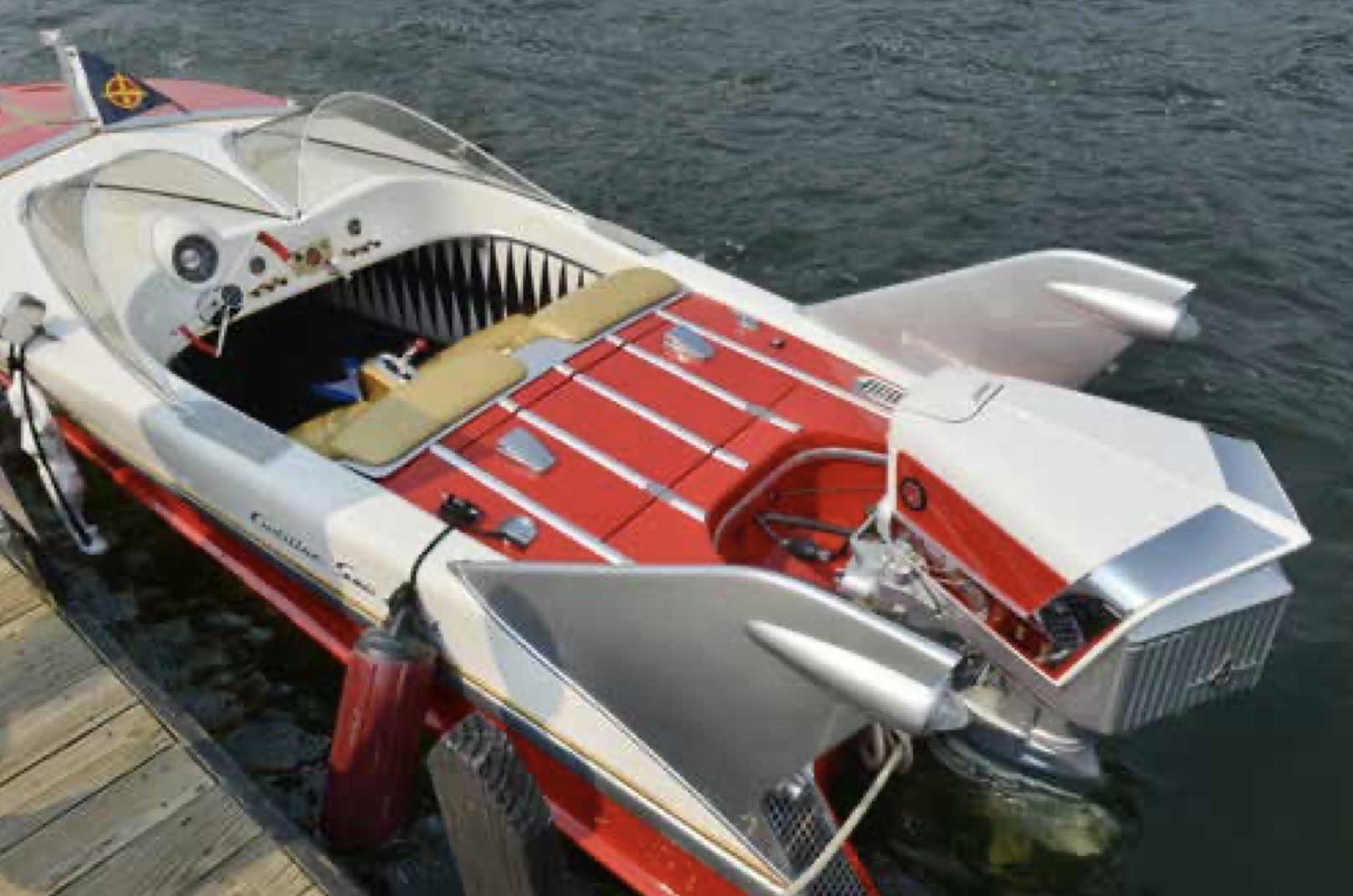
 Power steering came out on the 1951 Chrysler Imperial as a first. We all know Henry Ford was first, and invented the automobile, ahhh… NOPE. But he did invent the assembly line, NOPE again, Oldsmobile was building cars with interchangeable parts, using an assembly line in 1900. What Ford did come up with is the MOVING assembly line. He got the idea from the slaughter houses, where they had a moving line for, well, disassembly, and Henry just reversed it! Chris-Craft was great at the production of boats, using pre cut parts, but they had no real moving assembly line, just various task departments with many men. But they were good at it, building boats large and small at a record pace. They were great innovators, having tried fiberglass on the sporty cobra fin and hatches in 1955, but they decided it had no real place in boat building. Wow! Most other boat builders catered to special orders, custom building boats one at a time, large and small.
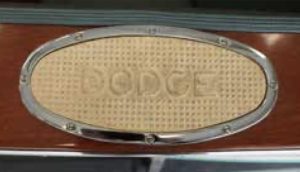
The DODGE BROTHERS created a massively successful car company, but they started by supplying components to a lot of other companies, nearly owning Ford at one point, as Henry owed them so much money. They too, had many firsts, mostly with their driveline and chassis parts and pieces, but both brothers suffered from influenza complications in 1920. John Dodge died from this illness and Horace senior was making a slow to recovery, but then passed away the end of that year. Later, Horace Dodge Jr., at his mother’s insistence, was urged to start a business. He loved boats and boat racing, so he began Dodge Boats in 1923. He had a lot of mom’s money to throw at it, and he created a boat he called the Watercar, applying the high tech assembly line to building his Watercars in a new factory. He was not very successful till around 1928, by then making his best boats, but the stock market crash in 1929 really hurt any future progress.
 Some think that Chrysler pioneered unibody construction of cars, but Lancia did it in 1922. In fact many things happened much earlier than we realize. E. L. Cord, owning Duesenburg and Auburn, built a car bearing his name. The L29 Cord, a true work of art, introduced in 1929, was the first production car to have front wheel drive, as many cars are today. The Germans used supercharging for more power on engines in WW1, now used on most race engines today, but those roots type blowers pumped fresh air in coal mines predating the automobile. Cadillac offered the self starter in 1908, and hydraulic brakes in 1912. While we are mentioning Cadillac, they gave us the first v8 in 1914, then later the v12, and even a v16 cylinder engine! All to create a powerful smooth running car. Then, A synchromesh shifting transmission in 1929, a sunroof in 1938, and auto dim headlights in 1952! They offered air conditioning in 1941, but it did not really catch on till the 50’s.
We cannot imagine a car without cool air here in the west. What a company of innovation firsts. By the late 30’s, all cars were much smoother and faster, and it follows that boats were, too. The movement of boats through the water was a big area of innovation. In the early days of boating, vessels were displacement hulls, just parting the water and waves as it moved forward. Not much speed here, and it absorbed a lot of power. Cars were getting faster, so there must be a better way for boats. We have all seen the old photographs showing signs offering very popular SPEEDBOAT RIDES in the 20s. Well, they were not speedboats as we think of them today, but there is more to the story, those boats did have some new technology, the PLANING hull, as opposed to a displacement hull.
 George Crouch and John Hacker, nautical engineers, had a lot to do with this. Riding on “TOP” of the water like a racing boat, now many boats could achieve this, and people flocked to ride in a fast, planing hull, quite a thrilling ride. These hulls still had a mostly flat aft riding surface, it worked well, and something Chris Smith insisted on, but bless his heart, he was also very incorrect. In 1953, Raymond Hunt improved all boat hulls with the change from that flat design, to deep vee hulls, adding what is called deadrise, for a softer ride, and better tracking and turning. A big first that really improved all boat handling.
Stay tuned for Part 2.
Nice article. Minor correction. The first us car air conditioning was the 1940 packard.