
By Lew Dobbins, Northern California/Lake Tahoe Chapter
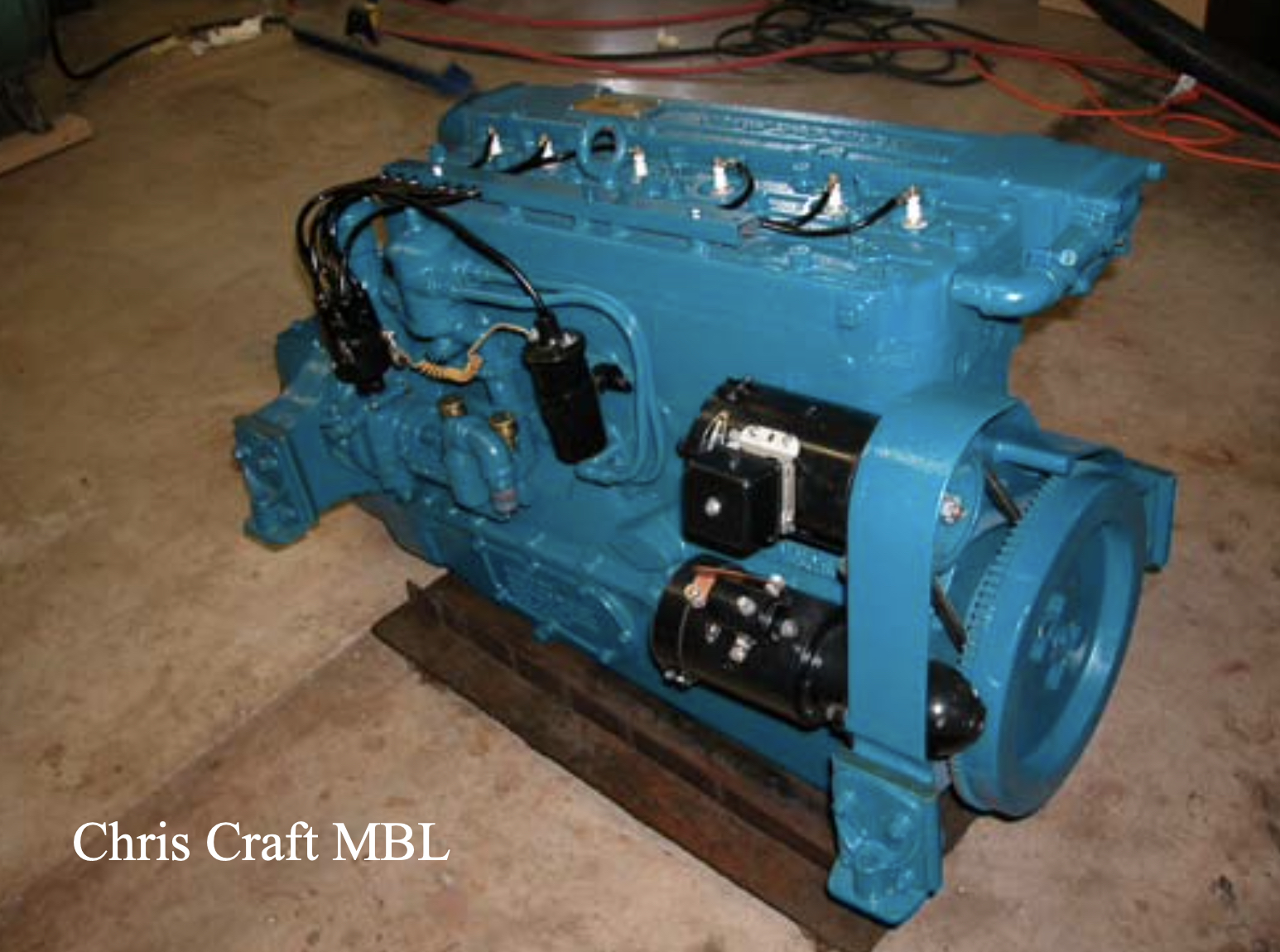
The Model K and M series are the most commonly used engines built. The number of variations are staggering. The Model K is built on the Hercules QXD and QXLD series of blocks. The Model K was introduced in 1937 as a 221.4 cubic inch six cylinder. It developed 85 H.P. at 3,200 RPM from its 3.375” bore and 4.125” stroke. In 1939, starting with Chris Craft engine serial number 204762, the bore was increased to 3.4375” growing the engine to 229.7” and raising the power to 95. Today the earlier 221 inch QXD is hard to find. Mostly you will find the QXD5M 229 inch blocks. This engine lasted until 1960 when it grew to 100 H.P. and finally dropped from the line in 1963.
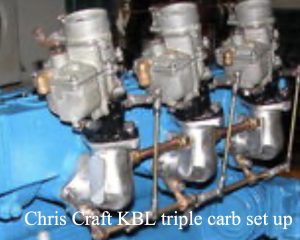
The variations of the Model K are as follows: A rare Model KA with a high compression aluminum head and larger carburetion added 10 H.P. at 3,500 RPM. People say they have seen them but your author never has had the honor. Another pre- war version was the Model KB used for racing with a different cam and lighter flywheel as the KA had. This was the same K block but instead of one Zenith 1.375” updraft carburetor, it had 3 Zenith down draft carbs to produce 121 H.P. at 3,800 RPM. This engine appears to have been dropped in late 1940. The KS & KR engines have a reduction gear added to the reverse gear. The KS uses a 1.5:1 ratio while the KR has a 2:1 ratio.
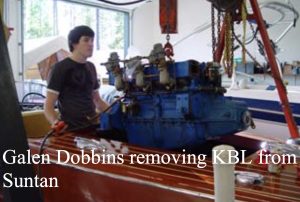
The Model KL did not come around until 1948. Its Hercules QXLDML block had an increased stroke of an eighth of an inch to 4.25” increasing the displacement to 236.6” and 105 H.P. at 3,200 RPM. The KLS and KLR models followed. Can you guess what they had? Yep, the same gear reduction transmissions as the KS and KR. The KB version resurfaced as the KBL in 1948 with the long stroke block QXLDMB and 3 carbs for 131 H.P. at 3,800 RPM. This engine screamed of power just by look- ing at it! The 3 carbs in a descending height was used in the 1955 Cobra 19’ version and the 19’ Capri. The engine was so tall that a chrome cover had to be placed over a cut out in the hatch. The KBL was replaced in 1956 by the twin updraft KFL also producing 131 H.P. but not as tall. The KLC is almost the last variant. It was a late 50s engine that had, like the KBL, hot rod parts with a higher compression. It produced 120 H.P. with a single updraft Zenith.
That’s it for the K series! Confused? You should be. But wait! There’s more! Yep, add an “O” to several of the model numbers for opposite rotation. This practice was more common for the M series as they were larger and used in cruisers where a pair were required. The Starboard engine would be standard marine or right-hand rotation and the Port side motor would be opposite rotation or left-hand or counter clockwise when viewed from behind the transom.
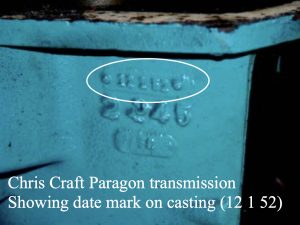
 Speaking of the M series, all of these letters are getting boring and redundant. So I will speed it up here. If you followed the logic on the K series, then the M and W series engines will be a piece of cake. The M was built on the Hercules JX block and introduced in 1937. The long stroke version built on the JXLD block (L for long) came along just after WWII. The M series has a bore of 4” and a stroke of 4.25” to produce 320.4”. The stroke was increased to 4.50”, creating 339.2 cubic inches for the ML. This also took the horse power from 130 at 3,300 RPM to 145 at 3,000 RPM for the long stroke. Although it is interesting that some advertising material in 1938 listed the M as delivering 135 H.P. The same model variations apply here for the M as did the K: ML, MS, MLS and MLR added the reduction gears to the standard Paragon reverse gear transmission. And again, add an “O” for opposite rotation as in MO, MSO, MLO, MLSO etc. The MBL had a power rating of 158 but at a higher speed (3,400 RPM) than the ML. This engine was for the sports cars, it pushed the 20’ Customs and 19’ Racing Runabouts to over 40 MPH at Tahoe elevation! And the sound…the long stroke coupled with their 3.5” copper tubing exhaust system created an unforgettable melody. The last version of the M was the 1955 MCL. This was the same as the MBL but had twin updraft Zenith carburetors to produce 175 H.P. at 3,400 RPM. The MBL was never available with a reduction gear but the MCL was available for cruiser use as the MCLS, MCLSO, MCLR and MCLRO.
 The final Chris Craft six cylinder model was little known but enjoyed a long production run. This is the Model W of 404.31 inches from a 4.25” bore and 4.75” stroke. It produced 160 H.P. at 3,000 RPM from its inception, also in 1937. This engine was available in reverse rotation and with the same reduc- tion gear variations of WO, WS, WSO, WR, WRO. The only power variant was in the mid 50s, the WB was released providing 190 H.P. and eventually 200 H.P. each at 3,200 RPM. The history of the Chris Craft flat head engine production spans 5 decades and as seen is comprised of many, many models. The Smith family business was very cost minded, thus building their own engine was the correct decision in hindsight. While they built boats with other engines, these were fewer in number. V-8 engines returned to Chris Craft boats in 1955 with the Chrysler Hemi and Cal Connell Cadillac as used in the Cobra, Continental and Capri. The Chevrolet 283 would be marinized by Chris Craft and installed in many models of boats in 1959. This engine and the other small and big block V-8s would soon become the demise of the old reliable flat head. With the success of the partnership with Hercules, the same model was setup of purchasing short blocks from Chevrolet, Mercury and Ford and then building the required manifolds and related hardware. The models and makes of V-8 engines in the “Modern Era” will be the subject of another article in the future.
Originally printed in the winter 2014 edition of Western Wood, the chapter newsletter for Northern California/Lake Tahoe Chapter.
Additional credits:
Misc. Chris Craft documents, ads & pamphlets.
The Legend of Chris-Craft, Jeffrey L. Rodengen Ph.D., 1993. Chris Craft Boats, Anthony S. Mollica Jr. & Jack Savage, 2001. Motor Boating Magazine, Annual “Show Number” (January and February issues from 1918 to 1954) and many misc. issues.