
by Jeff Waco, Rocky Mountain Classics
It seems whenever a new Bilge Pump comes out, I highlight a particular boat builder or company. For this issue I am going to highlight the Ditchburn Boats.
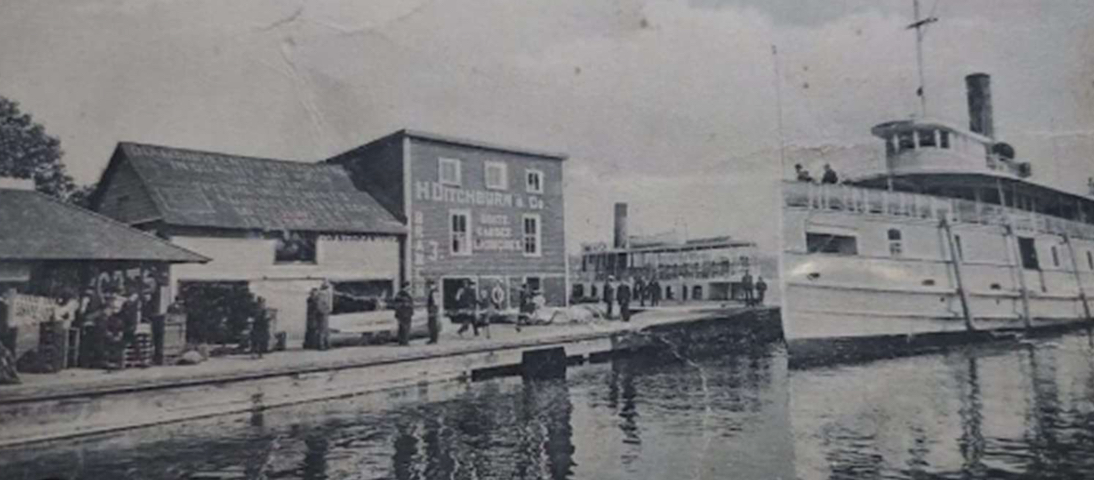
 The Ditchburn Pleasure Boats Ltd was established in 1871 on Lake Muskoka by Henry Ditchburn to build wooden pleasure boats and launches. Joined by his brothers, William, John, and Arthur, they began by building wooden rowboats in Lake Rosseau, and moved to in Gravenhurst, Ontario, in 1890. The company began building gasoline launches in 1898 along with rowboats.
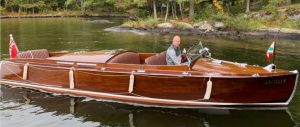
In 1904 the enterprise was run by Henry’s nephew, Herb Ditchburn, who partnered with Tom Greavette to reorganize the firm as the H. Ditchburn Boat Manufacturing Company. The firm built many custom-built gasoline launches along with some stock models, mostly consisting of rear-cockpit configuration with engine forward.
In 1910 the company’s line included 26-to-30-foot launches. In the late 1920s Ditchburn began selling forward- cockpit designs.
His was the largest operation on Lake Muskoka, employing 30 men in 1921, expanding to 60 by 1923. Sales built on the success of the company’s Rainbow racing boats. Ditchburn met the ever-increasing demand for gasoline-powered launches by opening a second plant in Orillia, Ontario, in the mid-1920s, increasing employment to 130 men.
The company was impacted by the Great Depression, experiencing its first layoff in July 1930. Slow orders were compounded by the opening of Greavette’s boats in 1931, dividing a smaller market between two competitors. The company succumbed to the Great Depression, folding in April 1932. It reorganized and reopened 9 March 1933 in a smaller plant. The company survived for a few years, but failed again in 1936, and was again reorganized. The company failed for a third and final time in 1938.
Ditchburn Racing Boats
Ditchburn was known for building a number of internationally known racing boats named Rainbow, having been commissioned by Harry Greening in 1919. Greening ran the Rainbow series in the Gold Cup races. Rainbow III, developed as Greening’s entry into the 1923 Gold Cup was a 25-foot boat powered by a Packard Six engine. While the boat failed to win the race due to a malfunctioning rudder, Greening later set a distance record with it on Lake Muskoka running 1,064 miles in 24 hours. The Rainbow VII built in 1928 was a 38-foot racer powered by two engines developing 1,200 horsepower and won the Lipton Trophy in Detroit while carrying eight people.
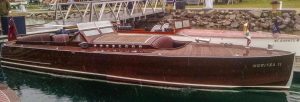
 In 1927 the company built a 28-foot racer for circus magnate John Ringling of the Ringling Bros. and Barnum & Bailey Circus fame named Silver Queen. This became the model of one of the company’s most popular line of launches, the Viking built between 1928 and 1931. At the same time the company developed a 31-foot line known as the Commodore model. Both models sported a raised deck over the engine to accommodate the larger engines then coming into use.