
By Brian Lawson, Hudson River Chapter
In 1973, fresh out of college and newly married, I went to work for Janco’s Marina just south of Plattsburgh, New York, on beautiful Lake Champlain. Although a full service marina, it catered mainly to sailors and sailboats. Janco’s was located on the New York side of the lake west of Valcour Island, made famous in the Revolutionary War when Benedict Arnold (before he became a traitor) led an action there against the British. Opposite us and to the north some were the Champlain Islands, and Vermont.
 Having grown up in the 1000 Islands where most of the boats are power boats, Lake Champlain gave me my first introduction to sailing and sailboats. While I love the sound of well-tuned outboard pairs and inboard engines, I also love the sound of nothing but wind and water and the sense you get when you truly feel a boat under you. In 1973 my wife Joan and I bought a secondhand race rigged Tanzer 16. It had a main, jib, genoa, and spinnaker and was fast as blazes with the main and spinnaker up. We kept it until 1976 when we moved to the upper Hudson River Valley, not a great place for sailboats.
I lusted after the larger Tanzer 22 and 26 that were being delivered by Janco’s, but there was no way we could afford one as we just starting out. The Tanzer 22 in particular was a great sailboat with both full and swing keel (trailerable) options. There were a mess of them at Janco’s moorage and an active weekend racing class. I looked in the ACBS Directory and found only one Tanzer sailboat listed, a 1976 Tanzer 26; home port Plattsburgh on Lake Champlain. But where are all the other Tanzer sailboats eligible for ACBS Classic status? Having lost contact with Tanzer over the years I did some research. Tanzer Industries was doing well in May 1986. It spent $400,000 for a French design (Tanzer was a French Canadian company) and tooling for new 25-foot and 29-foot models. The new boats were a success. Sales jumped and Tanzer had $3 million in orders (with deposits) waiting to be filled.
On May 15, 1986 the Royal Bank of Canada informed Tanzer it was concerned with the slump in the sailboat industry. The month before, C&C (none was listed in the ACBS Directory) had gone into receivership. C&C was also financed by the Royal Bank. The Royal Bank insisted that Tanzer hire a particular financial consulting firm to assess the company’s operations. The firm began its investigation of Tanzer on May 20 and filed its report on the 26th. The report indicated that Tanzer was a viable company and never recommended calling in the loans. The consultant also determined that by August of that year, Tanzer’s debt/ equity ratio would have improved significantly over the previous two years. The report did note that Tanzer had a cash flow problem and it recommended an injection of cash, the reduction of overhead costs, and financial restructuring after the completion of the year’s production cycle. The day after the report was submitted the Royal Bank walked into the Tanzer plant and demanded the immediate repayment of $1 million dollars plus $2,200 interest charges. Tanzer could not come up with the money on such short notice. The Royal Bank sold Tanzer’s assets to a liquidator for $793,000. In addition, Royal Bank had a guaranteed loan of $400,000. Royal Bank recouped over $1 million, but other creditors were left out in the cold. Eighty-five people lost their jobs, and Johann Tanzer lost everything. He had immigrated to Canada in 1956 with $5 in his pocket, a tool chest, and a head full of boat designs. I was sad to learn this.
 George O’Day, an Olympic and America’s Cup race winner, spent a lifetime racing, sailing, designing and building sailboats. George always focused on small, family-friendly boats. George began in the sailboat industry as George O’Day Associates selling Fairey Marine Craft, boats made by finishing out cold molded mahogany hulls he had shipped into the US from Fairey Marine in England. [Many thanks to Lee Wangstad for supplying a Fairey Marine Craft ad from his incredible archives!] One of the most enduring O’Day boats is the Day Sailer. The Day Sailer (also called the O’Day Day Sailer) is a sailboat for pleasure sailing as well as racing. It was designed in 1958 by Uffa Fox, a British designer, with input from George. O’Day envisioned a 17’ centerboarder that would have a beam of about 6 feet, flotation fore and aft, a small cuddy cabin, and an aluminum mast and boom. By 1959, the two agreed on the lines and the general layout for the boat.
In 1958 George bought Marscot Plastics from Palmer-Scott in Marblehead, Mass, an old time wooden sailboat builder who started a fiberglass line in 1948 and wanted out of the business. This gave George the production capability he needed to start producing fiberglass boats. O’Day eventually moved operations to Fall River, Mass. More than 14,000 Day Sailer boats were built. That’s more boats of this one model than all the boats listed in the ACBS directory. How many O’Day sailboats are listed in the ACBS Directory? None. In 2003 the Day Sailer was inducted into the American Sailboat Hall of Fame in Newport, Rhode Island.
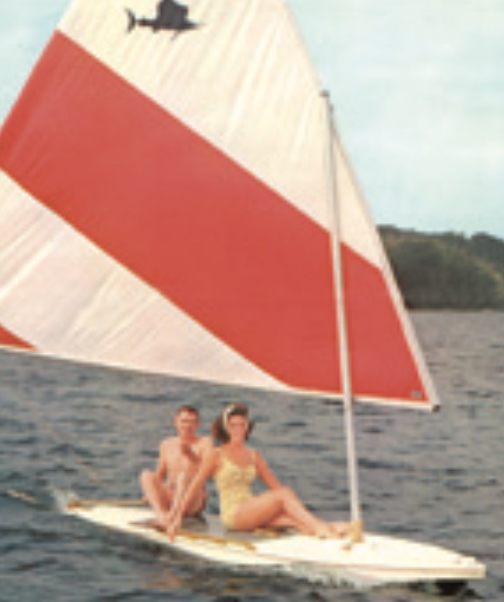
So when do you think the Sailfish first appeared on the boating scene? How about 1949! The Sailfish was designed by two ice boat builders who owned a company called Alcort, Inc. in Waterbury, Conn. There was not much profit for ice boat builders, so they used the same sail plan and designed a sailboat for when the water was soft, not hard. An August 15, 1949, article in Life Magazine indicated that 136 Sailfish had already been built. And, they were all wood.
The same Alcort, Inc. team designed the Sunfish in 1951, which immediately took front seat to the Sailfish with its little cockpit area that made sailing more comfortable. Sailfish production continued until 1962. Conversion to fiberglass production occurred in 1959 with the boats being built by Sunfish Laser, Inc. A quarter-million fiberglass Sunfish were built, making it the most popular fiberglass boat of all time. The Sunfish was inducted into the Sailboat Hall of Fame in 1995.
My nephew, Jim’s first boat was big, a 1976 Catalina 30, perfect for the waters of Long Island Sound. Along with the Sunfish and the O’Day Day Sailer, the C30 is also a Sailboat Hall of Fame inductee (2001). The C30 has been in continuous production for 35 years with more the 6,500 built. Jimmy’s 1976 boat is one of the first 350 C30 made.

Here are a few more examples of early Classic sailboats, all Sailboat Hall of Fame inductees; space does not permit more detailed examination. The Aqua Cat was introduced in 1960 by American Fiberglass Co. of Norwalk, Connecticut. The Ensign was produced from 1962 and 1983
with 1,775 hulls built. The Flying Scot was introduced in 1958 with 5,200 boats built to date.
The Pearson Triton introduced in 1959 was built until 1966 with 700 hulls made. And finally, the International Optimist Dinghy, introduced as a children’s wood boat kit, with hundreds of thousands built.
Yes there are some sailboats in the ACBS Directory, and some real beauties. But I ask myself why does it appear that the ACBS is mainly power boats. It may simply be that that is our heritage as an organization. The ACBS was founded by mainly power boat owners. There is nothing in our constitution that drives us in this direction, in fact quite the opposite.
Many historic boats are not powered, but rely on wind, paddle and oars for propulsion. So how did it happen that we as an organization have so few sailboats and sailors listed when they play such a critical link to the past? As the ACBS caught on, more power boat owners were brought into the fold than sailboat owners. Maybe it’s because that’s what the organization knew best.
It could also be that birds of a feather flock together. The boats I mentioned have class associations, some with thousands of members. The associations are devoted to racing, parts information, maintenance, and sharing information about the class. Many class associations, like the ACBS, have local chapters and most have websites. But in all the websites I visited I saw no focus on preservation, restoration, originality, or showing.
So how do we fix the absence of sailboats in our membership, and maybe grow our membership? This WILL take overt action. I think through outreach to the many classic and antique sailboat class associations some might be interested in linking up with ACBS.
One way to generate awareness in ACBS is simply to make contact and offer each other’s website links on our web pages. Alternatively, an outreach to these organizations reminding them of what ACBS is and does with invitations for Classic sailboat owners to join might work to increase the number of sailboats in the ACBS. I’m willing to work on this outreach because I believe strongly that sailboats need better representation in the ACBS.
This story was originally printed in the Spring 2010 issue of ACBS Rudder.
Thank you for this article. Having grown up on powerboats, (Dad had a 30′ SeaSkiff) I started sailing in High School because my best friend needed a crew for his Penguin. The bug hit! My wife and I, after 2 smaller boats, bought an O’Day 27 and sailed it every weekend for 15 years. Our kids grew up on that boat and the boat bug bit them. Things do change though and perhaps the level of affluence, and the cost of mooring small boats, moved people into powerboats because you can keep them at home, but nothing brings a connection to the wind and water as much as a sailboat. We live in Gainesville FL and the once mighty Hunter Marine was right up the road. They are gone. Sailboats aren’t selling. It is sad. And I think the other reason is, sailing requires skills, that powerboats don’t. ’nuff said!
From my expierence having owned both power and sail, I have a thought. From a boy, built Clark Craft kits, had canoes, Montgomery Ward Sea King, have owned a Gulfstar 45, C&C38, 51ft ketch, 60ft Nautical, designed and built a 56ft sailboat, owned power from lapstrake Grady White, to a Hatteras 60, designed and built an 82ft Motoryacht, designed, built and raced offshore powerboats, and much more. I say this only to show I have had contact with people from both sides of boating. Lived in Newport, RI and lived 37 years in the Caribbean. I have spent many hours on docks, shore side pubs to overhear endless scuttlebutt on boating, boats and sailors. My takeaway has been sailboat owners seem to have a distain for powerboats and perhaps the operators. Then again I have seen marinas have signs “no sailboats” allowed. Seems powerboat owners spend more money but then again make wakes. We all have a common love of being around and on the water and one would think that would be enough to bring both together. So ACBS might, at first glance, keep sailboat people away. I came to be aware of you last year when I bought a classic Correct Craft Barracuda. Love you articles.
What a wonderful read! As someone who lives here in the Les Cheneaux Islands of Northern Michigan, we certainly pride ourselves on our annual Hessel Antique and Wood Boat Show every August. This is one of the largest shows of its kind in the country; featuring not only wood powerboat catagories, but also sailboat and classic glass as well.
And at our Les Cheneaux Yacht Club, we take Ensign sailboating very seriously too. In fact, many of our members not only posess beautiful antique and classic wood powerboats, but you’ll find many mooring their Ensign out in front of their cottage or at the club as well. A few of our members even hold the prestigious Ensign National chamionship title. It’s ALL part of our boating heritage up here.
So combining antique / classic powerboating and sailboating isn’t just a good idea for ACBS . . . It’s makes for a great lifestyle too!
We have a 1958 sailfish purchased by my father at Abrecombie and Fitch in NYC and delivered to our cottage on Keuka Lake. It is now at our family cottage in NH.
Awesome article and excellent point!
Having spent 50+ summers in the Adirondacks sailing sunfish, M20’s, O-boats and the majestic, gaff rigged Idems, as well as racing J24’s and J29’s on Long Island Sound, I share your love of wind and water.
As for overt action, a first step would be a survey of existing membership to see how many folks also have sailboats of some sort…and then add the option to bring them to local boat shows.
Onward!
Great pull from the archives!
Very much enjoyed this article about sailboats. There is nothing like the looks and appeal of a beautiful sailboat. My first, was a new Sunfish when I got out of the Navy in 1969. That evolved into a used O’Day22 for a couple of years. Next was a new ComPac19, then finally a used Catalina25, and I enjoyed them all. Eventually, I turned to power boats. Getting onto a power boat, turning the key and starting the engine and boating away was just so much easier than all the rigmarole of sailing. Sailing was just too much work.. After many more years of power boating, due to age and health concerns, I “retired” from boating, but it will always be in my blood, and I still enjoy looking at both sail and power boats.