

Fiberglass boats, like wood boats, are judged in one of two ACBS categories: antique or classic. These two main categories are further divided into preserved and restored boats. To be considered an antique, the boat must have been built prior to 1943.
The development of glass fibers goes back several millennia; a number of civilizations are known to have made coarse versions of the material. Mass production of glass fibers began in the 1870s, and a patent for fiberglass cloth was awarded in 1880. The fiberglass cloth we know today was developed by Owens- Corning (1938 merger). In 1941, experiments with heat cleaning and treating provided a fiberglass cloth with more flexibility, a main consideration in making a plastic laminate. In 1936, Carlton Ellis of DuPont was awarded a patent for polyester resin.

During WWII, British intelligence agents stole secrets for German developed resin and turned them over to American companies. American Cyanamid produced the forerunner of today’s polyester resin in 1942. So just prior to 1943, the two base ingredients for building a fiberglass boat—fiberglass cloth and resin which, when combined, made a composite—were available.
There are references to early fiberglass sailboats being built by a Ray Greene as early as 1937 using Owens-Corning composites. I am not aware of any antique fiberglass boats in existence today, but it is possible a few still exist. How exciting if a fiberglass boat built prior to 1943 could be found!
The features of a fiberglass boat’s design must first be built into a mold against which the gelcoat is sprayed. Reinforcing layers are then added to the back side of the gelcoat, the boats outer finish. Fiberglass boats are essentially built from the outside in. Remember that in the 1950s and 1960s fiberglass mold making was done by hand, not by high powered computers that can take an engineering drawing and create a mold using computer controlled machines. Further, in these early days all fiberglass boats were laid up by hand, not using chopper guns that mix resin with chopped glass and spray it on the mold. Remember, too, that it was unlikely that any manufacturer in these early days was thinking 50 to 60 years ahead about how easy or hard it would be for some damn fool to try to restore one.
By the mid-1950s, manufacturers had sprung up in numerous locations. Designs for boats tended to follow what was hot in the automotive industry. As a result, many fiberglass boats of the 1950s and early 1960s had elaborately molded dash boards, tail fins, built in head and tail lights, sliding hardtops as well as some features I could only wish that manufacturers thought of today. The features molded into these early fiberglass boats are more complex and rich in design than anything currently available on the market.
Some of these manufacturers were in business only a short time, but all left enduring legacies. Here’s a trip down memory lane with some Classic Fiberglass boats, each a part of the ACBS membership:
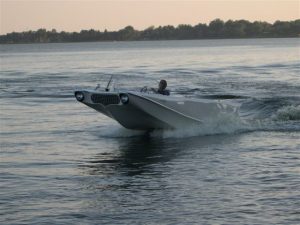
CAR Aqua VIP
Sunnyland Chapter’s Tommy Sciortino owns this remarkable boat, the only car Aqua VIP known to exist, and only two were ever made. That one of the two survived is in itself remarkable. The car Aqua VIP is one of the most eye-catching early fiberglass boats ever built. It has it all: inboard, huge fins, headlights, front grill. The restoration of this boat is top notch. The Crosley engine setup is unusual, an inboard engine with a through-the-hull outboard style lower unit that rotates for steerage.
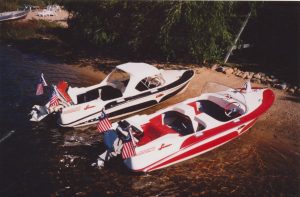 1957 LARSON THUNDERHAWK – Bob Speltz Land-O-Lakes Chapber member, Lee Wangstad, purchased a 1957 Larson in 1984 and restored it in 1991 to original factory specifications including new gelcoat. Re-gelcoating a fiberglass boat is a huge job, and Lee did all the work on the boat himself. The workmanship is stunning. A 1957 Evinrude, also restored by Lee, powers the boat. Larson continued operations until just a few years ago. It remains one of only a handful of fiberglass boat companies with a 50-year history.
1979 CROSBY HYDRODYNE – The Crosby name is synonymous with early fiberglass boats. Ab Crosby’s design wizardry spanned more than two decades, from the early 50’s to the mid-1970’s, and included the Crosby and Hydrodyne companies.
SANGER – The Davidson family started building Sanger boats in 1954 and they are still in business today as a second-generation, family-owned company. Not many fiberglass boat companies from the 1950’s can make that claim. The main reason they are still in business is that Sanger managed the conversion from wood to glass, a change that killed many a company.
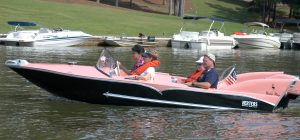
1957 HERTER’s DUOFOIL FLYING FISH
Named Mindy’s Mingo, owner Corinne T. Hurst says – What a fun boat! People just smile when they see it. Mindy’s Mingo was restored by Bryan Fenwick and named after his girlfriend Mindy. It has a 60 HP Scott motor and a bright yellow Tee Nee trailer. Corrine bought the boat over 20 years ago and has enjoyed taking it to boat shows that benefit children with needs. The kids always enjoy riding in it and she always leaves them with some type of pink flamingo toy item.
Adapted from an article written by Brian Lawson, originally published in the Fall 2008 issue of ACBS Rudder.
Great article! More articles on 1950s glass and plywood boats, please!
Nice to see the Larson Thunderhawk included here! We also have a 1957 Larson Thunderhawk Jr. that was restored sometime in the 90s and is still enjoyed regularly. Brought it to Woods & Water II last year and it received more attention that we would have thought! Old fiberglass fits our needs – and we are on the lookout for another interesting example that we can bring to Florida…