
by Kathryn Klos, Michigan Chapter
The Island Calls.
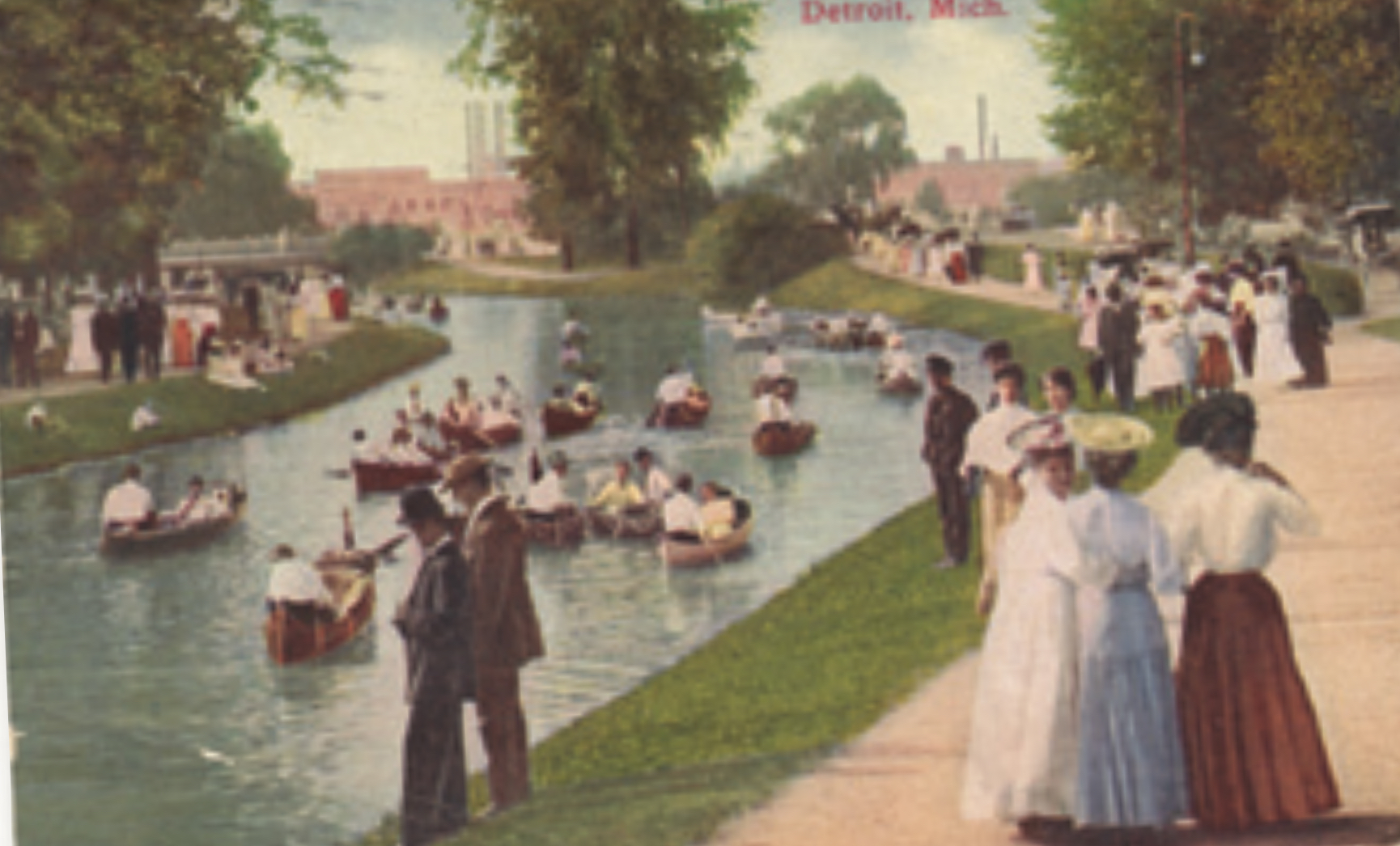
Hog Island it was once called; a place where pigs ran freely and fattened without falling prey to anyone or anything. Today, Belle Isle as it is now known, sits in the middle of the Detroit River with the city of Detroit on one side and Windsor, Ontario, on the other. Transforming it into a show place may have seemed a bold move in 1883 when Detroit’s citizens voted for improvements that would offer families the quiet of the countryside within the expanding city. As a result of the vote, the city engaged landscape architect Frederick Law Olmstead, designer of New York City’s Central Park, to work on the Belle Isle project.
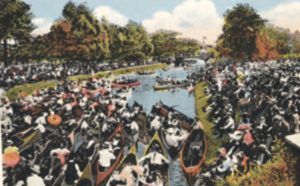
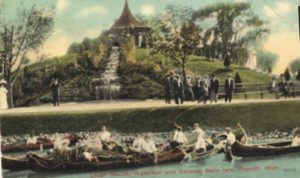
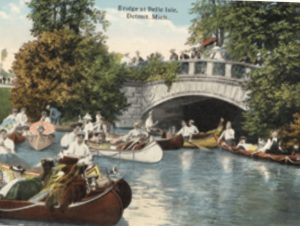
Islands hold a romantic lure, and Belle Isle was designed to be especially alluring. Swampy areas were filled and replaced with a system of tree-lined canals bisected by ornate arched bridges. Rolling green expanses of grass were planted, making sites for games and picnicking. It was a landscape dotted with fountains, pavilions, and covered bandstands, connected by walkways rimmed with flowerbeds. In 1889, a bridge was built which connected Belle Isle to the Detroit mainland. As public interest in Belle Isle rose, the city added a casino, arboretum, aquarium, a zoo, then dredged out two more lakes and extended the canals, which were choked with canoes on warm summer weekends.
The first canoes to ply the waters of Belle Isle were probably all- wood, lapstreak vessels of simple grace and beauty. These canoes were far different from the ones an enterprising Charles Molitor began selling from a corner of his father’s Detroit grocery in 1906. As a canoe dealer, Charles was, no doubt, aware of a growing public interest in the canoe as a recreational vessel, sold for the purpose of simply paddling around, rather than the traditional uses of fishing and hunting. By 1910, the canals of Belle Isle were filled with canoes and Molitor, then age 26, had been a dealer in B.N. Morris canoes for four years. Pictures of Belle Isle from this era show canoes that appear to be those of B.N. Morris, and C.J. Molitor was the sole agent for Morris in Detroit.
Opening in May of 1906, Electric Park hugged the shoreline on the Detroit side of the river opposite Belle Isle. Detroit’s first large-scale amusement park, with its entrance near the Belle Isle Bridge, it was purported to be one of the largest in the world. Three streetcar lines terminated at the bridge, which served as a grand entrance to Belle Isle. The previous year, the Detroit Department of Parks and Boulevards began bus service to the island. The Belle Isle Bridge was one of Detroit’s busiest intersections where, especially on summer weekends in 1910, it may have seemed like the entire city was taking advantage of the amusements that Electric Park and Belle Isle had to offer.
In 1910, Charles Molitor entered the Joy Amusement Company, a penny arcade east of the bridge connecting Detroit proper to Belle Isle. It stretched from a walkway just inside the amusement park to the water. Penny arcades of the day were filled with the whirl and ding of multiple Mutoscopes and machines designed to test physical strength, forecast the future, and provide winnings. Perhaps Charles Molitor considered the building’s proximity to the bridge, or the ferry that was available for those wanting to begin a canoeing experience with a trip on a different sort of vessel. Whatever the reasons, he established Molitor’s Canoe House at the rear of the building, where windows held views of the river and the island beyond.
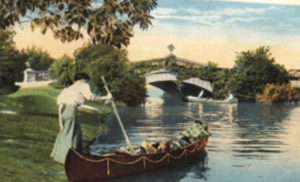 Charles Molitor’s Morris canoes were perfect for recreational use. Unlike the canoe typically used by a hunting and fishing guide, the Morris had beautifully upswept ends, gracefully curved stems, and trim of fine mahogany. Buyers could replace the typical small heart-shaped deck found on most canoes with long decks of gleaming mahogany, and seat frames, thwarts, and gunwales to match.
On Belle Isle, boys in crisp white shirts assisted renters into fully outfitted and beautifully trimmed canoes. As a Morris agent, Charles Molitor would have known that Bert Morris could build the sort of canoe that would turn heads, enticing many a young man desiring to woo his lady to choose a canoe from C.J. Molitor’s Belle Isle Livery.
The MorrIs Canoes of VeazIe In the early-twentieth century, formal courtship rituals of the Victorian Age were still in practice. The use of the canoe in courtship had begun in the late 1800s on the Charles River in Massachusetts, a river of easy paddling and quiet beauty—the perfect romantic backdrop for showing off canoes that, by 1910, were works of art. The canoe Morris built for C.J. Molitor’s livery had it all: long decks sporting flagstaff sockets, mahogany rub rails extending the length of the boat on either side, heavy D-shaped mahogany outwales, outside stems, and sturdy mahogany thwarts in addition to caned seats. This canoe was nearly as fashionable as any on Boston’s Charles River.
Initially built for hunting and fishing, the Morris canoe had easily been adapted to the social and recreational purposes that drove the evolution of the canoe from sporting tool to courting tool.
Although Morris wasn’t the first to market wood and canvas canoes, he was one of the first to spread his wares through a system of dealerships. Bert and Charles, the youngest sons of a Veazie, Maine, carpenter, were building canoes commercially in the 1890s. The early canoes appear much the same as their later models.
By the mid-1890s, individuals from throughout the United States approaching Bert Morris, offering to sell the canoes he and his older brother Charles were building. The Morris factory grew to become the biggest business in the little town of Veazie, and by 1906, B.N. Morris agents were selling canoes throughout the United States and Canada, France, and Germany. One of these agents was Charles Molitor of Detroit, Michigan.
As with other canoe businesses, the Morris Company initially offered its canoes in two grades: a “first grade” mahogany-trimmed model, and a “second grade” trimmed with less expensive hardwoods. Early in the twentieth century, however, Bert Morris began promoting his canoe as a single, high-grade vessel available in four models that differed little from each other beyond width, depth, and amount of tumblehome. In approximately 1905, Morris created the Veazie Canoe Company, through which he offered a second-grade canoe as a factory-direct option. The canoe was not simply a craft to be used by sportsmen, but was also a pleasure craft useful for many purposes and in many locations.
With his factory-direct company, Morris was able to compete with the majority of canoe companies, whose canoes were less expensive, without a middleman’s markup. More importantly, Bert Morris was able to say unequivocally that all canoes with the B.N. Morris name were of the highest quality. The one-grade-of-canoe claim was not simply an advertising scheme; Bert Morris apparently believed this first-grade canoe was the only canoe that deserved to be known as “a Morris.”
The canoes of B.N. Morris differ from other canoes in the construction of the gunwales, a process, which, while more difficult to accomplish, may be stronger than other closed-gunwale canoes.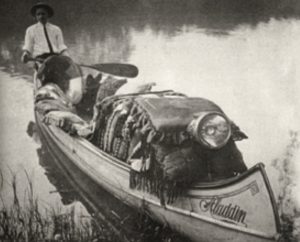 Traditionally, canoes with closed gunwales required that rib tops be thinned to fit the closed rail system, thus weakening the ends of the ribs. In building his canoe, Morris recognized the importance of maintaining rib-strength, and constructed canoes without removing wood from the rib tips. The ribs of a Morris canoe settle neatly into little pockets in the inwale, in a manner similar to the joinery of fine furniture. This technique provided a closed gunwale canoe that did not compromise strength and might not be as susceptible to rot as those that were thinned to fit the closed rail system. This problem was solved in approximately 1905, with the development of the open gunwale. With an open gunwale, the rib extends all the way through the rail and is sandwiched between the inwale and outwale. This leaves an opening between the ribs, permitting any water that collects inside the boat to be easily dumped out. A closed gunwale can trap water against the rails, and thinly shaved rib-tops could be compromised.
Open gunwales are easier to build than closed, especially the pocketed-rib system of the Morris; however, Bert Morris did not adopt the open gunwale as standard on his canoes. Perhaps he was proud of the Morris contribution to canoe construction and believed his closed gunwales were as strong as open gunwales. He may have preferred the look of a closed gunwale canoe: the straight, unbroken line of the gunwale having more eye-appeal than the staccato interruptions of an open wale canoe.
Because the open gunwale required thicker wood and thus added to the expense of building a canoe, it was initially offered as an option for which the customer paid an additional charge. As the public grew to understand the advantage of open gunwales, they became standard with most manufacturers. However, throughout the life of his company, Bert Morris continued to offer open gunwales only as an option.
The boats in Charles Molitor’s livery—eighteen feet long, with three-foot bow decks and two-foot stern decks— may very well have set the standard for the liveries on Belle Isle, rivaling those of the Charles River with their colorful exteriors and gleaming mahogany.. The fore and aft decks displayed pennants on foot-long poles. For wooing a lady on a moonless night, there were carbide spotlights, like those used on Ford’s Model T, attached to the bow decks of some of the canoes. Paddlers could rent a Victrola, complete with morning glory horn, and rugs for the floor, backrests that propped against the thwarts, and a supply of pillows—some emblazoned with the Belle Isle name. Tasseled roping, draped from bow to stern along the outside of the gunwales, not only added to the canoe’s decoration but deflected the bumps of other canoes in the canals of Belle Isle, which became crowded as the second decade of the century progressed.
Foces for Change
 Belle Isle continued to draw people through the second decade of the twentieth century. In 1914, city officials decided to turn all of the city’s riverfront into parkland, with picnic areas and bandstands along the Detroit River. This plan had barely gotten off the ground with the construction of a streetcar station at the entrance of the Belle Isle Bridge as the only completed step, when a new “craze” caught people’s attention. Perhaps the impact of the automobile should have been more obvious to people living in Motor City than those anywhere else. The city was moving outward and cars were taking people even farther, to natural rivers and quiet places not found in the crowded inner city. And canoes had an advantage; they could be strapped onto an automobile to make that journey.
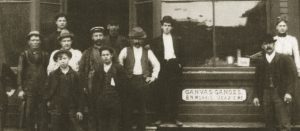
In addition to renting out canoes, Charles Molitor, as “The Canoe Man,” continued to sell B.N. Morris canoes from his shop at the rear of the penny arcade. He also bought and sold used canoes and rented storage space to those wanting to keep their own canoes on the island. Canoeing is a summertime affair, however, and Detroit is in Michigan with several months of cold weather. Raised at his father’s side in the family grocery, Charles Molitor was above all else a businessman, and in 1916 he opened the Molitor Screen and Storm Sash, a company engaged in the manufacture of windows. While this new business venture lacked the glamour of canoes and the excitement of amusement parks, it did meet a human need in a growing city.
A man with a keen business eye takes stock of changes that might impact business. The amusement park’s atmosphere was changing and aging. Its ill-maintained rides, which charged the blood of the young and appeared to offer thrills for reasons other than fun, may have begun to annoy the senses of Charles Molitor. And, while the situation on the island with the canoe livery remained as before, the changes began to add up. In 1911, Palace Gardens, a dance hall near the penny arcade building, burned to the ground. In 1915, the Belle Isle Bridge itself caught fire. The steel and wooden bridge built in 1889 was a total loss. C.J. Molitor’s Canoe House, just beyond the bridge, was untouched.
But, the fire with the greatest impact on Charles Molitor’s business was the result of a suspected arson that destroyed eight of the nine buildings comprising the B.N. Morris factory on December 15, 1919. In a special town meeting, the people of Veazie voted to exempt Bert Morris from taxes for six years if his factory was rebuilt as before. He’d been approached to rebuild elsewhere, but Veazie wanted the factory. It had employed seventy-five men, and was described in The Bangor Daily Commercial as “…one of the busiest and most active industries in this section of the state.”
Despite the townspeople’s offer and the fact that his factory was adequately insured, Bert Morris chose not to rebuild, explaining that at age 53, he was too old to begin again. Other, more subtle, factors may have played a part in this decision. The financial upheavals at the end of the First World War caused fluctuations in canoe prices and increasing competition with other boat builders. Like many who had started boat businesses building canoes, Morris had begun offering a simple powerboat in 1910. While other major manufacturers expanded their lines of boats, this level of competition may have been something he did not want to pursue. Additionally, the open gunwale was fast-becoming the standard way canoes were built, and Bert Morris may have been reluctant to give up his preferred method of constructing a canoe.
While the “Roaring Twenties” saw the end of Bert Morris’ factory, the canoes of Belle Isle continued to be a popular summer Detroit pastime. In 1920, material was added to the west end of the island, increasing its size to nearly 985 acres. In 1921, Charles Molitor became a dealer for Old Town Canoe of Old Town, Maine, and ordered thirty-one new livery canoes, which were shipped from the factory on June 1. Appearing much the same as those that had come from the Morris factory, the canoes Old Town built for Charles Molitor were eighteen feet long, with three-foot bow decks and two-foot stern decks, outside stems, rub rails, gleaming mahogany, and closed gunwales with pocketed ribs. These canoes— referred to as the Molitor model on the Old Town build records—were the last canoes to be ordered for the livery of Charles Molitor. Although Old Town could accomplish fancy designs on its canoes, these final boats ordered for the livery were simply dark green, blue, orange, black, brown and red, without further embellishment.
That February, another fire at Electric Park destroyed its largest concession, the Coliseum and Pier. In 1922, Charles Molitor left the canoe dealership and livery behind to focus full-time on the Molitor Screen and Storm Sash Company. He was a businessman and factory owner, and this product carried his own name.
The Legacy
 After the Second World War, canoes may have seemed to old- timers like Charles Molitor to be caricatures of the canoes that had won their youthful attention, but Molitor might have understood the business decisions behind these craft made of aluminum and fiberglass, which fit a modern image of the canoe and needs of the people. Charles Molitor had had his day, at a time when a person could run a hand the length of a three-foot deck of bookmatched mahogany and know the boat was among the best on the island. Although Old Town continued to build the Molitor model for several years in the 1920s, it was never a catalog offering, but was available to anyone who wanted a fancy courting-type canoe. Throughout most of the 1920s, Molitor models, built under the Carleton name as well as Old Town, were shipped all over the country, but by 1922, they were constructed with open gunwales.
The “modern” Old Town Molitor, a catalog offering from 1965 to present, more closely resembles a Charles River courting canoe than it does the tricked-out Morrises of Belle Isle. It has been speculated that Old Town may have received into its restoration shop a canoe that had torpedo stems and mahogany trim. When persons at the factory gathered to examine the unusual old boat, someone possibly explained that it was similar to a model made back in the 1920s, known as the Molitor. Whether or not a connection exists, in 1965 Old Town began offering a high-end courting-type canoe, and called it “The Molitor.”
If, in the fifteen years before his death in 1980, C.J. Molitor came across an Old Town catalog that was flipped to a page featuring the model bearing the name “Molitor,” it’s doubtful the man would have made any connection to it. Instead of long mahogany decks, the modern Molitor canoe has two, twenty-inch, sculpted decks. Where the canoes of C.J. Molitor’s livery had three thwarts, with the middle one removable via wing nuts, the modern Old Town Molitor has no thwarts at all. Unlike the canoes in Charles Molitor’s livery, the modern Molitor is seventeen feet long. It remains Old Town’s most expensive canoe.
Charles Molitor’s legacy may appear to be only that of the name Old Town attached to a canoe that was a spin-off of the canoes built by Bert and Charles Morris. But, it’s a larger story, one of two men who took the pulse of a nation and filled a moment in history with a joyous option. It was a time when many of the people of this world had moved beyond personal survival and were privileged to follow their ambitions, and in the fulfillment of dreams may lay the defining portion of a human life.
Postscript
Charles Morris died in 1928, at the age of 68. Bert Morris died in his sleep in 1940, at the age of 74. When J. H. Rushton began making canvas-covered canoes, he adopted Bert Morris’s pocketed-rib method of constructing closed gunwales on his top-grade canoes. Rushton is possibly the only builder other than Morris to have produced canoes with pocketed ribs. Charles Molitor was thirty-eight in 1922 when he gave up Molitor’s Canoe House, devoting his energies for the next forty-six years to the screen and storm window business. When he died in 1980 at the age of 96, the Detroit paper referred to him as “The Canoe Man of Belle Isle.” It seems the years at Belle Isle defined his life.
Many of the canoes of Belle Isle have survived to be restored to original condition—or better. Some day, Belle Isle may see a reunion of the Morris, Old Town, and other canoes that once graced the waters of the canoe canals. If you are an old canoe, not only can you go home again, you can do so in style.
This article originally appeared in an unedited form in the December ’09 issue of Wooden Canoe, the journal of the Wooden Canoe Heritage Association. Our thanks to editor, Patty Macleish. It was republished in the spring 2010 issue of ACBS Rudder. Read back issues of ACBS Rudder by logging into the member-only MyACBS.org portal.