

By Lee Chase, Northern California/Lake Tahoe Chapter
Over the years, I have heard old boat and car enthusiasts lament the banning of lead compounds in automotive fuel. The lead compounds increased the fuel octane rating and was credited with lubricating properties which helped to preserve valves. While automobile fuel is lead free, aviation fuel (avgas) is
not. Aircraft require high octane fuel to run the high performance high compression engines. Avgas contains a compound known as Tetra Ethyl Lead (TEL) which acts as an octane booster for the fuel. This begs the question of whether it would be a good idea to run Avgas in an old boat or car engine, if you could afford it.
 The mechanic that worked on the Campbell boat I purchased some years back proudly proclaimed that he filled both tanks (about 70 gallons) with Avgas and that would clean out all the deposits. The engine was then taken apart to get new valves. Another ACBS member had to redo the valves on a Hispano-Suiza that had been completely rebuilt earlier. The customer had run only Avgas in it, after all it was an aviation engine before it was put in a boat. So, what gives?
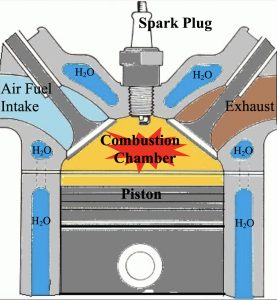
Avgas has octane rating of well over 100 which is far higher than the comparable 85 – 92 octane of road fuels. To achieve this, a lot of TEL is used – around 5 times the quantity that was used in the old Leaded automotive fuels. The problem with using Leaded fuel is that it will always burn with more deposits than unleaded fuels. The Tetra Ethyl Lead used for octane boost in the fuel naturally degrades to form Lead Oxide when it is burned. It is this transformation which gives the octane boost. Lead Oxide is a solid up to about 900 deg C which is higher than the wall temperatures inside a piston engine and can end up as a deposit on the cylinder walls.
To prevent these deposits from forming, a Lead scavenging compound is added to Avgas, Ethylene Dibromide. This scavenger is designed to react with the Lead oxide to form Lead Bromide which is more volatile, becoming a gas at around 200 – 250 deg C. This is a low enough temperature to enable the Lead to be removed from the engine as a gas. But for this reaction between the Lead Oxide and the scavenger to work, there needs to be a relatively high combustion temperature.
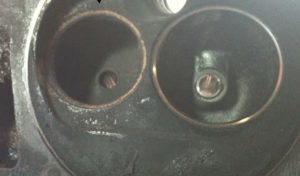
In the combustion chamber, Lead Bromide remains when combustion temperatures are low, which fouls valves and spark plugs. The temperature for Lead Bromide deposits to remain is most favorable on the isolated spark plug tips because the whole mixture cools them before the flame starts to propagate, and on the exhaust valves because the mixture cools after combustion and is pushed past the valves. The pale brown ash staining, that is
often seen on the plugs and exhausts valves of engines running Avgas, is in fact Lead Bromide. The fouled valves do not seal properly and compression is lost.
 So, what about boats?
Air cooled aircraft engines barely get hot enough to run Avgas, so how can a boat engine that uses ice water to cool it get hot enough? Both my engine and the Hispano-Suiza had the telltale brown stains on the exhaust valve seats. Many old boat engines run cold since lake water is pumped directly into the engine water jacket, usually without any thermostat or recirculation of water in the engine as is normally done in automobile engines. The colder operating temperature makes it unwise to use any leaded fuel in boats.
So here are the recommendations:
1. Stop complaining about unleaded gas.
2. Don’t run expensive Avgas in your boat
3. Use the money you save to have your engine fitted with hardened valve seats.
4. Run unleaded automotive gas
5. Bring your boat to all ACBS boating events
Originally printed in the Spring 2017 issue of Western Wood, the Northern California / Lake Tahoe ACBS Chapter newsletter.
Good article. Please continue a second chapter for the many member that run outboards.
Very good synopsis of why to simply use regular pump as in our marine engines! Thank you!
What about REC gas. It has NO ethanol and I heard many old timers recommend it for old boat motors as well as lawn equipment.
All that you say about Avgas is true . I have about 30 pre war motorcycles and several Model Ts .My Hydroplane has a 1936 Ford V 8 60 Flathead . My big gripe with Unleaded is that if left for long periods of time , the vapors from the ethanol will eat any pot metal pieces , carbs and gas caps and destroy any rubber hoses or diaphragms . You must keep your tanks full or drain for prolonged storage . Stabil is a good additive for unleaded for storage but you must be very sure of your proportions .
I know it’s a little costly but I use Leaded 85 octane with a shot of Marvel Mystery oil , this seems to be the best for my all of my toys.
You are better off running the highest octane you can get that is WITHOUT ethanol. Here in Wisconsin, we are fortunate that KwikTrip (and others, possibly) sell 91 no-ethanol. It’s the ONLY gas I run in my cars, the 47 Chris Craft and our small engines, like weed-whackers. leaf blowers and trimmer motors. While I am moving to battery trimmer/garden tools, it’s an expensive change, so I keep the gas engines running well.