
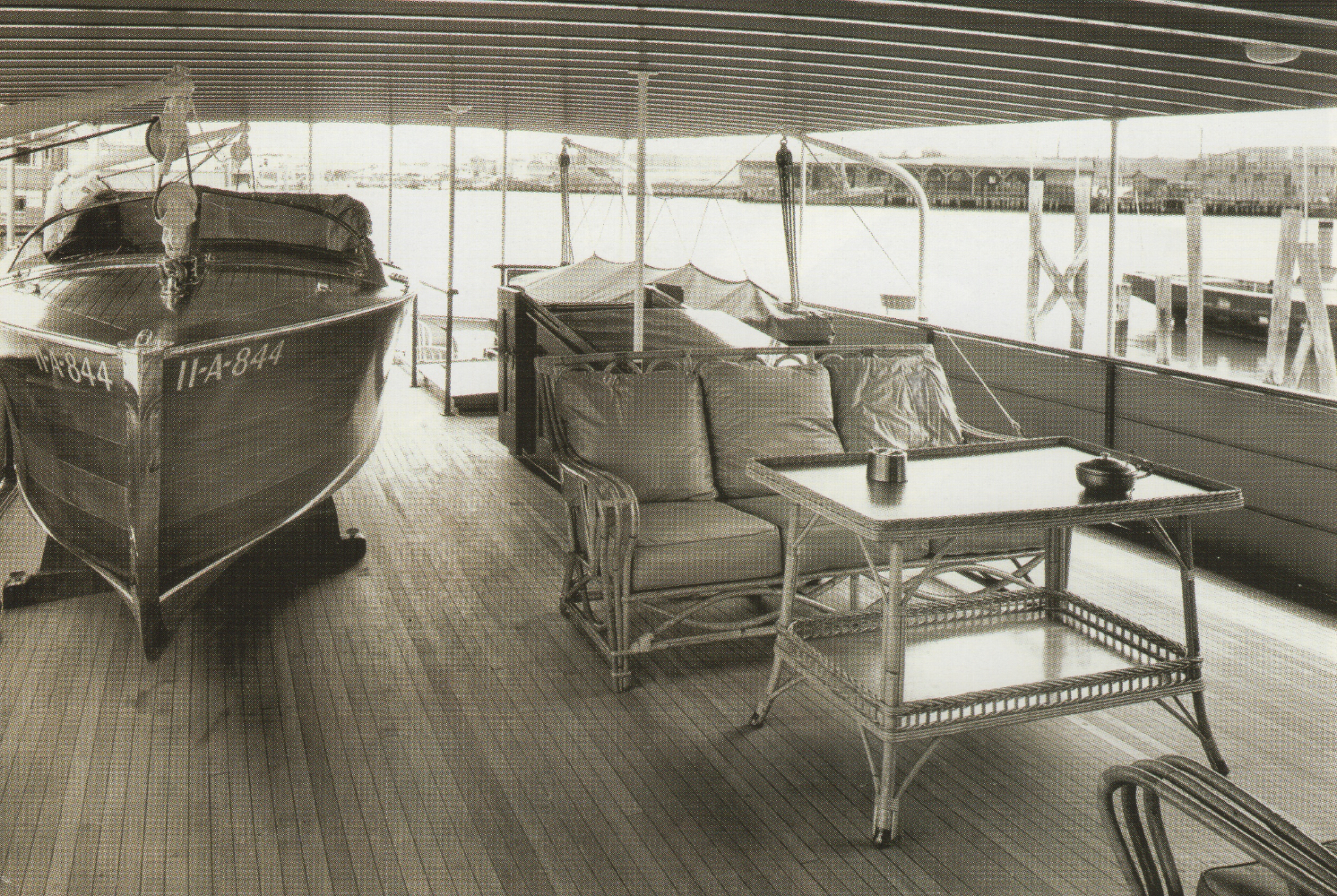
Frizzy Atwell was in charge of all new yacht construction at Trumpy’s. Jim Emmeric headed the plumbing shop, Frank Thomas, the joiner shop, Rob Childs, the electrical shop, Ed Norton, the mill shop, Frank Wagner, the carpenter shop and Bunky Durham, the boat building shop. The division of labor was well defined at the Trumpy boatyard, and each foreman headed a crew of workmen known as “gangs”.
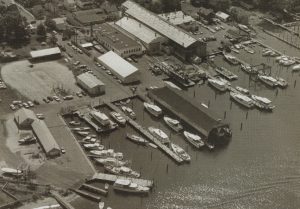
The outside yard had its own railway, and most of the repair work on transient yachts was accomplished there. The “little carpenters shop” stood nearby, housing a collection of power tools that provided a convenience to the men working on boats near the water’s edge. John Trumpy’s son, Donald, supervised the engineering, maintenance and repair work and made the Eastport operation a landmark repair and haul-out facility.
Alton Mitchell began working at Annapolis Yacht Yard during WWII as a carpenter. He remembers starting at the bottom.
“They put you with the hardest job; that’s carrying labor. I worked my way up and learned how to read the drawing. When Trumpy came down here, I was doing finish interior work. We built damn good boats and took a lot of pride in our work.”
Norman Cummings worked in the mill shop under Frank Thomas. Cummings said, “He was a man who really knew the mill business. He never shoved you and was a good teacher. He would always say there may be an easier way to do a job, but it was the way he was taught. Finding an easier way was up to me, he would say.”
Werner Schnoor remembers, “My father and three of his brothers worked there. So did two of my brothers. My uncles knew how to work with wood and learned it in Germany. My uncle showed me how to sharpen a scraper. It may not seem a lot, but he showed me how to hone and edge of a plain piece of metal into a fine tool so that it would cut or scrape wood. That tool would enable me to form a whole transom. Once a man learns the little points, the big jobs become easy. It falls into place.”
From 1958 until 1971, four devastating events occurred which contributed to the yard’s eventual closing. The first was the sudden death of Donald Trumpy. The son who was loved by all workers. The loss to his father, the family and business was a severe blow and many mourned his passing for years thereafter.
The second wound to the family was a fire that almost consumed the entire boat-building complex. Believed to have started in the main lumber shed, flames fanned by early fall winds in September 1962, quickly engulfed many of the other buildings. Sparks flew over the rooftops of many houses on the peninsula, and Eastporters feared their homes would also perish. Annapolitans lined the city dock to watch the fire that burned through most of the night and into the next morning.
 The Trumpy family and boat-building business survived the fire and soon rebuilt many of the burned-out buildings. But, one year later, almost on the anniversary of the fire, John Trumpy Sr., in his 84th year, passed away. He was the patriarch of the family and mentor to his workmen – admired by all for the way he conducted himself as a gentleman, businessman, and leader. Guiding the family business now rested on the only surviving son, John Trumpy Jr.
The task was not easy for John Jr. because the business of building yachts changed during the mid and late 1960s. Fiberglass came on the market, and the new material was found to be a very stable component in boat hull construction. Boat manufacturers across the country were switching from wood to fiberglass. But John Trumpy Jr., like his father, was a purist. He did not like fiberglass and would not incorporate the new material in the design of a Trumpy-built yacht. The late 1960s were turbulent years in America. It was what some historians have called the lost generation or a generation gap. Fewer young men looked to their elder mentors for guidance and direction. By the early 1970s, many of the men who for years had worked for the Trumpy boatyard were growing old. Minds still very active, their hands could no longer accomplish the tasks of building fine yachts. Fewer younger men applied for work – and fewer young men for the elders to pass along the skills and knowledge of boatbuilding. Men also complained about the pay scale at the boatyard – more money could be made elsewhere and with less arduous working conditions. Pensions and medical insurance became an issue, and in early 1971, a labor strike crippled the yard.
The once-busy shops around the yard now lay vacant. Only 15 of the yard’s 73 men were paid top wages. The others made on average less than $4.00 an hour. Many of the men decided to leave and sought work elsewhere, making almost twice as much as they had made at the boatyard. The strike broke the spirit of the men, and for John Trumpy Jr. the era of wooden boatbuilding on Spa Creek was about to come to an end.
 Doug Nowell worked at the yard in 1970 after he was discharged from the U.S. Army. He learned carpentry in high school, but when he applied his woodworking skills to his new job, he was lost. Newell said, “They old me to go work on the stem, but I didn’t know what that was until I asked Ed. Norton. He taught me how to use a planer, a joiner, shaper and other stationary pieces of woodworking euip,ent.” Nowell also remembers, “He was a particularly hard guy to work for. He ran through more than a few younger helpers. I went from a helper to a finish carpenter all because of Ed Norton. The older finish carpenters were considered the real craftsmen there. I tried to learn as much as I could from them. I was one of the last who learned wooden boat building in Eastport.
In 1972, John Trumpy Jr. sought a zoning change for the property from the city. He wanted to develop a $10.5 million, 156-unit condominium on the site. Opponents protested the overdevelopment and strains on infrastructure; proponents took the “man’s home is his castle” approach, eliciting considerable press support. But the Annapolis City Council, by a 5 to 4 vote, turned down Trumpy’s request for the zoning change. Saddened, defeated and angry, John Trumpy Jr. called a final board of directors meeting on December 20, 1973 – the decision was made. The boatyard would close. On July 8, 1974, the auctioneer’s gavel fell as most of the equipment and machinery at the yard was sold. Four generations of Norwegian boat builders came to an end, and it was another sad day for Eastport – the neighborhood lost yet another boatyard.
Some of the old craftsmen who stayed until the last day packed up their tools and either went into retirement or got jobs elsewhere. Mabel Atwell, Frizzy’s wife, said, “The older men knew their wood. Frizzy left Trumpy’s before it closed. I always told him if he ever left that yard, it would close up. Three months after he left, it did.”
Frank Wagner recalls, “It was a great time; the best part of my life. I worked my way through the yard at various skill levels. Frizzy Atwell taught me how to make patterns and other fine carpentry work. Many of us enjoyed years of friendship working at the yard. I worked there until it closed. I was the last one who left.
Many of the men had fond memories of their younger days at Chance’s boatyard, where they apprenticed, and later at Annapolis Yacht Yard – a time in their lives when they matured as shipwrights and fine yacht carpenters. A time in their lives they all remember that holds a special place in their hearts.
This story, written by Mike Miron, was originally published in the Summer 2000 issue of ACBS Rudder.
A wonderful story with a sad ending!