
By Mark Manes, Northern California/Lake Tahoe Chapter
I remember in my childhood driving my father’s 22’ boat from the launch ramp out to Cayuga Lake and having someone yelling at me that I was on the wrong side of the channel. They said something about Port to Port. I remember it, because it was the first time that I would realize that there were actually rules out there for navigating a boat.
As a Harbor Pilot and professional mariner, I have been asked many times “What is the most dangerous part of your job?”, my answer is always the same “Recreational boaters!”. An old timer tugboat captain that I used to work with once said to me “There is one thing in this industry that you can always count on, recreational boaters will always do the wrong thing”. Unfortunately, this has proven true many times over in my many years working on commercial vessels.
 For those in the club who have a USCG license, you already understand the Rules of the Road, you had to get a 90% on the exam in order to qualify for a license. For those that have never looked at them or tried a test, I challenge you to find an online source for practice exams and see how well you do. The USCG Rules of the Road can be found on the USCG website, broken down into various sections and include all things related to meeting other vessels on the water. There are Inland Rules which apply to the majority of the boating that most of us do, and also International Rules that apply to vessels outside of the demarcation line (a line from Pt Bonita to Mile Rocks Light for SF Bay). Lights, Sound Signals, and Passing Signals are all well spelled out in these rules.
I will highlight a few important rules that may keep you safe when navigating out on the bay or even Lake Tahoe. Many smaller lakes are not included in the USCG jurisdiction and have their own “rules”, understanding the federal rules will help you make better decisions overall.
Let’s start with Rule 6: Safe Speed
Every vessel shall at all times proceed at a safe speed so that she can take proper and effective action to avoid collision and be stopped within a distance appropriate to the prevailing circumstances and conditions. In determining a safe speed the following factors shall be among those taken into account:
(a) By all vessels:
(i) the state of visibility;
(ii) the traffic density including concentration of fishing vessels or any other vessels;
(iii) the maneuverability of the vessel with special reference to stopping distance and turning ability in the prevailing conditions;
(iv) at night, the presence of background light such as from shore lights or from back scatter of her own lights;
(v) the state of wind, sea, and current, and the proximity of navigational hazards;
(vi) the draft in relation to the available depth of water.
As you will notice, there is not a “speed” that is given to be considered “safe”, it is up for interpretation based on the rules above. Driving through a collection of boats at full speed would more than likely be considered “unsafe” if there is risk of collision. These rules are written in this manner for a specific reason, to allow for exceptions based on the existing conditions.
Now to Rule 7, Risk of Collision:
(a) Every vessel shall use all available means appropriate to the prevailing circumstances and conditions to
determine if risk of collision exists. If there is any doubt such risk shall be deemed to exist. (b) Proper use shall be made of radar equipment if fitted and operational, including long-range scanning to obtain early warning of risk of collision and radar plotting or equivalent systematic observation of detected objects.
(b) Assumptions shall not be made on the basis of scanty information, especially scanty radar information.
(c) In determining if risk of collision exists the following considerations shall be among those taken into account:
(d) such risk shall be deemed to exist if the compass bearing of an approaching vessel does not appreciably change; and (ii) such risk may sometimes exist even when an appreciable bearing change is evident, particularly when approaching a very large vessel or a tow or when approaching a vessel at close range.
In particular, I would like to speak to (d) in the above rule. In the commercial world, we call this constant bearing, decreasing range. When I am on a ship, this is something that I always look at when risk of collision exists. If a vessel is not moving across my window, and is getting closer, I know that we may have an issue. It is something that all of you should practice by looking up and checking to see if the other boat is staying on the same bearing. Adjust your course or speed (or both) until you see positive movement across your field of vision if it is.
Once we know that risk exists, we need to look at Rule 8, Action to Avoid Collision:
(a) Any action taken to avoid collision shall, if the cir- cumstances of the case admit, be positive, made in ample time and with due regard to the observance of good seamanship.
(b) Any alteration of course or speed to avoid collision shall, if the circumstances of the case admit, be large enough to be readily apparent to another vessel observing visually or by radar; a succession of small alterations of course or speed should be avoided.
(c) If there is sufficient sea room, alteration of course alone may be the most effective action to avoid a close- quarters situation provided that it is made in good time, is sub- stantial and does not result in another close-quarters situation.
(d) Action taken to avoid collision with another vessel shall be such as to result in passing at a safe distance. The effectiveness of the action shall be carefully checked until the other vessel is finally past and clear.
(e) If necessary to avoid collision or allow more time to assess the situation, a vessel shall slacken her speed or take all way off by stopping or reversing her means of propulsion.
(f) (i) A vessel which, by any of these rules, is required not to impede the passage or safe passage of another vessel shall, when required by the circumstances of the case, take early action to allow sufficient sea room for the safe passage of the other vessel.
(ii) A vessel required not to impede the passage or safe passage of another vessel is not relieved of this obligation if approaching the other vessel so as to involve risk of collision and shall, when taking action, have full regard to the action which may be required by the rules of this part.
(iii) A vessel, the passage of which is not to be impeded remains fully obliged to comply with the rules of this part when the two vessels are approaching one another so as to in- volve risk of collision.
RULE 9: Narrow Channels
(a) (i) A vessel proceeding along the course of a narrow
channel or fairway shall keep as near to the outer limit of the channel or fairway which lies on her star board side as is safe and practicable.
(ii) Notwithstanding paragraph (a)(i) and Rule 14(a), a power-driven vessel operating in narrow channels or fairways on the Great Lakes, Western Rivers, or wa ters specified by the Secretary, and proceeding down bound with a following current shall have the right-of-way over an upbound vessel, shall propose the manner and place of passage, and shall initiate the maneuvering signals prescribed by Rule 34(a)(i), as appropriate. The vessel proceeding upbound against the current shall hold as necessary to permit safe passing.
(b) A vessel of less than 20 meters in length or a sailing vessel shall not impede the passage of a vessel that can safely navigate only within a narrow channel or fairway.
(c) A vessel engaged in fishing shall not impede the passage of any other vessel navigating within a narrow channel or fairway.
(d) A vessel shall not cross a narrow channel or fairway if such crossing impedes the passage of a vessel which can safely navigate only within that channel or fairway. The latter vessel shall use the danger signal prescribed in Rule 34(d) if in doubt as to the intention of the crossing vessel.
(e) (i) In a narrow channel or fairway when overtaking, the power-driven vessel intending to overtake another power-driven vessel shall indicate her intention by sounding the appropriate signal prescribed in Rule 34 (c) and take steps to permit safe passing. The power-driven vessel being overtaken, if in agreement, shall sound the same signal and may, if specifically agreed to take steps to permit safe passing. If in doubt she shall sound the danger signal prescribed in Rule 34 (d).
(ii) This Rule does not relieve the overtaking vessel of her obligation under Rule 13.
(f) A vessel nearing a bend or an area of a narrow channel or fairway where other vessels may be obscured by an intervening obstruction shall navigate with particular alertness and caution and shall sound the appropriate signal prescribed in Rule 34(e).
(g) Every vessel shall, if the circumstances of the case admit,
Sections (a) and (b) are the ones that I feel are the most important for the recreational boater. Take action early, and make sure that the action you take is appropriate and obvious to the other vessel. Make large course changes to make sure that the other vessel understands what you are intending. There are rules for which vessel has right of way in every situation. I am not going to go into detail here, but you should certainly read the rules to have an understanding. In general, if you are in doubt as to another vessels’ intentions, it is always better to give way and remove yourself from the situation completely. Many of you have heard “Sailboats always have the right of way”, and while this is true in many situations, it is NOT true while on the SF Bay. If you have ever looked at a chart of the bay, you have seen that the majority of the bay is very shallow. The ships and commercial traffic on the bay generally must run in very deep water and confined channels. Because of those facts, Rule 9 applies to almost every situation between a large commercial deep draft vessel and any other type of ves- sel. Bottom line, stay out of the way of ships and commercial vessels. Make your intentions known early and do not impede the passage of a ship…ever! Ships cannot just move out of the way without risking running aground and causing major damage. When we have boaters that want to challenge that, it is very stressful for all of us involved. If you hear 5 or more short blasts, this is the “Danger Signal” under these rules and means that the person who is blowing the whistle feels that there is an immediate threat and is notifying the other vessels in the vicinity that they are in danger. If you hear a ship blasting the whistle multiple times, stay clear!
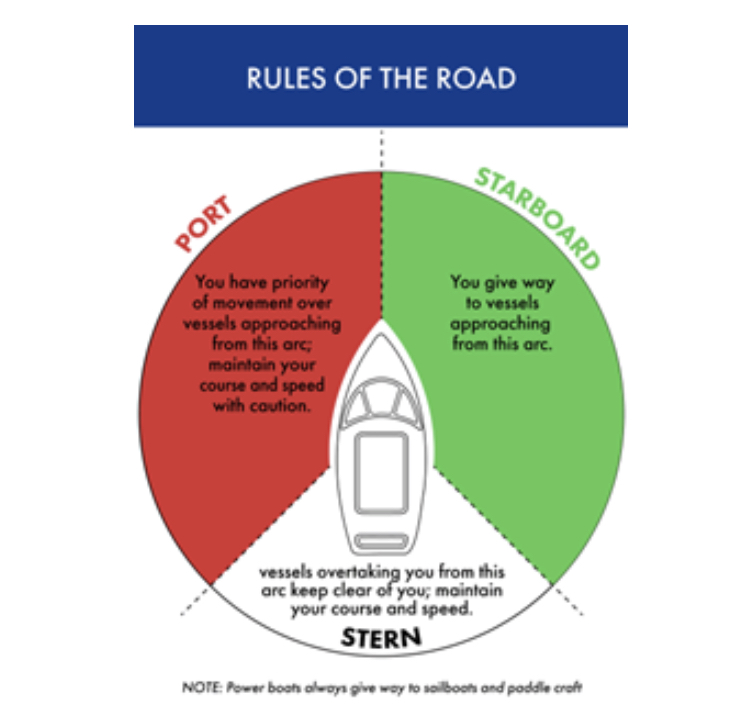
I recommend that all of you brush up on Section II of the rules which talk about what to do in various meeting, overtaking, and crossing situations. These cover all of the possibilities between TWO vessels, when taking action, the rules specifically say that any action you take should not create another dangerous situation with another vessel. I am not going to bore you with all of the details, you can read and learn them for yourselves. In general there are a few simple things: Port to Port is the preferred method of passing, any vessel being overtaken has right of way over the overtaking vessel, and when meeting in a crossing situation, the vessel to Starboard has the right of way.
One other thing I wanted to mention in closing is blind spots on ships. The IMO (International Maritime Organization) has rules on visibility from the bridge of a ship.
1 Ships of not less than 45 m in length as defined in regulation III/3.12, constructed on or after 1 July 1998, shall meet the following requirements:
1.1 The view of the sea surface from the conning position shall not be obscured by more than two ship lengths, or 500 m, whichever is the less, forward of the bow to 10° on either side under all conditions of draught, trim and deck cargo;
In simple terms, the “blind spot” on a ship should not exceed 500m or 1640 feet from the bridge wheelhouse conning position. This means that if I am piloting a ship, there can be 1640 feet in front of the ship that I cannot see at all! We call this the “blind spot” and many times recreational boaters will cross through our blind spot in front of the ship and cause a great deal of stress and fear. I always tell folks, “If you cannot see the bridge windows, they cannot see you either”.
Please keep this in mind as you are running around the delta, don’t put yourself in the blind spot, and avoid crossing in front of a moving ship as they are often traveling at a much higher speed than you might think. Our speed limit while in the bay is 15 knots through the water, ship’s can come up quickly if you are not paying attention.
Take care and make sure that all of your safety equipment is up to date.
This article was originally published in a 2023 issue of the Northern California/Lake Tahoe Chapter’s newsletter, Western Wood.
Correction, the PNW Chapter newsletter is the WET EDGE. This article is from the Northern California Lake Tahoe chapter, WESTERN WOOD
Thanks Kirk! We’ve updated the article with the correction.