
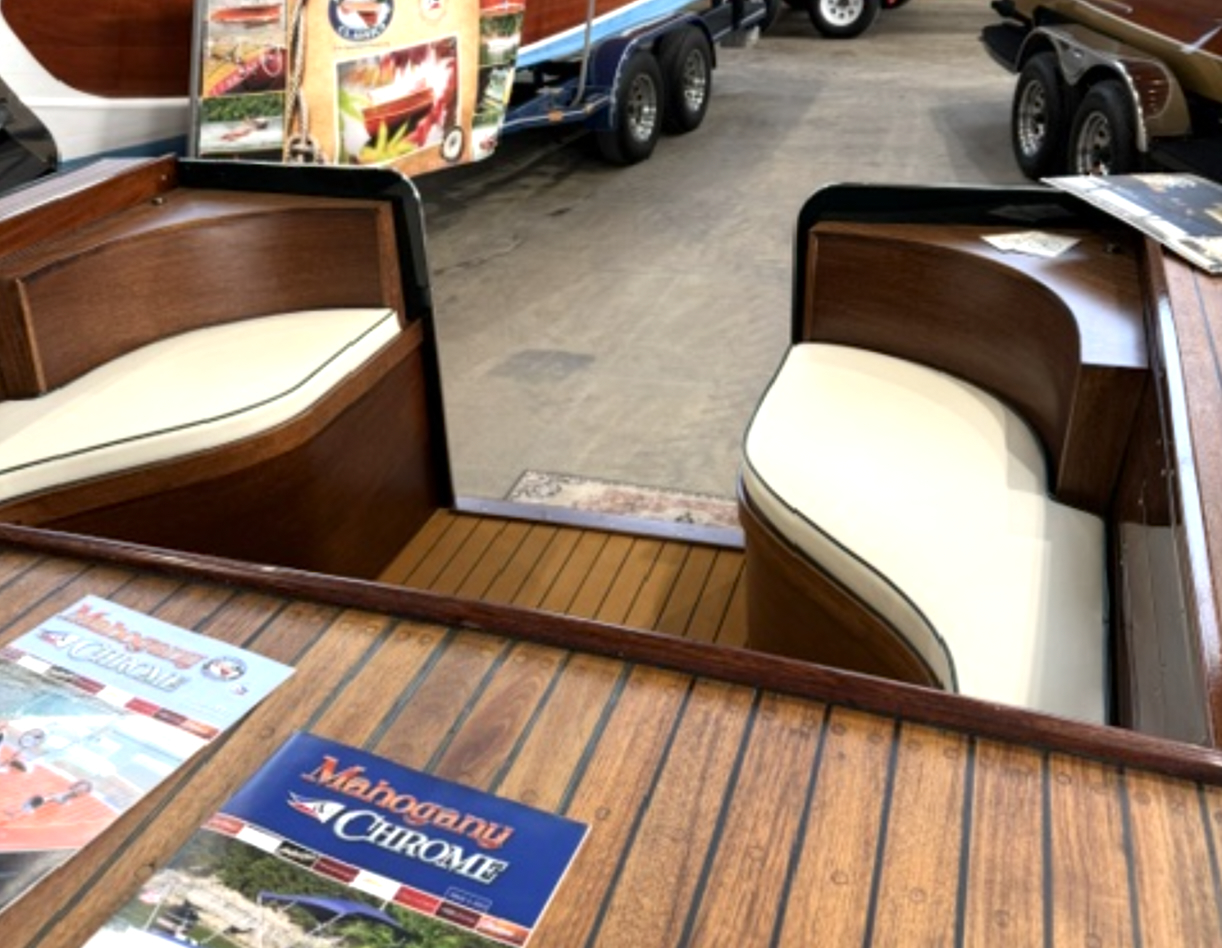
A 1964 28-foot Chris-Craft Sea Skiff gets a new life and steals the show.
Story by Kasey Rideout, Kyle Jamar, and Brent Howard, Heartland Classics Chapter members
Photos by Kyle Jamar
In the beginning, according to Brent Howard, he wanted a boat booth for Heartland Classics to use at Workshops, Boat Shows and Events, resulting in him acquiring a non-restorable Sea Skiff to use as the platform. The concept was simple, but designing and executing was another story.
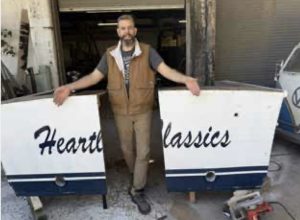 The booth would wind up 9’ x 7’ x 3’, weigh about 800 pounds, move in and out of different locations and terrains, and sit on the ground. Once the booth section was cut out, according to Brent, it was “loose as a goose.” To stabilize the structure, a platform base from steel 2 x 4s was built, and the booth was reinforced with 1 x 5 white oak ribs, 1 x white oak forward mini transoms with 1 x mahogany cover boards, 1 x white oak cross brace under the edge of the transom deck, and a removable 2 x 2 angle iron brace across the open end to double as a light bar in transit.
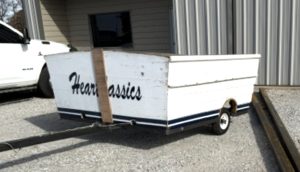
In order to load, transport, and unload the booth, a lot of ideas were developed, including built in retractable wheels, using a forklift, or utilizing a car hauler. A design was settled on which included designing and building a trailer for the booth that would transport, load and unload in tight spaces. The booth was bolted to the trailer to transport. The load and unload functions were accomplished by detaching the trailer from the tow vehicle and pivoting the trailer. The booth then was slid off the trailer and loaded with a cable winch mounted near the hitch.
The restoration was standard procedure; replace wood as needed, paint, varnish, Sikkens, new Chrome plating, etc. The metal deck was covered
with plywood and marine vinyl. Brent recalls the transom as being a mess, including dry cracks in the planks, a sizable gap between two planks, dock
dings, and screw holes from the boat name brass letters. The first thought of the restoration method was placing new transom planks. However,
since it was to be used as a show booth, the decision was made to show various ways to repair different types of damage. Five different shapes of
wood were used for repair. Since the new wood was a different shade, the blending of the stain color was quite a process.
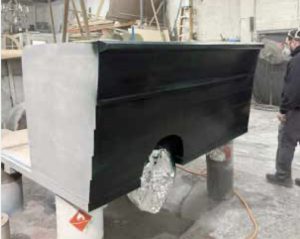 His hope was the show booth would provide multiple purposes – to be helpful to classic boat owners by showing ways to repair, help determine whether to repair or replace with new planks and understand what is behind lap strake and other interior construction.
Fast forward to September 2024. Multiple years and multiple occasions for its use, the Booth was in a shape that would benefit from another restoration and redesign. There have only been a few people in its history as a Show Booth who know how to unload and place the Booth from its trailer. The difficulty in this process resulted in more than one occasion when desperate calls were made to get assistance. Use, weather, trauma, and time eventually showed their toll. Enter the men in red capes and “S” on their chest: Kyle Jamar, Pete Seitz, Dan Diehl. Following the close of the Grand Lake show, arrangements were made to transport the Booth to Pete Seitz’s shop for the fun to begin, and these guys were there to make it all happen.
This project was not as much a restoration as it was a transformation! Beginning at Kyle’s shop in Tulsa, the Booth was cut, with 14” removed from the width, and 8” cut from the overall height. The creative approach was used to also measure, cut, and trim the wheel wells with epoxy finalizing this step. Once the chopping was completed, she took her next trip to have her permanent shoes made. Pete Seitz and his man, Tom, made a custom chassis and attached the chassis and the transom together. It was a match made in heaven.
 She was now ready for her next trip – back to Tulsa and Kyle’s shop and was here that the shenanigans continued. Here is where the stripping, sanding, and building began. The chassis got a coat of paint and new decking was installed. Kyle mocked up a seating design and went forward. While he was laminating the interior pieces, his guys started the body work. During that time, a “quick” trip was made to Dan Diehl’s shop in Jenks to peruse the treasures Dan has acquired. The pile revealed a piece of mahogany veneer and an entire 4’x8’ piece of beautiful mahogany plywood – they hit their paydirt! The piece found its home among the rear panels of the transom, where marine plywood was used for this construction, with the mahogany attached with use of epoxy to the transom. Once the glue had set up, stain and then layers of west epoxy, with special clear hardener were applied.
It was here that the first application of many would be made, in this case, the chassis, of whatever partial can of paint that they could find – gotta use up that paint and not let it go to waste! Their next step was to tackle the veneer. After the parts were measured, made, and faired flat, they laid out the mahogany.
Trim was laminated to the parts and then made ready for finish. Once the parts were bleached (they bleached all the wood so they would have a consistent base on which to apply the stain so that all the wood would match), stained, and dried, they were ready for the epoxy base coats. It seems Dan Diehl’s shop always has its “Open” sign on. Combing through the pile of mahogany, once again, Kyle scored some mahogany combing boards (interior sides) that needed some love, and with that, Voila! – the gunnel sides are covered and finished using the same steps as their sister parts.
While all the above was happening, Kyle’s guys were hard at it blocking and fairing the sides, making them straight and glorious.
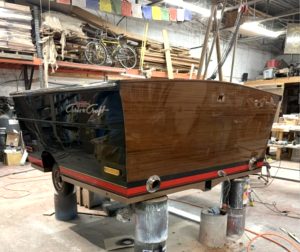 The first base coat hits and more fairing is needed (but that’s Kyle’s hobby, right?!). With the base coat finalized and the transom faired to 400 grit sandpaper, they’re ready to spray the whole thing. Kyle has a thing for Automotive Clear – and it’s “clear” to see why – it’s fabulous, and tuff, as well! For the final finishing touch, polishing, polishing, and more polishing was completed.
To say the finishes were sublime would be an understatement. While on display at the Tulsa show, a woman argued with one of our members that the materials used for the Booth were really not wood – they were plastic. When the member tried to explain the process used to achieve the resulting product, the woman shook her head, gave a “bless your heart” look, and walked away. Many more times than could be counted, visitors were observed coming into the display, starting with admiring the boats, but always coming back to the Show Booth to admire its beauty. It was a stunning addition to the show.
Following the application of the finishes, it was time to assemble, wet sand, polish and complete even more assembly. She was ready to go to the Tulsa Boat, Sport and Travel Show – and she looked great! Just in the nick of time, Jodee Winkle comes in with the final pièce de résistance! Seat cushions made of white vinyl and green ostrich welting cord were placed and were perfect!
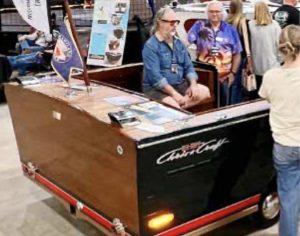 To say there requires a lot of time, effort, manpower, and funds to complete a project such as this is an understatement. Many, many hours were spent on its reconstruction to restore it and make it something to admire. An abundance of appreciation goes out to: Pete Seitz, Tom Hall, Dan Diehl, Joe Park, Darren Arnold, Jodee Winkle and Moss Seat Cover, and ALL the guys at High Prairie! A special and huge amount of gratitude goes to Brent Howard for his creation of the original Show Booth and his donation of it to Heartland Classics.