
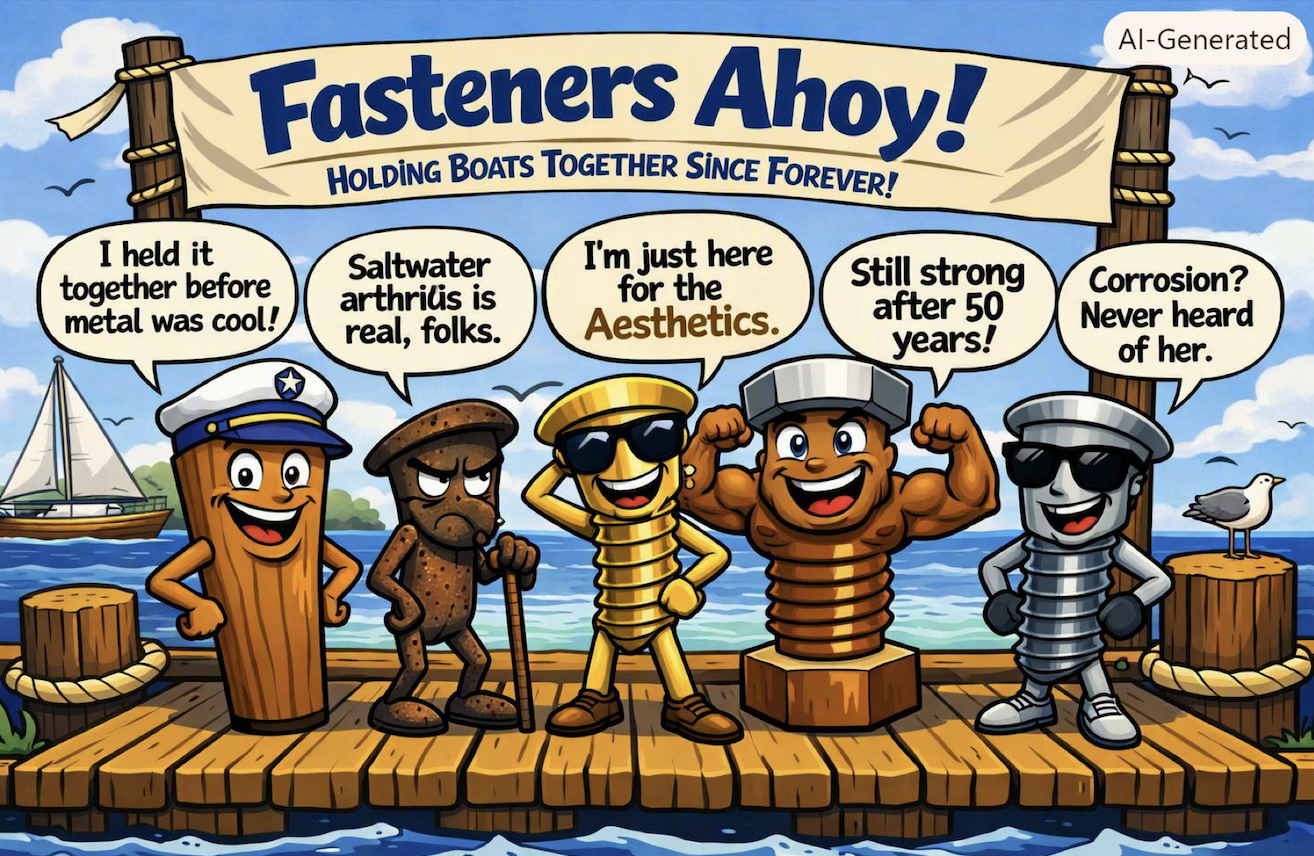
By Bill Calliet, Smith Mountain Lake Chapter
Metal fasteners have played a critical role in boatbuilding for centuries, evolving alongside advances in metallurgy, woodworking, and marine engineering. From hand-forged iron nails used in ancient vessels to today’s precision-manufactured stainless steel screws and silicon bronze bolts, the choice of fastener has always been influenced by strength, durability, corrosion resistance, and the demands of the marine environment.
Early wooden boats were often held together with wooden pegs, known as treenails or trunnels, combined with rope lashings and animal fibers. As metalworking improved, blacksmiths began producing wrought iron nails, spikes, and bolts. Iron offered greater strength than wood and allowed larger vessels to be built, but it came with a significant drawback. Exposure to saltwater caused iron to rust, weakening the fasteners and staining surrounding timber. Boatbuilders learned that iron fasteners required regular inspection and replacement, particularly below the waterline.
The search for more corrosion-resistant materials led to the use of copper and its alloys during the eighteenth and nineteenth centuries. Brass, an alloy of copper and zinc, became widely used for screws, nails, and smaller fittings because it resisted corrosion far better than iron and was relatively easy to manufacture. Brass fasteners proved especially popular in freshwater boats and for interior joinery where exposure to saltwater was limited. However, marine experience eventually revealed that ordinary brass was not ideal for long-term use below the waterline. In seawater, zinc can leach from the alloy through a process known as dezincification, leaving the fastener weakened and porous. As a result, brass became best suited for decorative hardware, cabin fittings, and lightly stressed applications.
Bronze emerged as the premium fastening material for traditional wooden boatbuilding. Marine bronze, particularly silicon bronze, combines copper with small amounts of silicon and other elements to produce exceptional corrosion resistance, high strength, and long service life. Unlike brass, silicon bronze is highly resistant to dezincification and galvanic corrosion, making it well suited for structural fasteners exposed to seawater. Throughout the twentieth century, bronze screws, bolts, and carriage bolts became the preferred choice for fastening planking, frames, keels, and other critical structural components in high-quality wooden boats. Many classic yachts built with silicon bronze fasteners continue to serve reliably after decades of use.
The development of stainless steel during the early twentieth century marked another major advancement. Stainless steel contains chromium, which forms a thin protective oxide layer that resists corrosion. Marine-grade alloys such as Type 316 stainless steel provide excellent durability in many marine environments while offering greater strength than bronze. Stainless steel fasteners became increasingly popular in fiberglass boats, aluminum vessels, and modern yacht construction because of their availability, mechanical strength, and attractive appearance. They are commonly used for deck hardware, rigging attachments, engines, and equipment installations.
Despite its advantages, stainless steel is not without limitations. In oxygen-poor environments, such as permanently submerged timber or sealed joints where moisture is trapped, stainless steel may suffer from crevice corrosion. For this reason, experienced wooden boatbuilders often continue to favor silicon bronze for below-the-waterline structural fasteners, reserving stainless steel for above-water applications where oxygen is readily available to maintain its protective surface.
Today, boatbuilders select fasteners based on both the construction material and the intended operating environment. Brass remains useful for non-structural and decorative applications, bronze continues to be the benchmark for traditional wooden boats, and marine-grade stainless steel dominates modern recreational and commercial boatbuilding. Understanding the strengths and limitations of each material helps ensure that fasteners provide decades of reliable service. The evolution of these metals reflects the ongoing pursuit of stronger, safer, and more durable boats capable of withstanding one of the harshest environments on Earth.
So what type of fasteners would have been used in a 1948 Chris Craft Deluxe Runabout?