
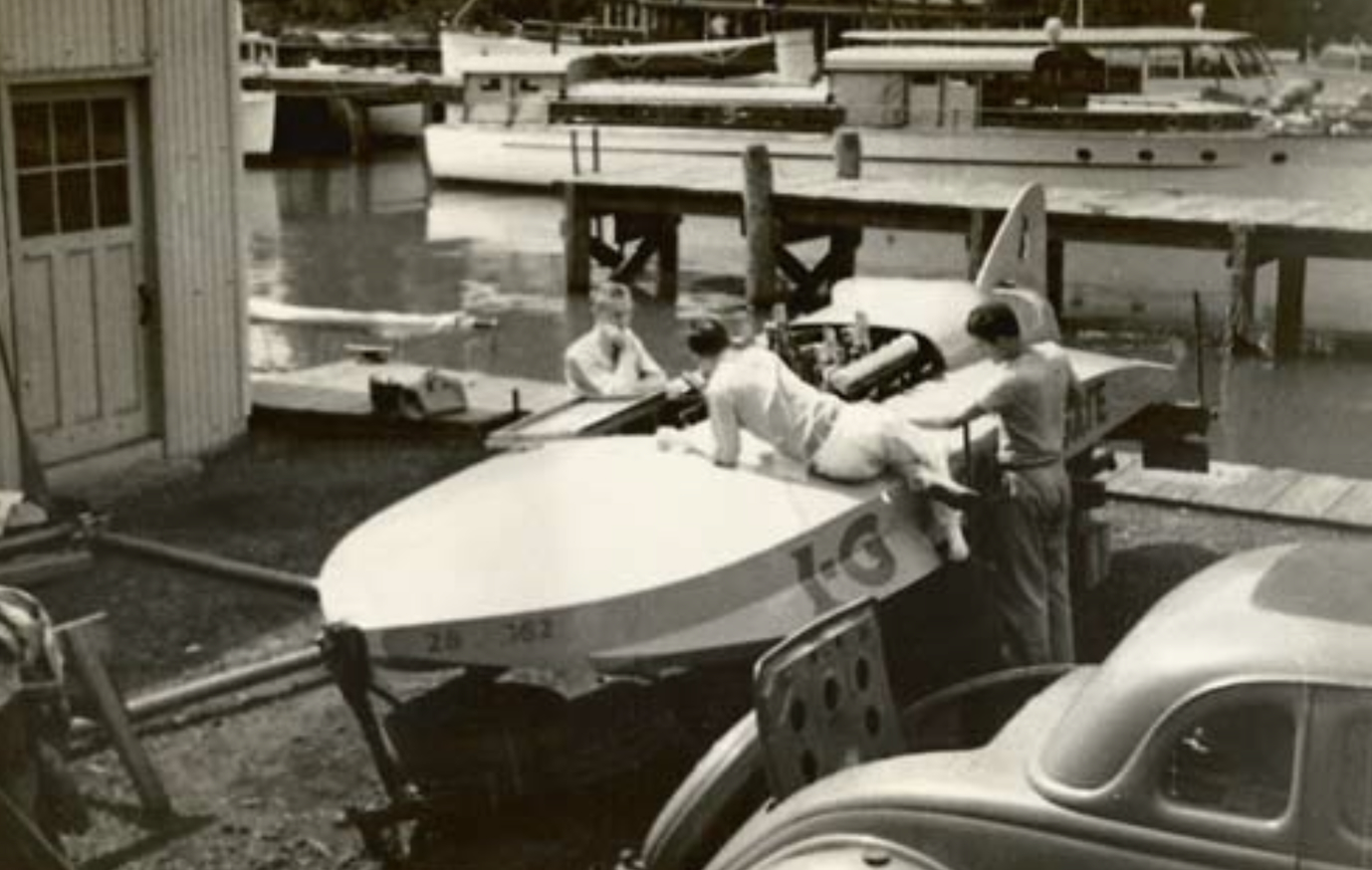
By Dan Arena, Northern California/Lake Tahoe Chapter
Dan Arena was born in 1916 in Oakland, California near Lake Merritt. Dan and his younger brother, Gene, made the Lake as well as their father’s nearby Golden Gate Winery their personal playground during their adolescence. They had constant access to water and the woodshop within the winery. A young 12 year old Dan built his first boat at the winery with his little brother helping.
Dan came by his competitive nature genetically. As a youth, his father, Dan Sr., was a national speed roller skating champion. Was it any wonder that son, Dan, would be racing boats competitively by age 15? Dan progressed rapidly through the outboard divisions and into the inboard class, and with each change came a newer and bigger boat with more power.
 In 1937 his boat, “Miss Golden Gate”, had already won the Pacific Coast Championship for ’36 and he was well on his way to repeat winning the championship title. He had also won the prestigious Doc Baron Trophy along with setting several new speed records. It was during the ’37 season that he set his sights on the East Coast and the Motor City of Detroit where one of the most coveted races in power boating was run, the “Gold Cup”.
Between races, he got on a plane by himself and headed to Michigan to see how the “Big Boys” played. Remember, the first international “Gold Cup” was run in 1904, and was the oldest and most sought after trophy in power boat racing. Upon his arrival at the raceway on the Detroit River, Dan was in awe of the beauty and the power of the race boats that were before him. They included such names as “Juno”, “Alagi” (from Italy), “Miss Canada” “Miss Judith” (from New South Wales), and many more. Yet the one that caught his eye was the “Notre Dame” with its unique W-24 cylinder Dusenberg engine. It was owned by Herb Mendelson and driven by Clell Perry. It also won the “Gold Cup” that season. After watching the race, Dan vowed to design and build a new boat to compete in the 1938 “Gold Cup” the following year.
Once he was home in Oakland his excitement still continued as he told everyone that he could about his adventure in Detroit and world class boat racing. He still had to complete the west coast season of racing before he could move on to his new adventure and he did so. The biggest obstacle he
encountered on the new project was convincing his family that he needed a new boat and an engine powerful enough to challenge the “Notre Dame” in Detroit the following year. The sale of the “Miss Golden Gate” would not provide the needed funds to complete his race boat. Perhaps, once again, Mom and Dad would help with funding. Not only did Dan’s family play an important role in the building of “Golden Gate II”, but his close friend, Danny Foster and boat builder, E. A. MacLean were also instrumental in this project.
 For the next year Dan’s focus was on the new “Golden Gate II”. He knew that he could not compete with the horse-power of the Dusenberg engine in the “Notre Dame”. His advantage would need to be that of holding his speed into and out of the turns. To accomplish this, he planned to incorporate two Ventnor Boat Company sponsons on each side of the boat to give it more of a lift.
The engine that was to be used had a story of its own. Ironically, one day while Dan Sr. was on a road trip he came across a WWI Curtiss-Wright 718 cubic inch engine. It was perfect for the boat. Dan, Danny Foster, and another friend went to work on the engine modifying and rebuilding it. By early 1938 even the press was giving the project notice with articles and photos in local newspapers. My father, Gene, now 15, was often on hand helping Dan when he was not in school. He was given the job of teaching the new owner of the old “Golden Gate I” how to operate and race it! At this time the Arena/Foster team was not only testing and making changes to the boat, but they were also competing in some of the early west coast races before Detroit’s “Gold Cup”.
With the boat funds almost depleted, Dan sold his car to his brother, and his father provided enough money for the $500.00 entry fee for the “Gold Cup” race and the travel expenses to Detroit for both Dan and Danny Foster. Yet now, they were without a means to tow the boat. Somehow Dan managed to “borrow” his mother’s car to do the job. The “boys from California” drove day and night to Detroit to participate in the “Gold Cup” race. The two Dans
were met by a crowd of newspaper reporters and race officials who had a barrage of questions for them, and that pre race week was filled with news articles about the 20 year old kids with their 20 foot, 300 HP race boat. They would be competing against a brand new “Notre Dame” (the race favorite) and the million dollar metal craft, “Alagi”, which was owned and driven by Count Theo Rossi of Italy. Foster, who was the more talkative of the two, always had a story to tell anyone who would listen. A quote from one article written at the time gives one the feel for these young men.
Dan had planned to enter the opening day regatta race in the 725 cubic inch class on Saturday, but he felt the water was too rough and determined that he would wait for Monday’s Gold Cup race instead. The following day, being Sunday, brought disaster to the new “Notre Dame” when it struck a submerged log and sank. Clell Perry, the driver/designer was seriously injured and hospitalized. Hence, the hometown favorite and defending champion was out of the race, and Dan’s year long wish to race against the W-24 Dusenberg was not realized.
 Race day brought more rough water with it. Seven qualified racers were ready to compete in the three 10 mile heats for the famous Gold Cup. By the beginning of the last heat, with ten laps to go, only three boats were still running. “Miss Canada” limped back during its first lap leaving only Dan in
“Golden Gate” and Count Rossi in “Alagi”. Sometime during the third lap the throttle linkage broke on Dan’s race boat. Foster immediately climbed up on deck and held the linkage together with one hand while Arena drove the boat around the course for the last seven laps chasing after the million dollar, “Alagi”.
The winner was never in doubt, but the two boats put on a memorable show for the 250,000 fans. Newspaper articles and photos of Danny Foster hanging over the engine cover while the boat moved at a cautious high speed spread around the world. Incidently, this was the first time the Gold Cup race was won by another country. The following quotes from newspaper articles in Detroit show something of the spirit of those boys from California.
Dan had planned to continue the season’s race circuit the following week at the President’s Cup in Washington D.C., but he discovered that a large section (1 ½ feet) of the right sponson had ripped away during the Detroit race. It was time to head home for repairs. On the drive back to California, Arena would ponder over the last year’s adventures, including the quest for the Gold Cup and the challenge of the “Notre Dame” with its Dusen-
berg engine.
The boys slipped back into a more routine life style after their return to Oakland. Initially, there was a flurry of fan fair and interviews, but that subsided with time. Dan worked at the winery, repaired the boat, and attended night school to earn his naval architecture degree. Danny Foster went back to racing his midget car on weekends and attended the local college.
Life seemed to have returned to “normal” for the Arena family during the first months of 1939, but that all changed one afternoon when Dan received a call from Herb Mendelson asking him to return to Detroit and drive the “Notre Dame” in the Gold Cup race. It was at this point in time that Dan’s passion changed from a hobby to a profession for he was now getting paid.
Arena arrived in Algonac, Michigan (a short distance from Detroit) and met with Mr. Mendelson and immediately learned of the “Notre Dame’s” repair progress. Herb explained that the hull always had some handling problems in the turns, but great speed in the straight away. After seriously studying its hull and running gear, Dan was ready for his first trial run with the “Notre Dame”. It was done at the south channel of the St. Clair River near Algonac where a group of reporters and fans watched.
Later in private, Dan admitted to Herb that there were serious stability and steering problems with the craft. The two men were quick to form a special bond of respect for each other, and this made for a great working relationship. Dan made changes to the hull and designed a new rudder for the “Notre
Dame” before it ran in the Gold Cup. At that race and subsequent races during the season, Dan finished in the middle of the pack.
Finally, after constant changes to the boat Dan went to Mendelson and explained that he was unable to take advantage of the Dusenberg power with the current hull. “If you want to win races you are going to need to build a new boat, and I would like to build you that boat.”
Originally printed in the Winter 2026 issue of the Northern California/Lake Tahoe Chapter newsletter, Western Wood.
GREAT STORY! WAITING FOR MORE! VERY INTERESTING TIME PERIOD OF POWER BOAT RACING FOR SURE! MY GRANDFATHER FC JUDSON WON THE OPEN RUNABOUT RACE AT THE DETROIT GOLD CUP IN 1937 WITH HIS TWENTY EIGHT FOOT GARWOOD CURTIS POWERED BOAT.POWER BOATING MAGAZINE OCTOBER 1937 PHOTO BY JOHN G ROBINSON.
Great reading.
Proud to say that I own a 225 racing hydroplane named Singer Miss, it competed against Dan Arena in the 1936 Oakland J.C. 718 Class. Lake Merrit, Oakland, Calif., September 7 1936.
Dan Arena ran his Miss Golden Gate 1.
A stepped hull with a Hispano Suiza eight.
Of course Dan Arena won and Singer Miss came second, with not so less speed.
It was not uncommon that 225’s and Gold Cup raceboats in those days took a battle against each other. So it must have been in this particular event.
Today Singer Miss resides i Sweden.