
By David Luttenberger, Mid-Atlantic Chapter
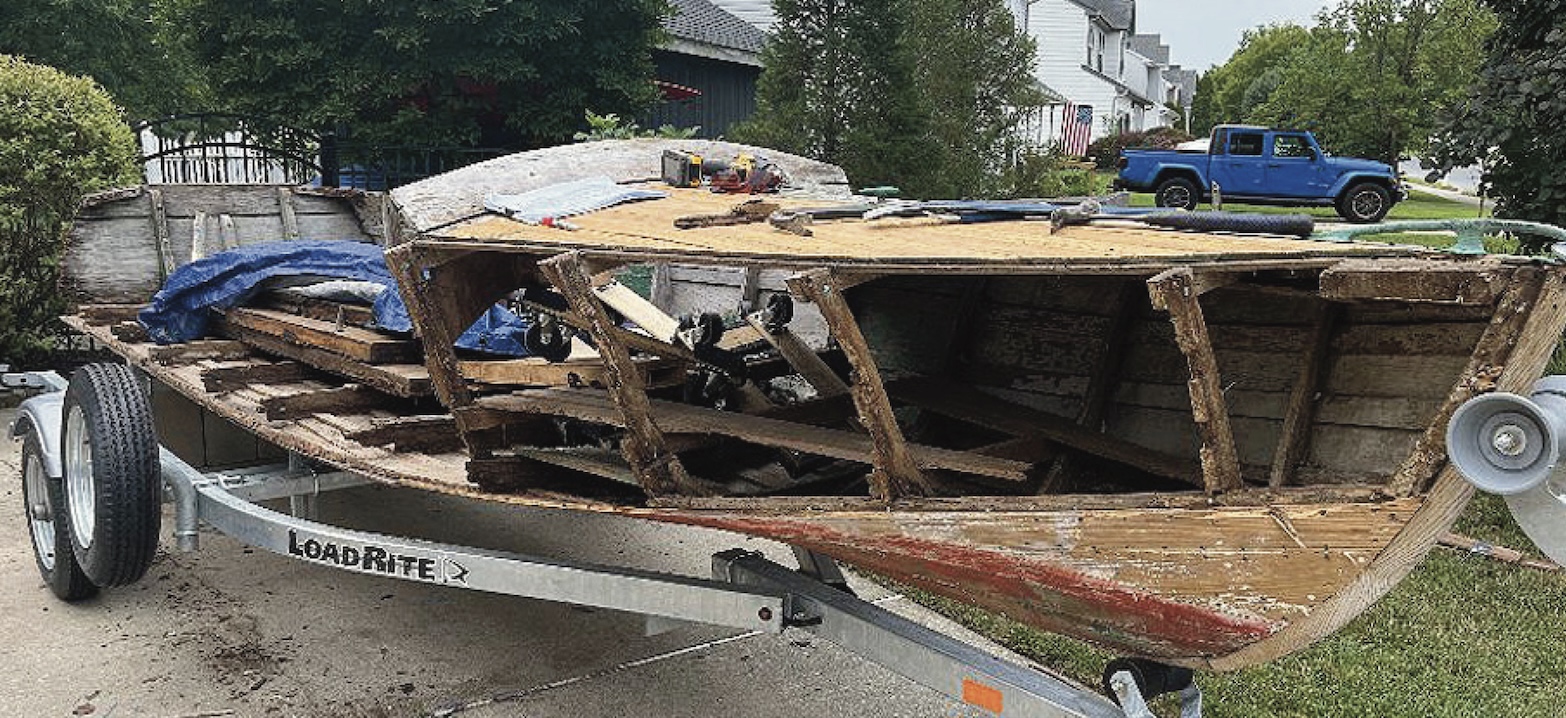
Forty years of Southern New Jersey summer sun bleached her deck white. Four decades of rain and snow painted her brass work with a sea-green patina and tarnished her remaining brightwork until it was brown and pitted.
Too many years setting on an ill-fitting roller trailer had hogged her hull. A flat right tire sunk axel-deep in mud created a hard list to starboard, causing rain water to pool and fall leaves to collect and rot at the intersection of the chine and transom. The result was a hole big enough through which a 20-inch ring buoy could easily pass.
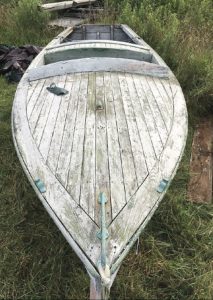
Sexy deck lines.
According to the sawyer in whose log yard near Mullica Hill, NJ, where she had been grounded, the boat was destined to be chain-sawed in half length-wise and sold at auction as wall art in some Chesapeake or New England nautical-themed bar. But David Luttenberger, a retired Marine and accomplished custom wood smith envisioned another, more fitting fate.
In the spring of 2022, Luttenberger had been milling and slabbing black walnut logs at the Lockman Hardwoods lot. He had spied the 17-foot, dual-cockpit runabout among spiers of goldenrod, stalks of teasel, massive clumps of crabgrass, and flitches of stacked walnut slabs on several occasions. Despite the bleached deck, tarnished metal, and rotting hull, he was taken aback by the art-deco-inspired curves of her bow and the elegance with which the gunwales arched their way around the forward cockpit and disappeared toward the stern.
“I just couldn’t let that boat be cut up and used to decorate a bar or restaurant,” said Luttenberger. Despite having never owned a boat other than a wood strip kayak he built a few years prior he decided to give her a second life.
Initially the plan was to restore the boat. But after further inspection by ACBS member Steve Ingraham, who Luttenberger had found via the internet, and who graciously agreed to take a trip to see the boat in person, revealed it was too far gone to save. Not to be dissuaded, Luttenberger shifted his plan from restoration to a complete rebuild.
The next, and probably most important step, was to join the Mid-Atlantic Chapter of the ACBS. “Hours of internet research, YouTube videos, and Facebook browsing told me I knew nothing about the proper was to go about building a classic wood boat,” confessed Luttenberger. “I quickly found ACBS veterans who were eager to help with written resources, historical insight, and even personal engagement and encouragement.” ACBS
members also believe the boat, which bears no name plate, and is only listed as “unknown make/model” on a 1986 registration card found in a forward storage compartment, is homemade and from the 1930-ish era. Said registration card is well-chewed, likely by a racoon, who skeletal remains were found in the storage compartment as well.
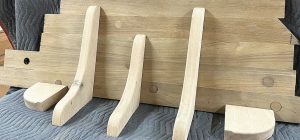
A strongback was built to facilitate accurate frame and rib positioning during the first stage of the build project.
On several occasions, Luttenberger was invited to the garage of current Mid-Atlantic Chapter President Dave Bernard, who lived about 45 minutes away in Buena, NJ. There, the two enjoyed a few “cold beverages” together around the Mr. Breeze, Bernard’s 1941 Century 16 ft. Utility boat. Bernard was even kind enough to share several pieces of white oak that had been felled on his property and used in the reconstruction of his own boat’s keel.
To date, Luttenberger has completed schematic diagrams of the boat from multiple angles. He has dismantled it plank by plank, batten by batten, corroded brass screw by corroded brass screw. Prior to dismantling it he marked and photographed every piece. It goes without saying that the process has been a bit humbling – taking more research, time, and patience than initially thought. “But I am enjoying the process,” says Luttenberger, who’s father owned a small wood Thompson in the 1980s that he acquired in trade for service work on a washer and dryer.
At this stage a strongback has been built. White oak frames and battens have been cut using the crumbling originals as templates. The keel has been cut and three transom knees have been shaped. One of the more interesting pieces so far, according to Luttenberger, is the transom.
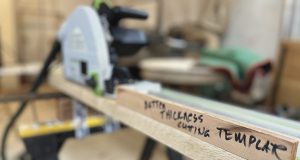
A track saw was used to cut the keel and battens, helping to ensure straight cuts and proper width
“Several years ago, when the Battleship New Jersey began to undergo a complete redecking, I was lucky enough to strike a deal with the Museum to buy all the salvaged teak decking being taken off the ship,” explains Luttenberger. “I have sold reclaimed teak deck planks across the US, Canada, and even in Europe, and designed and crafted such custom pieces as tables, flag cases, keepsake boxes, and even a salon door for a yacht in Maryland from the historic teak.” Luttenberger also saved a few prime planks for himself, which have been used for the transom of his boat. Besides the teak and white oak, his plans are to use mahogany for the hull and deck planks. “I’m also planning to do a custom Marine Corps logo inlay on the deck,” says Luttenberger, a proud 23-year Marine veteran. The runabout was originally powered by some sort of outboard motor.
The plan is to re-power it with a small outboard, but not something vintage. “I can build anything from wood, but I’m not a mechanic. The plan is to use a new motor and perhaps wrap or paint it in a period-correct art-deco scheme.
While Luttenberger hopes to have his boat in the water late in 2026, the best laid plans, well…you know how it goes with boats. But for now, he is enjoying the camaraderie of his ACBS Mid-Atlantic chapter friends – especially ACBS National President Ed Andrews, who gave Luttenberger the thrill of piloting his 1982 Roosevelt model Grandcraft, “Rum Runner” during a chapter outing on the Delaware River this past August. “Once he learned I had my boating license, Ed put me right in the captain’s chair, helped me with some finer points of navigation, and watched smile for the next 25 miles up the river,” exclaimed Luttenberger. “That experience made me even more eager to pursue and finish my own boat.”
To be continued…
Originally printed in the ACBS Mid-Atlantic Chapter’s newsletter, Nautical Mile.