
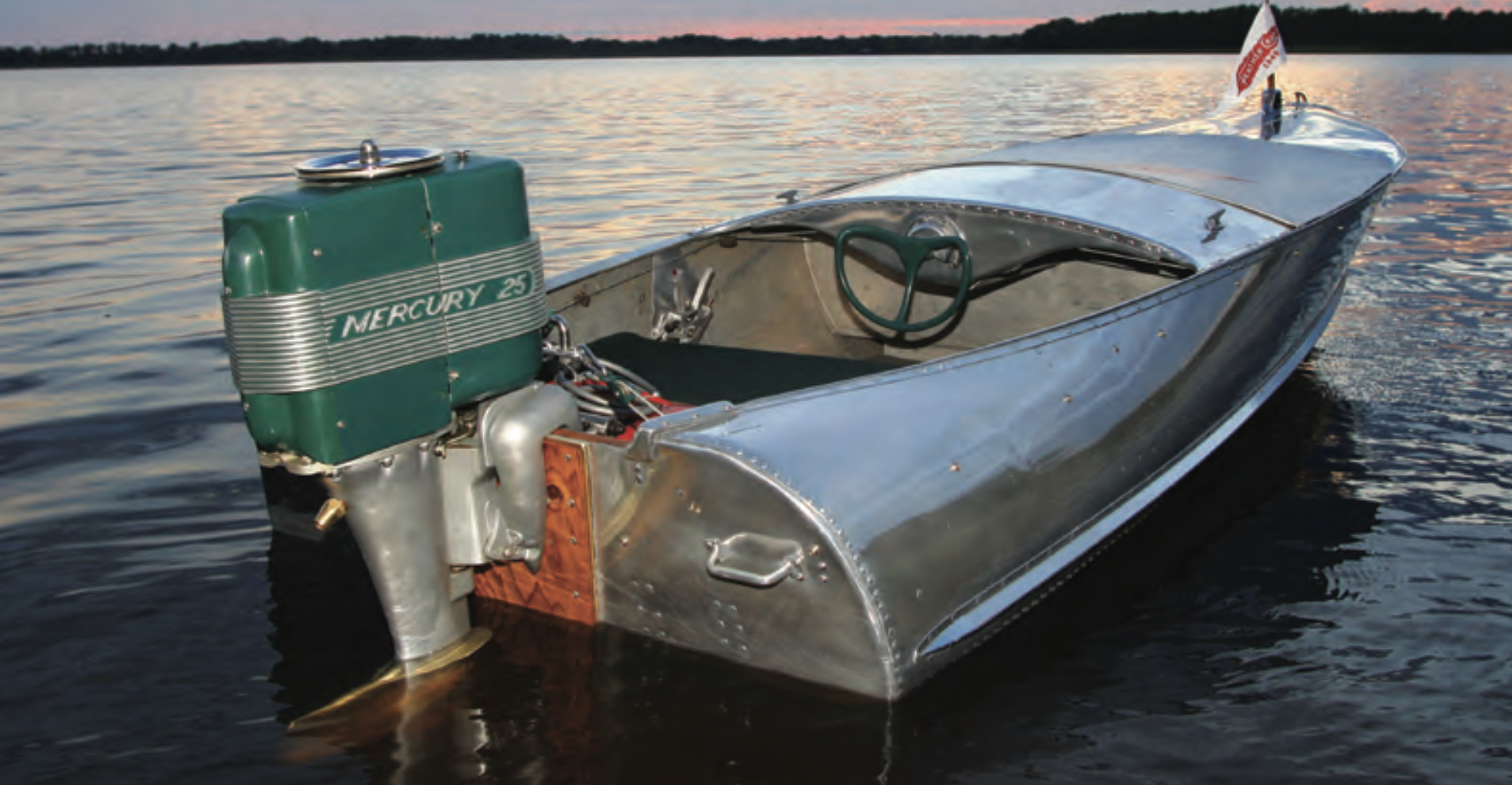
Nearly thirty years ago a friend offered to sell me his boat. His four children had learned to water ski and were growing too large to all fit in the Silver Bullet. It is a great looking boat and I immediately took him up on his offer. They moved up to a larger boat and I bought my first Feather Craft. I was more than happy with the appearance of the boat yet I had no knowledge of the aluminum craft having never heard of Feather Craft before.

The boat was sold to me as a 1956, or so they thought. Over time I’ve learned much about the old boats but not very easily, as the stories become more elaborate with age. “My father owned one like this but it had wings on it and a walk thru deck,” is what I’d hear.
I was told to examine the transom for the serial number; sure enough the Silver Bullet was built in 1949, not 1956. Since I had already registered the boat, upon learning its true vintage I requested the upgrade of information by the Marine Division of the Florida Department of Transportation.
After a long explanation of how I registered an out of state vessel as 1956 instead of 1949, Florida Department of Transportation decided to send the Marine Patrol to do an inspection of serial numbers. The officer apologized and explained he was legally blind and could not be certain about the small I.D. numbers, so he took me at my word and allowed the reregistering of the Silver Bullet.
We live on a Florida river and enjoy boating downriver to our local watering hole (restaurant) where nearly all the boaters will spend time ogling the shiny old Bullet while ignoring the new ski boats! It is a real attention grabber. And then the explanations of, “You’re looking at a 1949 with a 1949 Merc outboard.” begin. Everyone’s impressed with an original condition, polished, 61-year-old boat.
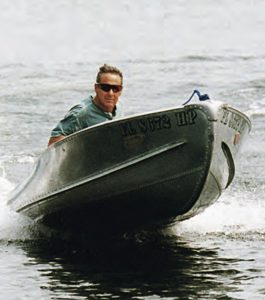
It has truly been a learning experience owning an old boat that very few people know anything about other than, perhaps, distant memories.
My purchase prompted me to visit the Mt. Dora Antique and Classic Boat Show, where I met a gentleman selling old boat literature and brochures. Nat had boxes of old flyers, brochures, magazines and other great stuff. I asked about Feather Craft and he just happened to have one photo copy of a 1949 Feather Craft brochure. I was ecstatic and once again was off on a new quest!
The ’49 brochure states that Feather Craft began manufacturing aluminum boats in January 1946. I discovered the my 14-foot, 7 1/2 inch-long boat was a Vagabond model and looked exactly like the brochure photo.
Later, we found our 1948 Feather Craft while antiquing the backcountry of upstate New York. Because I now knew where to look, the 11-foot 7-inch Feather Craft was easily identifiable by its serial number. I could not pass it up! This 1948 Feather Craft was an instant purchase. It was a smaller version of my other boat, and just needed polishing.
Is it possible a new boat building business, started in 1946 would have sales literature coming along after the new company’s first major achievement: winning a race in the 1948 Albany to New York City Outboard Marathon?
This first race win by Feather Craft started a “race boat by design” from the bottom up. They were looking forward to increased sales with the smaller aluminum racing craft. They introduced these racers in late 1949 through 1953, but returned to fishing and family boats because aluminum racers never caught on; wood boat racers held on to their roots.
The late 1940’s Feather Craft runabouts all shared the same style bow lift handle, cast aluminum and stylish. In 1950, a change to the eyelet style bow lift handle was incorporated into new Feather Crafts, making identification of the boats simple. The 1950 Mercury ad showing an airborne Feather Craft can be identified by this bow handle as a ’48 or ’49.
In my years as a Feather Craft aficionado, I have seen only two 1947 runabouts and one had the decks cut out to make it a fishing boat. The 1948 racing runabout seems to be out there, but very few boats remain.
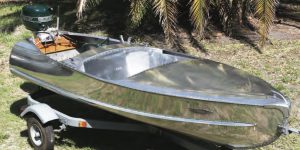
The 1949 Feather Craft Vagabond is the only one that I know of to this date. Only partial information of its history is truly known. Did it participate in the photo of the race start in the 1949 Albany to New York City Outboard Marathon race? How did it remain in such great shape? Sixty-one years is a long time for an aluminum boat to still be in original condition!
I made another discovery a few years ago. Paul Harvey, the famous newscaster, narrated the race coverage in a short film from the ‘48 and ‘49 outboard marathon races; Mercury Marine has converted it to video. Although heavily-favored Mercurys dominate the coverage, it is an excellent representation of the times and the outboard drivers from that period. Also, a good number of Feather Crafts are shown racing in this video. The tonneau covers on race boats of that era illustrate the efforts to streamline and aerodynamically speed up the racing. Every advantage to go faster was employed.
Almost everyone involved in boating knows about Mercury outboards and their outstanding reputation, yet it’s good to know that back in 1948 the largest outboard they made was 10 hp, and that in 1949 Mercury introduced its first-ever, 4-cylinder, in-line 25 hp outboard. It is a fine looking and running combination boat and motor. I can only trace mine back to one prior owner, but can it be that this combination ran together in the 1950s, 1960s, or 1970s?
by Roger Schleicher, Sunnyland Chapter, originally printed in the fall 2010 issue of ACBS Rudder.
I had a Feathercraft Clipper in the early 60s that had fins like a Cadillac and carried a Johnson 50 horse and it would move, great boat!
Interesting to read about the older Mercs and the Feather-Craft. My own old canoe, also aluminum, is a Grumman Aircraft — not a Grumman Boat — originally registered with the ACBS as a 1945 Grumman but now registered as a Grumman Aircraft but almost certainly a 1944. Since it has never been registered with a governmental authority there is no problem there. My family is the original owner, my uncle Leonard Wichern having worked in Melville New York where Grumman Aircraft had a facility manufacturing World War II equipment and no doubt having seen this canoe as some kind of war surplus; Uncle Len always liked a bargain. The canoe is very heavy gauge aluminum and, hard to believe, the air pockets are still airtight. I use Len Wichern’s original 1930’s Petersen paddles with their deerhide grips and his Old Town wicker canoe seat. Now to switch topics slightly, but this comment was generated by the reference to the old 10hp Merc engine, I have in my garage a bunch of cans of Mercury engine oil from the 1960s; recently Barry at Barnes Brothers at Lake Hopatcong was able to confirm the 1960s dating from some of the language on the cans, and so this story caught my attention for several reasons other than my enjoying the story about the Feather-Craft.
Nicely polished and shined. Peter Hunn,s (2006) book : Tail Fins and Two -Tones; a guide to America’s classic fiberglass and aluminum Runabouts shows the Vagabond II with a walk through center deck in ‘59 model. (page 152); the Vagabond I had the solid center deck. More pics
are in his book.
Kevin Bamerick, ACBS member
Hats off to you for finding value in a boat that no one knew about and taking the time to research its history. It looks like a really fun boat to run. Such a unique find. Its really cool that the Feather Craft made such a beautiful design.
Great article. Beautiful boat.
What a cool looking boat, and would be easy to operate and affordable to just buzz around in!