
Capt. Mark Manes, Northern California/Lake Tahoe Chapter
I wrote the bulk of this article before I made a fool out of myself at the Concours in 2025. That’s right, your education and safe boating rep almost had a collision in front of the entire world, right at the bridge at Obexers. I was using another member’s newly refinished boat, and the transmission got stuck in forward. My fender was still attached to the steering wheel when the Obexers team let our lines go. We rocketed across the harbor out of control and had no way to turn or stop! I managed to shut off the engine, but without the help of some Obexers team members on the other side using boat hooks, we would have been doomed to certain damage. Just goes to show you that stuff happens on the water when you least expect it.
During my time wandering the docks at many of our events this year (including the Concours), I noticed that many of our members might need/want a refresher on some seamanship tips. Bow’s rubbing on the dock, damaging varnish and polished chrome, lines rubbing on varnish, lines incorrectly secured on cleats, and lines tied to…steering wheels?
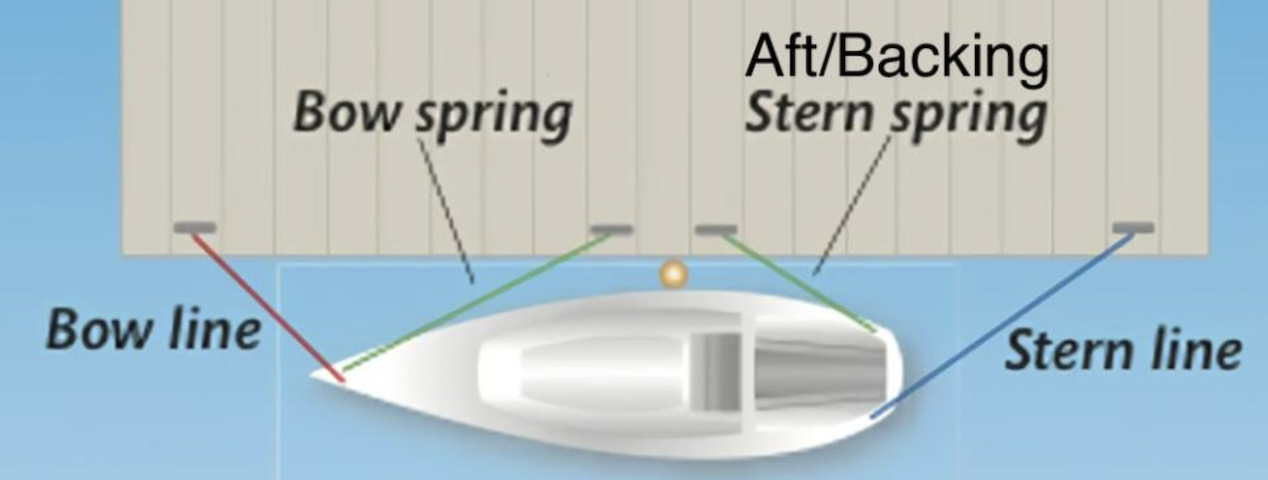
 Okay, let’s start with a few basics for terminology. You have bow lines and stern lines, and occasionally a “Spring Line” which keeps the boat from moving forward or aft in the slip. Many of the boats I saw rubbing their bows did not have a spring line put up. This “Forward or Bow spring” should be running aft from the bow section of the boat to prevent it from moving forward, or a “Backing spring/Aft or Stern spring” if we want one going the other way to keep the stern from hitting something. Most of our boats are short on cleats, so springs sometimes must run across the varnish work to get a lead that works. I bought some fuzzy seat belt protectors that work well to pad the line where it might rub on the varnish. Spring lines can also be helpful when trying to get off the dock on a windy day. You can carefully work against these lines to move the stern away from the dock, or back against a stern spring line to “pop” the bow of the boat off the dock. One thing to consider is to “double-up” the line so that it is secured on both ends to your boat, and only one wrap on the cleat (looped). With this method, you can release your boat without stepping on the dock. Flip it off the cleat or let it run through around the cleat, then pull it in.
Now let’s talk about a few knots that might be helpful: the Bowline, Clove Hitch, Square Knot, and Cleat Hitch. IMHO, these are the most common that we use on our boats. As my good friend Dave Lyon tells me, this is “Magic”.
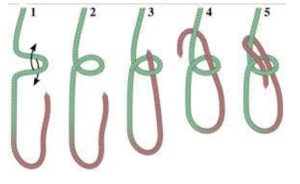
THE BOWLINE:
This knot is used to make a loop in a line or to secure on something like a lifting ring or ring on the dock.
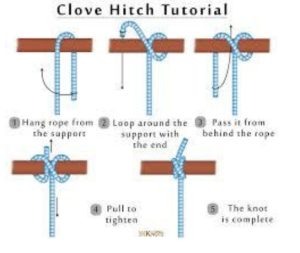 THE CLOVE HITCH:
This knot is used to secure a line to a pipe or piling; it is beneficial when you need to tie off to the piling on the dock if the cleat is broken or in the wrong spot. At the Concours last weekend, there were several boats that could have benefited from securing to the pilings using this knot.
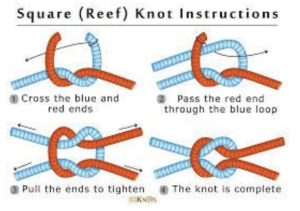 THE SQUARE KNOT:
This knot is used to tie two lines together. This one comes in handy when your line is too short or you need to tow a friend (like me) back to the dock and need more length.
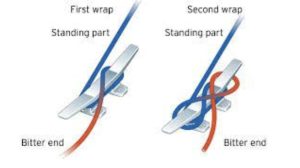 THE CLEAT HITCH:
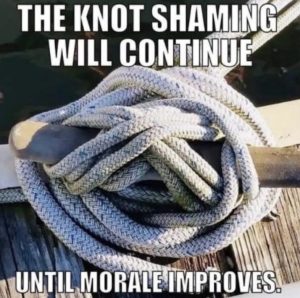
Okay, folks, this is my biggest Pet Peeve. It drives me crazy when I walk around and see the carnage on the cleats! This knot is effortless and makes sense when you look at it closely. The top line will lock down on the others to prevent them from slipping. From your boat, look at the cleat and the line should be run so that the first thing it touches is the underside of the furthest horn of the cleat from your boat tie-off point.
Now it is time to practice. Here is to another great year of ACBS safe boating.
Originally printed in the spring-summer 2025 issue of the NorCal/Lake Tahoe Chapter newsletter, Western Wood.
Good morning,
You and I are kindred spirits. Nothing is more aggravating than to see someone tie off an expensive boat incorrectly, and leave it thinking that it is secure. I cannot help myself, I always tie it correctly so the boat is secure for the owner and stops it from harming other boats as well. The knots shown here are probably used most if you are a good skipper!
Thank you! I agree, a bad cleat hitch drives me crazy too! I was in the Coast Guard, Search and Rescue, and we HAD to tie that cleat hitch the same way all the time. Odds were, you were not the next guy to try to unravel some spaghetti while we are waiting to rescue someone!
Thanks Mark!