
by Jane Larson with Gary Berg, Glacier Lakes Chapter
When the Chesapeake Bay Chapter invited me to present two seminars at its Antique & Classic Boat Festival, Gary and I couldn’t pass up the opportunity to experience another ACBS chapter’s boat show. We left Wisconsin Wednesday, June 17, for St. Michaels, Maryland, and spent much of the day watching tornado-producing storms in our rearview mirror as we continued east. Let’s just say it made for fewer rest stops. The storms finally caught up with us overnight in Ohio, but by Thursday evening we had arrived in St. Michaels.
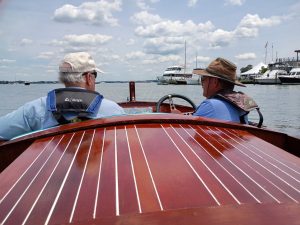
Out for a cruise.
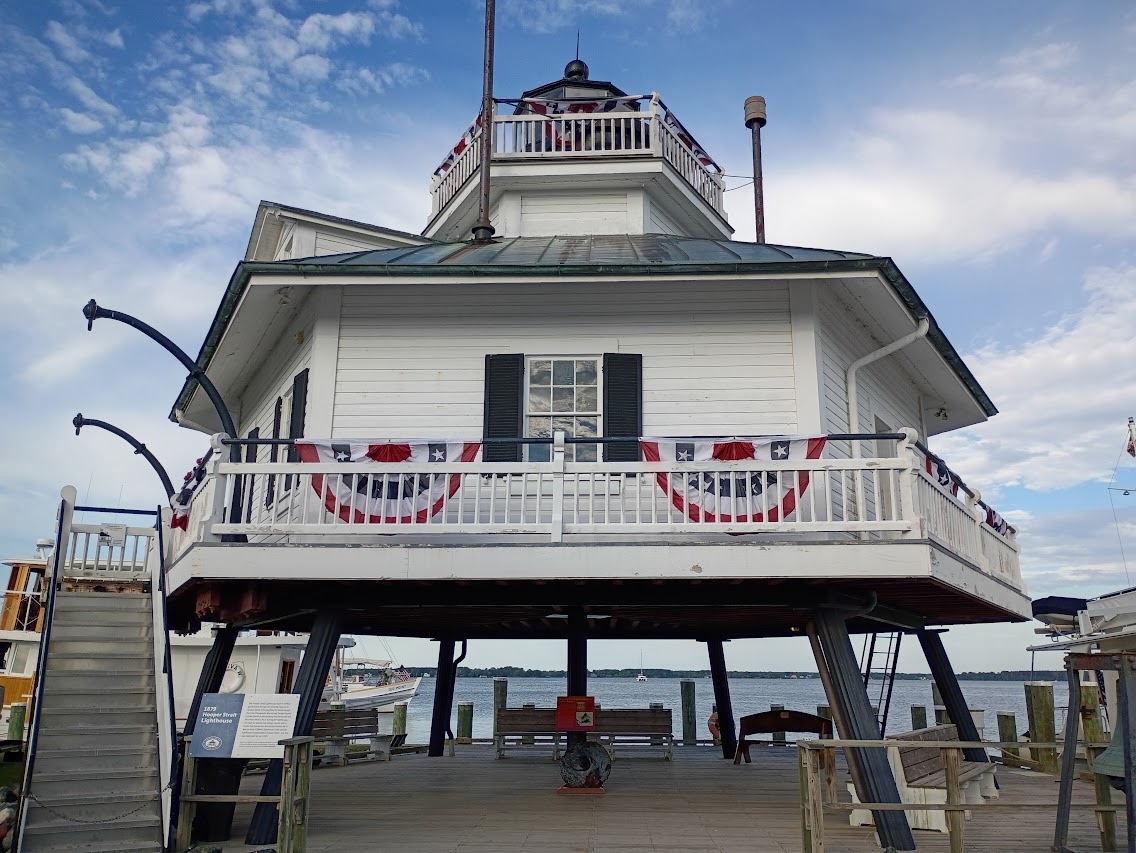
The Chesapeake Bay Chapter’s 38th Antique & Classic Boat Festival was scheduled for June 19–21 at the Chesapeake Bay Maritime Museum. Curious to see where we were supposed to be the next morning, Gary and I headed to the museum Thursday evening.
Our first look at the show was a little surreal.
The museum had closed for the day and the show didn’t officially begin until Friday. The tents were up. Signs were hung. Classic boats sat on the grounds and filled the docks. A few buildings stood open.
And there wasn’t a soul in sight.
We wandered around wondering whether we were even supposed to be there. It felt a little like we’d walked onto a movie set after everyone had gone home for the night. Eventually, we found two men setting up audio equipment who assured us we were fine, welcomed us and gave us the lay of the land.
By the next morning, that strangely quiet museum had come to life.
The sun was out, the weather was warm and a little humid—but surprisingly pleasant for Maryland in June—and a breeze off the water kept things comfortable. Boats, owners, vendors and visitors now filled the grounds we had wandered almost alone the night before.
And there were boats. Lots of boats.
This year’s theme was “Boats from Michigan and the Midwest,” which explains how two people from Wisconsin ended up in Maryland.
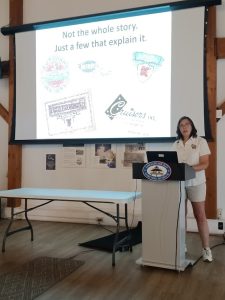
Jane Larson presents “Honey, I Got This.”
Many of the smaller boats were familiar friends—Chris-Crafts, Gar Woods, Lymans, Cruisers and others we regularly see at Midwest shows. But there was also an impressive collection of large cruisers and houseboats.
It was hard to miss the P-520, the massive wooden World War II military crash rescue boat. Equally hard to overlook was MAR-SUE, a 67-foot houseboat built in 1915.
Friday morning, I presented the women-only boating seminar “Honey, I’ve Got This!” Some of you have heard me talk about it. No boys allowed, which meant Gary was on his own for the morning. He apparently made good use of his time. While I talked about dock lines, safety equipment and boating emergencies, Gary found his way aboard MAR-SUE, where he spent time exploring the boat and visiting with her owners.
Friday afternoon we finally had a chance to get out on Chesapeake Bay.
A fleet of classic boats headed out for the Wye Island cruise, and Gary and I were lucky enough to ride aboard Moby Dick, a 1966 28-foot Marinette family cruiser (houseboat). We passed waterfront homes and watched for wildlife as we cruised the Bay. At one sprawling estate, a herd of black sheep was busily “mowing” the lawn. I’m not sure they were part of the official tour, but they were memorable.
That evening, boat owners and registered participants gathered for the Captains Party. There was food, music, a little dancing and plenty of time to visit. The silent auction also began Friday evening and continued throughout the weekend.
By Saturday morning, the festival was in full swing.
There always seemed to be something happening somewhere on the museum grounds. Kids built wooden paddleboats and sailboats, wandered the show on a scavenger hunt or tried their hand at Junior Judging. Artists and vendors filled parts of the grounds. There was a nautical flea market, a Field of Dreams for boats for sale and even a “Fishmobile” filled with living creatures typically found in Chesapeake Bay.
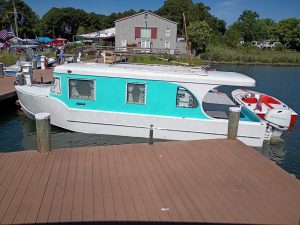
Bob and Alicia Boardman’s Moby Dick.
Larger boats welcomed visitors aboard, and owners seemed genuinely happy to answer questions and show people around.
Ask a question about a boat and faces lit up. Restoration stories were told, hatches opened and invitations to come aboard quickly followed. There was an unmistakable pride in the boats and, more importantly, a genuine love for them.
That felt very familiar.
So did the interest in boating history. Eight Boating History Talks took place Friday and Saturday, with this year’s topics focused primarily on boats and boating companies from the Midwest.
My Saturday seminar was quite a change from Friday’s. “From Ice Cream to Horsepower” explored the quirky beginnings, big personalities and stories behind Wisconsin’s boating legacy, touching on Evinrude, Kiekhaefer, the Thompson family and many other boat builders and outboard pioneers.
I’ll be honest. I wasn’t sure how a seminar about Wisconsin boat builders and outboard motors would play in Maryland!
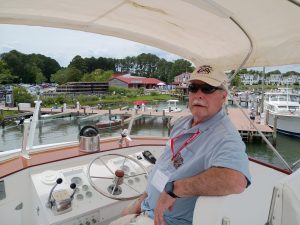
Gary Berg enjoys the ACBS Chesapeake Bay Chapter show in St. Michael’s, Maryland.
It played very well.
The room was full, people laughed in the right places and, perhaps best of all, several people told me afterward they had no idea Wisconsin played such a large role in boating history. One self-proclaimed “Doubting Thomas” admitted he hadn’t expected much from the topic—and then proceeded to gush about the presentation.
I’ll take that as a compliment!
Later, Gary and I climbed aboard a 1941 Century Utility for one of the chapter’s free boat rides. With the sun shining, a breeze coming across the water and a classic wooden boat underneath us, it was pretty hard not to grin.
Somewhere between the boats, seminars and boat rides, we also managed to explore the Chesapeake Bay Maritime Museum itself.
The museum is far more than a backdrop for the show. Maritime history surrounds you as you walk the grounds, and we were particularly impressed with the hands-on exhibits. In the crabbing shack, visitors could actually try their hand at snagging a crab from the water with a traditional crabbing tool. The Watermen’s Wharf exhibit gave us a glimpse into the lives and work of the men and women who made their living on Chesapeake Bay.
We quickly realized the museum itself deserved far more time than we had given it.
Sunday brought the festival’s awards luncheon and a chance to recognize some of the weekend’s standout boats.
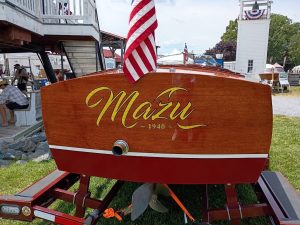
Mazu won People’s Choice award.
The P-520 received the American Heritage Award, while MAR-SUE received the Spirit of the Show Award. A 1940 Gar Wood Vacationer named MAZU won People’s Choice for the second year in a row.
Best of Show went to something completely different—a beautiful 56-foot 1934 William Hand Jr. sailboat named STEADFAST. Even surrounded by more than 100 boats, she stood out.
As the weekend wound down, Gary and I kept coming back to the sheer amount of activity packed into the three-day festival.
The Chesapeake Bay Chapter currently has just over 200 members—only about 30 more than Glacier Lakes. Yet the size of the show, the number of activities and the amount of member involvement were impressive.
Much of the credit for keeping all those moving parts together goes to Festival Chair Kathy Jones. Having helped with our own chapter’s boat shows over the years, Gary and I know enough to recognize the enormous amount of work happening behind the scenes. Members staffed the hospitality tent and Ship’s Store, organized boat rides, helped with children’s activities, judged boats, coordinated vendors and handled the countless jobs most visitors never notice.
Kathy frequently reminds her members, “It Takes a Village.”
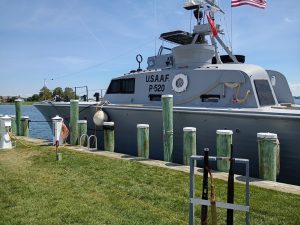
P-520, the massive wooden World War II military crash rescue boat.
She’s right.
St. Michaels itself was also part of the experience. The quaint Eastern Shore town very much feels like a summer destination. After long days at the show, we enjoyed dinners on outdoor patios and the relaxed atmosphere of a town surrounded by boats and water.
We went to St. Michaels because I had been invited to give two seminars. We came home talking about the boats, the museum, cruising Chesapeake Bay, a herd of lawn-mowing sheep and, most of all, the people.
Travel halfway across the country, walk into a boat show where you know almost no one, start talking about old boats—and somehow you are among friends.
That, perhaps, was the most familiar thing of all.