By Jeff Waco, Rocky Mountain Classics
The magnetic compass is basically standard equipment on most boats both large and small. What does a compass do? Almost nothing. Basically, it is nothing more than a disc with some magnets. On the disc are the cardinal directions and degrees. Older compasses did not have degrees, but it was labeled with points such as SSW, NNE etc.
 We use the compass to find out where we are in conjunction with a navigational chart. The compass always points to north, and the boat revolves around the compass card.
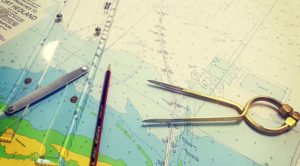
In order to navigate from point A to Point B we plot a course on the chart to True. We later convert this to Compass. We use dividers to get the actual direction of our course from the compass rose and then we convert. From True we either add or subtract the e compass variation, which is printed on the compass rose. That will give us the magnetic heading which we would use to follow our course.
We are not finished yet.
There might be deviation which is pulling the compass off a bit. Of course, you have a deviation chart which you can either add or subtract this anomaly. That will give you the compass course to steer by.
It is more complicated to explain than to do. Or you can just turn on your GPS and follow what the GPS tells you. What happens if you have a power failure? You are screwed if you don’t know what to do.

I always carried a compass on my dinghy when I went gunkholing. You never know when things might change. Fog or other weather conditions which impair your visibility to find your way back. It happened to me.
GUNKHOLING
 What the heck is “Gunkholing,” you may ask? I had to look it up: Gunkholing is the art of exploring shallow, secluded waterways and coves by boat, often anchoring in these quiet spots to relax or find a scenic
stopover. It’s a type of cruising that involves navigating narrow inlets and hidden places that are inaccessible to larger vessels, focusing on the slower, more adventurous side of boating. The term comes from “gunk,” which refers to the mud or silt found in these areas, and the goal is to find the perfect, protected “gunkhole” to drop anchor and enjoy.