
By Brian Thalhammer
Sponsored Content
Few endeavors feel more tied to the eternal dialog between man and the sea than restoring a wooden boat. Maybe it’s the aroma of varnished mahogany in a warm workshop, the glimmer of chrome beneath marina lights, or the moment an old inboard awakens from decades of silence with a murmur that feels almost primordial. Whatever the reason, restorers understand the pursuit is never simply about repairing a boat—it’s about preserving craftsmanship, storytelling and a uniquely American chapter of nautical history.
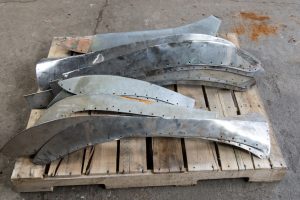 The ancient Greeks understood this relationship between mankind and water deeply. To them, the sea was never just geography. It was consciousness, temperament and divinity itself. Homer repeatedly called it the “wine-dark sea,” not because the water resembled wine literally, but because the ocean possessed mystery, volatility and depth beyond mortal comprehension. In Greek thought, sailors never conquered the sea; they survived through temporary negotiation with it. They respected it, and survival depended upon reverence and humility. In many ways, wooden boat restoration carries that same philosophy today.
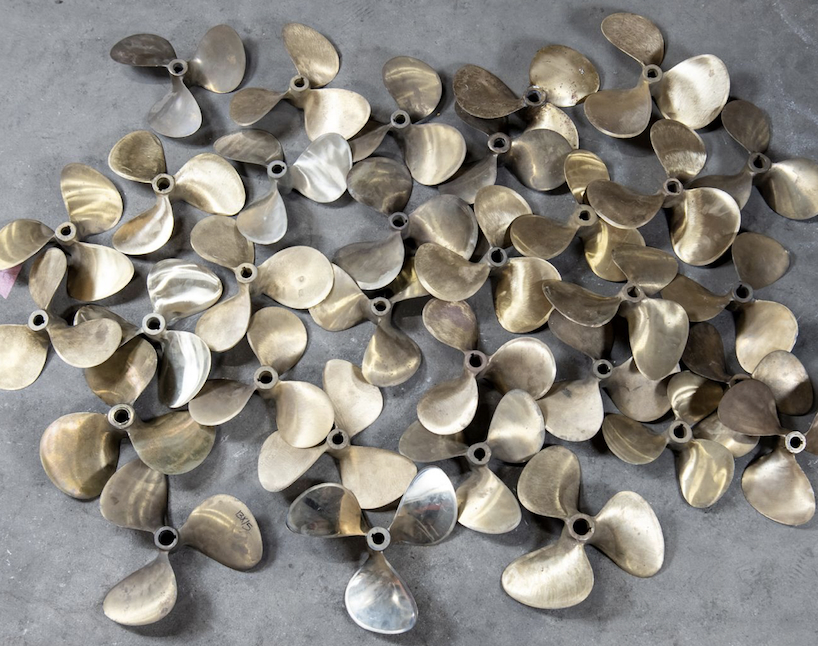
That is what makes The American Wooden Boat Restoration Collection: Parts & Accessories auction—presented by Mecum On Time®—so compelling. It is a preservation of nautical lineage, offering nearly 5,000 rare parts and artifacts—many increasingly difficult to source as original hardware disappears into completed restorations and private collections. For anyone who has stood before a boat wondering whether the final missing component would ever surface, this collection feels almost Nereid-like in nature: forgotten treasures rising once more from the depths.
Highlights From the Collection
The evolution of American wooden boat styling throughout the 20th century mirrors shifting eras of maritime mythology. Early prewar boats possessed an almost Apollonian elegance—clean curvature, balanced proportions and restrained simplicity. Postwar builders like Chris-Craft and Century, however, embraced chrome-heavy styling and dramatic flair that reflected America’s postwar optimism. If the earlier boats resembled stoic temple architecture, these later runabouts became more like the chariot of Helios: polished, radiant and impossible to ignore on open water. That transformation is vividly represented throughout this remarkable assemblage.
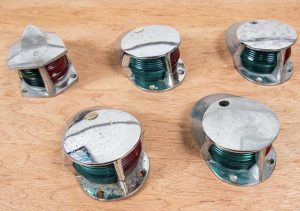 Consider the Attwood Marine Bow Navigation Lights. Their teardrop-shaped chrome housings embody the streamlined confidence of midcentury marine design, but they also symbolize something older and more elemental. In Greek mythology, light upon the sea represented survival itself. The Dioscuri—Castor and Pollux, divine patrons of sailors—were believed to appear during storms as St. Elmo’s fire, the luminous glow upon ship masts said to signal divine protection at sea. Navigation lights like these carry echoes of that ancient maritime instinct. Long before GPS or radar, illumination upon dark water meant orientation against chaos.
The same philosophical weight applies to the prewar through 1960s windscreen latches, steering wheels and columns and the exceptional assortment of Chris-Craft gauges. To outsiders, these may appear as isolated mechanical leftovers. To restorers, however, they function more like textual fragments from a partially lost epic. Every original gauge face, chrome bezel and authentic latch restores continuity to a vessel’s historical narrative. Much like the fragmented epics preserved through centuries of copying and retelling, antique boating survives piece by piece, detail by detail.
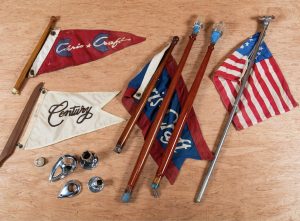 Then there are the objects whose rarity approaches the realm of mythology itself. The mahogany lighted flagpoles, mounting bases and pennant flags evoke ceremonial traditions as old as seafaring civilization. Many archaic triremes carried painted eyes near their bows, unique symbolic guardians intended to help ships “see” across uncertain waters. Maritime identity mattered deeply, and ships carried symbolism, lineage and civic pride. In postwar America, Chris-Craft and Century pennants fulfilled a similar role. They transformed boats into personal standards—floating declarations of individuality and aspiration.
Likewise, the porthole windows, complete with wooden frames, brass rims and hinged glass, recall an older maritime intimacy with the sea itself. Greek literature frequently portrayed windows, thresholds and harbors as liminal spaces—boundaries between safety and uncertainty, civilization and wilderness. Looking through an original brass-rimmed porthole aboard a restored woody still feels strangely liminal even today.
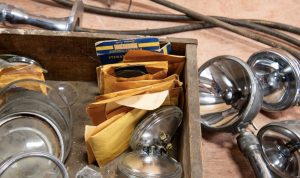 Even the collection’s more obscure offerings harbor narratives worthy of excavation. Bow-mount spotlights and replacement glass lenses harken back to a period when nighttime cruising possessed genuine mystique. Ancient sailors feared open water after dark because visibility collapsed into uncertainty; sea travel at night belonged to mythic wanderers like Odysseus, perpetually navigating between danger and revelation. Midcentury boating retained traces of that atmosphere. Before overdeveloped shorelines and digital instrumentation, cruising beneath darkness still harbored romance and unpredictability.
Memorabilia and More
Perhaps nowhere is the emotional resonance of this collection more apparent than within its memorabilia offerings. Vintage marine advertising has transcended commerce entirely to become cultural iconography. Framed Chris-Craft and Century advertising prints depict polished mahogany runabouts gliding across mirror-like lakes beneath impossibly radiant skies. Their imagery resembles what the Greeks called “nostos”—the deep emotional longing for home after a voyage. These advertisements did not only help sell boats; they sold return: return to family, leisure and to tranquility after war and industrialization reshaped American life.
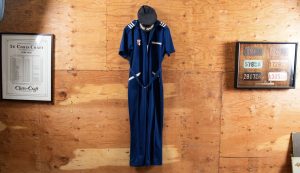 Even the Chris-Craft jumpsuit and captain’s hat ensemble reveals something profoundly human. Greek mythology unfailingly celebrated not gods alone, but craftsmen like Daedalus, Hephaestus and the anonymous shipwrights who enabled exploration itself. Restoration culture preserves that same respect for skilled hands; every finished woody exists because someone cared enough to rebuild what others abandoned.
These are artifacts from an era when American boatbuilders fused artistry, engineering and ambition in ways that still fascinate enthusiasts today. As original nautical components disappear over time, opportunities like The American Wooden Boat Restoration Collection: Parts & Accessories auction become vital to preserving this maritime heritage.
For seasoned restorers, this Mecum On Time event may reveal the final piece needed to complete a lifelong project. For newcomers, it may mark the beginning of an odyssey entirely their own.