

by Alan E. Dinn, Historian, Purdy Boat Company
The Purdy Boat Company was created in 1916 by Carl Graham Fisher of Indiana. Fisher was an automobile- and boat racing enthusiast, and a co-founder of the Indianapolis Speedway. Fisher had known and admired brothers Ned and Gil Purdy when he had bought boats they had designed and built at Consolidated Shipbuilding of Morris Heights, NY, where Ned was shop foreman and Gil was chief designer. He hired them and set them up as their own company with Ned as president and Gil as vice president.
The Purdys began building their first boats in Fisher’s shop at the Speedway before moving the boats and their shop to Miami Beach, Florida, in late 1916. They moved to Trenton, Michigan, in 1919, and from there to Port Washington, New York, in 1925. The firm was among the most famous racing boat and custom yacht producers during the 1920s and 1930s. The name evokes a bygone era of magnificent custom-designed boats. Many prominent owners had Purdy boats, including Walter P. Chrysler, who had 10, and Carl Fisher, who had 27! Their clientele also included Harold Stirling Vanderbilt, Rodman Wanamaker, Caleb Bragg, auto magnate Henry Joy (Packard), and many more.
 Two of their race boats won the prestigious APBA Gold Cup, and others competed for the Gold Cup, National Sweepstakes, and other trophies. One of their “Biscayne Baby” racing runabouts was owned for a time by famous British auto and boat racer Major H.O.D. Segrave and later by Lawrence of Arabia. Their most famous yacht, the 74-foot power cruiser Aphrodite, had a passenger list including Fred Astaire, Sir Laurence Olivier, Catherine Hepburn, Spencer Tracy, Henry Ford II, Shirley Temple, and Nelson Rockefeller.
Of the more than 300 boats designed and/or built by the firm, only a few remain. One ended its days as a training ship in the Venezuelan Navy. Another carried bananas from Central America to Florida until it struck a reef off Cozumel. Many were sunk, several were destroyed in a 1935 explosion/fire in a Florida yacht basin, some were used during World War II and abandoned at the end of the war, and more than a few disappeared from public records. Survivors include the 1929 Gold Cup champion Imp II, the 1930 step-hydroplane runabout Wyndcrest, the 1937 yacht Aphrodite (though some argue that this is a replica), and several Purdy-designed “Sea Lyons.”
The oldest survivor, the 1919 cruiser Altonia (now known as Zipper II) languishes in a Florida warehouse and has not been afloat for many years. The second oldest is Ebisu.
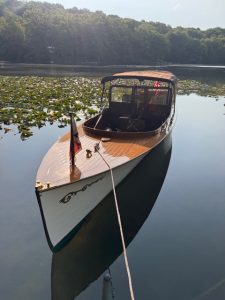
Ebisu (named for the Japanese goddess of fishermen) is the only Michigan-built Purdy known to exist, and the oldest that is still in use. It was designed as a fishing boat in the fall of 1923 for Trenton businessman Austin Church and delivered to him in the spring of 1924. Mr. Church’s primary business was the Church & Dwight Company (Arm & Hammer baking soda); born in Brooklyn, NY, in 1871, he came to Michigan in the early 1890s to manage the family’s holdings in the Sibley limestone quarry in north Trenton (the limestone was used in baking soda production). He also had a boatbuilding shop near the quarry and offered the use of his shop to the Purdys when they came to Trenton; the first Purdy yachts designed in Trenton showed Sibley as the location on their blueprints.
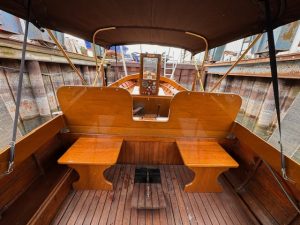 Ebisu is an open-cockpit boat, 25 feet in length, with a beam of 6 feet, and a draft of 1 foot, 8 inches. The hull is constructed of cypress and the deck is butternut. It shows many of the design features of much larger Purdy yachts, from its plumb bow to its plumb rounded stern (the latter a feature that Gil Purdy had developed while at Consolidated), joined by a hull with a sweeping sheerline more common in sailboats and a noticeable tumblehome toward the stern. A unique feature includes two “live wells” under the center pilot seats.
Mr. Church always drove Packard cars and was impressed by the reliability of their engines, so he had a 45 hp 6-cylinder Packard installed in the boat. Although it was the smallest Packard marine engine available, it was too large for Ebisu and the boat was later reengined with a 60 hp Chris-Craft Hercules Flathead 4.
From the beginning, Mr. Church kept Ebisu at the Old Club at the tip of the South Channel of Harsens Island, in the St. Clair Flats of the St. Clair River, the world’s largest freshwater delta. After Mr. Church’s death, the boat was later owned by two priests, Father Hardy in the 1960s and Father Shannon in the 1970s.
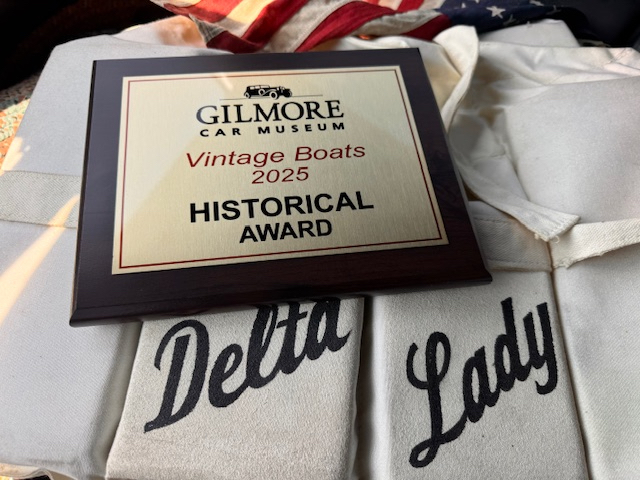
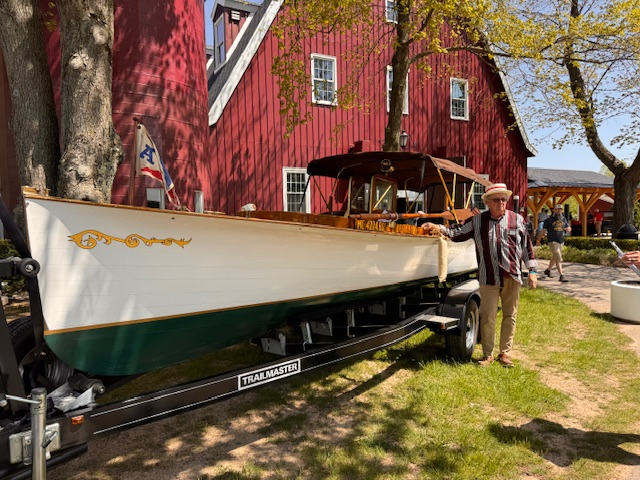
In 1982, wooden boat enthusiast Jack Teetor purchased Ebisu from Father Shannon and renamed the boat Delta Lady. He had the boat restored in the mid-1980s by Tom Cuthbertson and Alan Mackie of Algonac. In approximately 2009, Sid Brown purchased the boat and enjoyed ownership through 2023.
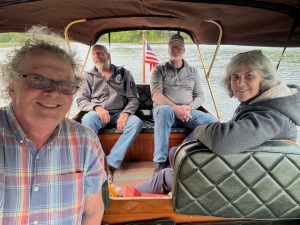 In 2025, David Irvine became Ebisu’s new caretaker. He brought it to western Michigan to use it regularly and share its history and beauty with a new generation of wooden boat enthusiasts.
Mr. Dinn is a grandson of Ned Purdy. He is the author of two books, Boats by Purdy (Tiller, 2003) and The Many Lives of Aphrodite (Trafford, 2010), and has written articles about the Purdys and their boats for WoodenBoat and Classic Boating magazines.
Some really great local Michigan marine history. Great story!
Great story,thanks she is a beaut!
Very interesting. Especially the links to Trenton. It has a great new caretaker.
Brock….Free boat rides this summer!!! Hope to see you at Gun/Gull Lake (MI), Lake James, Lake Leelenau, and / or the Les Cheneaux Islands.
See below web link for videos/more information:
http://www.runaboutrenaissance.com