

Christopher Columbus Smith celebrated a birthday today. This founder and namesake of the iconic brand Chris-Craft still today captivates devotees. With well over 3,000 Chris-Crafts spanning the decades in the ACBS membership, and a close connection to the Chris-Craft Antique Boat Club,, what better time to revisit a favorite story from the winter 2013 issue of ACBS Rudder?
Chris-Craft Corporation, The Back Story
By Wilson Wright
Christopher Columbus Smith, a native of St. Clair County, Michigan, was born just as the U.S. Civil War began in 1861. His parents moved to Algonac in 1868, a town that later became home to a great boat company. Algonac is located about fifty miles north of Detroit on the western shore of the St. Clair River.
Older brother Henry was a talented fisherman and duck hunter; he taught young Chris how to hunt, fish, and make decoys. Although not proven, it is alleged that Chris carved his first boat at age eleven.
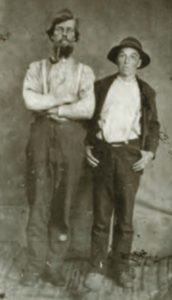
Henry and Christopher Columbus Smith
Together, the boys established a successful commercial duck hunting operation to supply the resort hotels of the area and some in Detroit. To accomplish this, they built a couple of boats—aptly described as “sink boxes”—literally designed to sit low in the water like floating duck blinds. In these boats, the boys would set out a couple hundred decoys, then when the live birds settled in, they would start firing. Supposedly, Chris
could get half a dozen birds before they even began to take off. To have a good week they needed 700 to 800 ducks. Back then there was no hunting season, although fall was best for them.
Around 1874, Chris and Hank built their first real rowboat; Chris would have been thirteen. These suited their duck hunting needs better than the sink boxes. In fact Smith rowboats became so popular during the next several years, the boys were kept busy building boats for sale to others. An 1899 edition of the Algonac Courier described Chris (now 38) and H.M. Smith as the oldest boat builders in Algonac and added, “A boat with the Smith brothers’ mark means style, stability, swiftness and safety.”
In the early 1900s, Chris and Henry apparently went their separate ways, because the company changed its name from Smith Bros. Boat Builders to C.C. Smith Boat builder. Later, this became Chris Smith & Co. Boat Builder and Boat Livery, as Smith continued to tinker with gasoline engines and faster hulls. In 1905 he hired Nap Lisee, an experienced woodworker and wood turner who would prove seminal to Smith’s success.
This was also about the time that A. J. “Baldy” Ryan moved into the Algonac area. A flashy, diamond-studded gambler, he wanted the fastest boat in town and quickly sought out Smith, who built him two 28-footers Reliance and Reliance II. The latter achieved thirty-three miles an hour!
By now, Smith had a successful boatbuilding business, but with Ryan’s financial backing he was able to expand his market. It was one of only four times Smith would accept help from an outside investor. Smith again changed the name of the company, this time to Smith-Ryan Boat Company. The company could market both 25- and 33-foot models at prices cheaper than East Coast competitors.
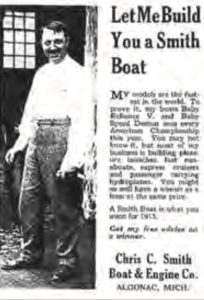 Smith was always interested in speed; after observing water bugs skim on top of the water, he studied the hydroplane concept, determining that a step in the bottom of the hull would lift part of the boat out of the water, thus reducing surface drag. Through experiment and trial and error alone, Smith determined exactly where to place a step for peak performance, which he did in Reliance III and Baby Reliance IV. These ultimately beat international competitors to win races in St. Louis and the 1910 National Motorboat race in New York. This followed Smith’s offering of a 29-foot, single-step hydro at the 1910 New York Boat show. His charge: $100 per mile, or $3,500 for a boat that would achieve 35 miles per hour.
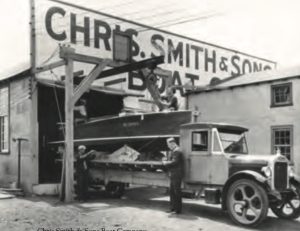 With some tinkering with engines to lighten them—and new “step” hulls—20- foot Baby Reliance II and 26-foot Baby Reliance III achieved 40-plus miles an hour in 1911. To reflect this engine development, the company name was again changed, this time to Smith-Ryan Boat and Engine Company. Even higher speeds were recorded in the next year, but the 20-foot Smith-built boat lost out to a larger English competitor in the rough seas that served as a course for the international Harmsworth trophy, the America’s Cup of motor boat racing.
After eight years, the Smith-Ryan partnership was dissolved in September 1913 and the company name again changed to C.C. Smith Boat and Engine Company. In 1914 Baby Reliance III would capture the coveted Gold Cup.
With Ryan and other financial backers out of the picture in 1915, a 53-year-old Smith organized a foundation to build Miss Detroit, which won the Gold Cup race that year, averaging 48.5 miles per hour. The win caused one writer to proclaim Smith as “The Wizard of Algonac.” Unfortunately—and much to Smith’s surprise—his influential backers were never able to completely pay for Miss Detroit.
The following year a group formed to build Miss Minneapolis, another 20-foot, single-step hydro that won the 1916 Gold Cup race on the Detroit River averaging more than 61 mph; it was the first boat to break the mile-a-minute barrier. Meanwhile, last year’s winner, the still unfinanced, Miss Detroit was sold to a wealthy 35-year-old named Garfield Arthur Wood.
Wood got into racing quite accidentally while observing a race in Dubuque, Iowa. An owner was having difficulty with an engine, and Wood offered to help. When Wood finally got the engine running, the race had started, and Wood—dressed in his Sunday best—found himself part of the winning racing team. From that moment on, he was hooked on boat racing.
Great story. Chris Smith and Gar Wood were the founders of the speed boat industry. They were great men, innovators and true “Legends of Algonac”!