
By Robert Charron, 1000 Islands Chapter
In the summers of the early 1950s I explored the shores of interconnected lakes and streams in the Allagash region of northern Maine. I came upon a new Chris-Craft runabout and was totally mesmerized by its sleek design and gleaming mahogany. How was I to know this enchanted vision would change my life?

Peter, left, Robert (aka Bob} and their mom on the Oswegatchie Crescent Park.
A few years later we moved to Ogdensburg, NY, where the Oswegatchie River joins the mighty St. Lawrence. My captivation with boats continued as more fascination was waiting to be discovered. Exploring local waterfronts was vastly entertaining.
I realized that I needed a boat. But how was this to be done? My mother was a winner of the State of Maine fly fishing championship and fly fishing from a boat was not practical. Dad witnessed a waterfront tragedy and was not comfortable being on the water.
In the summer of my ninth year, a friend arrived towing a Radio Flyer red wagon filled with scrap boards leftover from his father’s construction project. He suggested building a tree house on the towering maple next to the sandbox. It was more than twice the height of our house with no lower branches that enabled us to climb to a desired height.
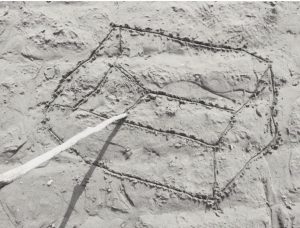 How about building a boat? Creating a pointed bow craft was way beyond our skills so we envisioned a square-shaped bow. My younger brother, Peter, jumped at the idea. Drawing lines in the sand, we settled on a design of something that resembled a rowing punt. We figured something about six or seven-feet long would accommodate a couple of us who were keen on exploring the area’s waterways.
We gathered hand tools and nails and began our project in earnest. Several hours later our boat was beginning to take shape. Although our craft didn’t exactly match the visions we had, we were still proud of our efforts. But, what should we do about the large gaps in the seams? Someone suggested caulk, but we had no idea what it was or where we could find some. Then the bright idea of nailing sheet metal to the hull popped up. Our neighbor arrived the next day with a roll of metal flashing in his Radio Flyer. We still felt we needed some caulk, but we were eager to launch our dream and go for a test ride; refinement would have to wait.
Rob Charron’s childhood drawing.
The boat needed to be tested and so did I. As we loaded the boat onto the Radio Flyer for a trip to the Oswegatchie shore, Mom said she would join us. We launched the boat from a seawall into a sluiceway next to the dam. Just as I was about to climb aboard, mom suggested we wait a moment to see how it would float. It didn’t. It sank in less than ten seconds!!!
We tried to fix mistakes but they made things worse. Wood is supposed to float and I thought we just needed calmer water. Peter said that would not work. I convinced him we should try at a local St. Lawrence River beach. The boat was waterlogged and it barely fit into the trunk of our Pontiac. He was correct. It sank faster this time! Peter, thanks for your wisdom.
POST SCRIPT
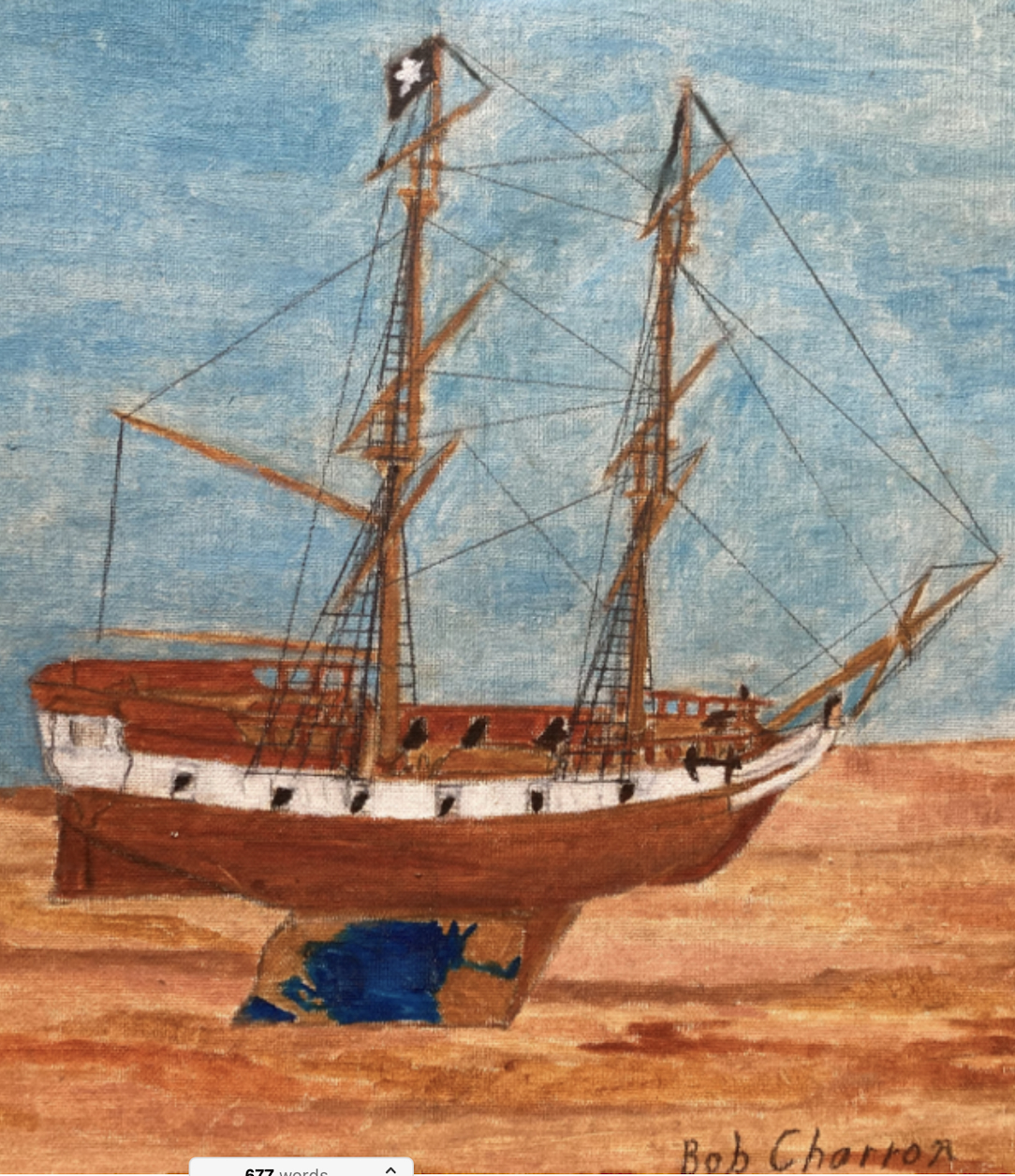
After the above misfortunes, my mother, a well-known artist, encouraged me to fill my dreams with drawing and oil painting boats large and small. The following painting of my pirate ship model sits on a wood tabletop and dates from around age eleven. By coincidence my grandson, Owen Spenser, also developed his artistic abilities around age 10.
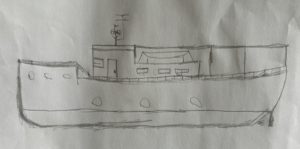
Owen Spenser’s drawing of Alexandria, a 1928 42-foot Elco on display at ABM.
The dream of someday owning a boat didn’t die on those summer days. Over the years I’ve owned a few boats, power and sail, and I think my C&C Corvette is the finest boat in its class. I’m content to enjoy her for years to come.