
by Lee Wangstad, BSLOL Chapter
It wasn’t just the 50s cultural revolution in America that brought style into the American consciousness. Towards the end of the second Industrial Revolution as the last gasps of the 19th century tapered to a halt, the early stages of the 20th century brought a new renaissance in just how objects would appeal to a higher order if presented in a fresh manner. By the early 20s, design, style, and art all melded together to became an important part of the American cultural scene.
Industrial designers were playing an increasingly prominent role in product design, all the way from the simplest electric toaster to streamlined steam locomotives. It was all in the name of better products for an increasingly sophisticated buying public. Sound familiar?

By the time that the enlightened fifties came to play, style was already playing a significant role in the marketing of American products. But the public was about to be bombarded with a whole new wave of technology, tuned in with years of wartime service and production. Drawing boards had not been idle for the entire War. In the background of war production, companies were preparing for war’s end with newly redesigned shapes and reconfigured products.
At first, anything would sell, backed by years of pent up demand for products that were not available or were considered an extravagance that we could and should be able to do without. But the country was coming out of not only World War II, but also the Great Depression, that had been still nagging at our heels at the beginning of the conflict in 1941. The war had a significant impact on the American economy as well as providing employment as hadn’t been seen in over a decade. Not that this was a particularly well-planned recovery; rather it came as a by-product of the world at turmoil.
 After the war, America went to work with a new zeal brought on by years of sacrifice, hardship, and loss. Education, brought forward by the GI Bill, and its monumental impact on our society played a major role in the development of a whole plethora of new, exciting, recreational products. With an increase in the average wage and the move towards a five-day workweek, Americans were looking for products to fill their leisure time as well as bring the family together. This set the stage for the fifties, the greatest time of all to come of age.
General Motors made headlines with their cars of the future and the grand Motorama displays at automobile shows around the country. This glimpse into the future drove the American public into a frenzy to buy anything new, modern, better than the rest. This new interest spilled over into every facet of American life. If there was anyone that wasn’t impacted by this new wave of consumerism, they must have been living on the moon.
Brooks Stevens even coined the term “planned obsolescence.” In his own words, this translates into “the desire to own something a little newer and a little better a little sooner than is necessary.” He even went so far as to state that the whole economy in the fifties was based on this principle. He probably had a greater impact on the marine marketplace than any other designer during that decade.
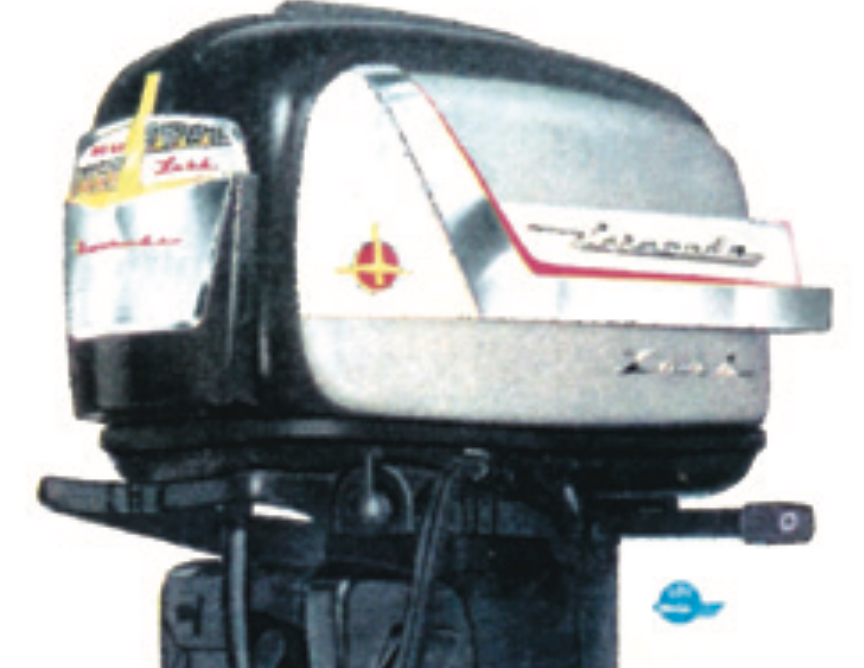
He brought new ideas, fresh concepts, a chart to take us to the future of the marine industry. Evinrude had hired Stevens as a style consultant in 1935. In 1936 Brooks Stevens Associates was also brought onboard to revamp the Johnson line, both major players in the Outboard Motor & Manufacturing Corporation (later to become OMC), the largest outboard conglomerate in the world. The executives at OMMC knew then that styling would come to play a significant role in outboard sales. Stevens penned the first fully enveloped motors for both Evinrude and Johnson.
As his work developed at OMC (the Johnson Javelin and Evinrude Lark come to mind), executives at OMC, along with Stevens, came up with the idea of a concept boat. The Motorama’s success for generating excitement at the automobile shows went without saying. OMC would put the same plan into effect to create this same level of enthusiasm in the marine marketplace, while Brooks Stevens was thrilled to introduce his brand of style in yet another venue. Stevens already had some history in the marine industry with the Globe Corporation, of Joliet, Illinois, on their line of astercraft boats. This was shortly after World War II had come to a close and the recreational boating revolution of the fifties was in its infancy.
 When Stevens was delving into the future, nothing stood in his way. His style was flamboyant, striking, thought-provoking. His work for OMC in 1955 would create a balance between these three elements, packaged into one boat and motor, each built to complement the other. It was a daunting task, as the motor would have to look fantastic on other boats as well. The amazing thing is that Brooks Stevens Associates would be working on so many other products simultaneously, each with its own specific brand and style.
When the OMC outboard motors for the 1956 model year first appeared in design sketches and in mock-up form, their working titles were the Johnson Javelin and the Evinrude Emperor. Later in 1955 the Evinrude’s top-of-the-line model became the Lark, a decision that would carry through for many years in Evinrude history. The Javelin nameplate would repeat for only two years, 1956 and 1957. These two models were meant strictly as top-shelf, dressed- to-the-nines, best-in-outboards. Many boat manufacturers produced advertisements with either the Javelin or Lark placed distinctly on the transom of their boats with the owners dressed in evening wear, ready for a gathering at the country club or polo match.
Brooks Stevens Associates had a number of specialty shops doing prototype work for them, most centered in the Milwaukee area. When the go-ahead came from the top level at OMC, Brooks Stevens contacted the Fedder-Carlson Corporation to build two boats to his new design. They were able to work with the talented designer as per his instructions as this would be essential towards meeting his very exacting goal. The boats wouldn’t just resemble his drawings; they would be correct down to the slightest detail.
Work began in mid-1955 on two mahogany planked hulls bought from Century boats. These were based on the 1955 Century Palomino/Pinto/Roan hull, although you could hardly tell by the time that Stevens was through giving them his complete analytical attention. These designs were anything but conventional. While all industrial designers worth their title were extravagant to some degree, Stevens had always managed to somehow go over the top when given a free hand to explore concepts that would be both new and daring. And daring this design was!
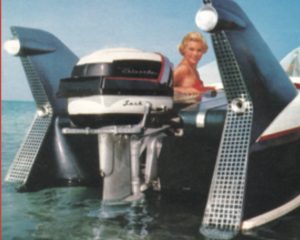 Conventional in the fact that it was pointy at the bow and wider and flatter at the stern, this is where the boat drifted from standard marine design practice. Mated to the mahogany planked hull was a fiberglass deck/cockpit piece that came right out of Buck Rogers. With twin, swept-back windscreens and aircraft pilot-type steerer, the two-bucket-seat interior came complete with black and white harlequin-style side panels. The stern was probably the most controversial part of the boat. Jutting upward from the gunnel were two fins, one on each side, very much resembling the tail fins on a jet aircraft. They had a reverse slant at the back where the fin met the water in what can only be described as totally off the charts. This stainless steel grate with red background coloring set the design years ahead of anything else on the planet. And it was all just for show. OMC, championed by the Brooks Stevens Associates Design Studio, had meant to shake up the industry, inspire new design trends, and lead the marine marketplace into unconventional ideas and unknown territories.
The unveiling would prove to be a master stroke of marketing. Introduced at the 46th National Motor Boat Show in New York City in January of 1956, it captured the imagination, and the headlines of not only the boating enthusiasts, but the general public as well. The Lark was positioned across the aisle from the Lone Star Meteor, another predecessor of things to come in the style-induced market of the late fifties. Together they would lead an industry into a styling revolution that would produce some of the best, as well as some of the worst, designs in marine history.
The Evinrude Lark was featured in photographic form in the business section of Newsweek magazine in January of 1956. It mentioned both the show and the appearance of both the Evinrude Lark and the Lone Star Meteor. It was not just publicity for the two companies, but for the entire marine industry as well.
The Evinrude Lark was so unique that Brooks Stevens obtained a patent on the design of the boat as assignor to Outboard Motor & Manufacturing Company filed on January 12, 1956, and granted on August 14, 1956. As planned, the boat was a tremendous asset to OMC, with full-color cover shots appearing on both Popular Boating as well as the April 1957 issue of Newsweek. The Newsweek cover was quite a coup, with an inside feature article entitled “Whippets on the Water” covering America’s infatuation with boating and the development of the outboard boating market.
 The Evinrude Lark boat was featured in full-color advertisements placed in all the boating magazines, showing off the Lark motor in all its glory. It also appeared in many other magazines as a new concept in boating design. Evinrude, along with Stevens, made the decision to allow “recognized boat build- ers” to use their ideas from this unique design. Over thirty-eight different build- ers chose to utilize one or more of the styling elements in their 1957 designs. Owens Yacht Company offered the Rocket, a model that closely followed the Lark styling theme, but softened some of the extreme elements. This collaboration with Owens led to Brooks Stevens Associ- ates designing the Cutter line of boats, the Owens brother’s foray into the world of fiber- glass outboard runabouts.
The Wagemaker Com- pany, builders of Wolverine Boats, would build a dupli- cate of the Evinrude Lark for the public market. Coming from its Cadillac Marine & Boat Company division, it was sold as the Cadillac Sea Lark, with an alter ego model, the Javelin, coming from Wolverine. Both of these boats used photography borrowed from OMC to promote their boats, differing in nameplate only. Using a molded hull from its U.S. Molded Shapes Division mated to a fiberglass deck, Wagemaker was hoping to cash in on the excitement that Evinrude had created the year before.
There were some compromises that had to be made to enable production. The original Evinrude Lark boats carried a price tag somewhere in the range of $11,000 in 1956 dollars. This wasn’t even close to what the market would bear. The Lone Star Meteor, while not quite as extravagant as the Lark, was listed at $1,595— including radio—at the 1956 New York Boat Show. According to the 1957 Cadillac price list, the Sea Lark would debut at $1,975 f.o.b. Cadillac, Michigan. You have to realize that after spending close to $2,000 for your Sea Lark, you still had to buy the motor and have it rigged. Also figure in the $50 packing fee. How about a trailer to go with it?
The Cadillac Sea Lark was labor intensive to produce. Those pieces made of stainless steel on the prototype boats were now made of fiberglass on the Sea Lark. Cadillac moved away from the aeronautical- style dashboard toward a more conventional marine instrumentation. Also gone was the two pod steerer, giving way to a round, off-the-shelf steering wheel. Driving the high cost of the Evinrude Lark were the custom touches by specialty craftsmen who were excellent (read well paid) in their fields. Standardization would be paramount in bringing the Sea Lark to market at an affordable price. The interior became more conventional (easier to produce, therefore less costly) with a bench seat as opposed to the twin buckets of the prototype.
 These changes in the production version of the Sea Lark didn’t necessarily water down the design, they just made it easier to produce. Gone was the “price-is-no-object” manner that prototypes were built under while still staying true to the original design from Brooks Stevens. I would imagine that there was some formal agreement stating that Wagemaker would not change any of the design details when the boat went into production. The Sea Lark was still a striking boat, even a full year after the Lark shocked the boating public. It still has the same impact today.
What is interesting to note here is that Wagemaker didn’t have much actual hands-on fiberglass production experience at this time. My assumption is that they were subcontracting these parts out or were getting their feet wet in an extreme fashion. One thing is certain: the Sea Lark didn’t invite large production numbers due to the intensity of the labor involved in its production. Also, the number of people that were willing to plunk down close to $2,000 for a two-seat outboard sports boat were few and far between.
Like other extreme boats marketed at that time, these models were introduced to create excitement in the showrooms. It was to bring customers in, ooohing and aaahing over these production “sports boats,” then sell them on a nice four- or six-seat runabout that they could get the whole family into. Much like the concept of the Corvette, everyone likes to come in and see them, kick the tires, maybe sit in them for a minute or two, then go home in an Impala, but continue to dream about the Corvette.
The Lark and Sea Lark boats have a certain mystique surrounding them. Certainly one of the rarest boats of its era, it continues to mesmerize those familiar with its futuristic design from the drawing board of a visionary with the stature that Brooks Stevens enjoyed. Planned obsolescence? Although he designed and built five more futuristic show boats in the ensuing years, none had the impact and staying power that envelops the Evinrude Lark and its derivatives.
The story was originally printed in the winter 2014 issue of ACBS Rudder. Special thanks to the Milwaukee Art Museum for use of the photos from the Brooks Stevens Archive. www.mam.org.
Lee, You did a good job in 2014 writing this, PLEASE let’s have some more of your work! Rerun the back page stories you wrote for the magazine! Robert Speltz made a good decision gifting you all his ’50’s & ’60’s stuff. ACBS should feature you as a speaker every year at the annual meeting and boat show, you are a talented, knowledgeable guy. Thank you!
Seconded 100%