
By Dan Arena, Northern California/Lake Tahoe Chapter
As the 1939 racing season neared its end, Dan Arena and Herb Mendelson continued their discussion about a proposed new boat for the Duesenberg W-24 engine. Dan wanted to build a larger three-point hull like the “Miss Golden Gate” that he raced the year before. He was convinced that a three-point hull would be THE race boat of the future.
 The first three-point style is actually credited to Adolph E. Apel in 1937 who owned Ventnor Boat Company. That boat was named “Juno”, and it won the President’s Cup Race in Washington D.C. running at 72.7 MPH. This was the same year that Dan paid Ventnor Boat Company for the rights to incorporate their patented sponson into his “Golden Gate II” design.
An agreement for a new boat was agreed upon between Dan and Mr. Mendelson by the finish of the last race when Dan took second at the President’s Cup. The designing progressed rapidly from this point. A young 22 year old Dan Arena, had his first professional contract to both design and build a Gold Cup Class race boat.
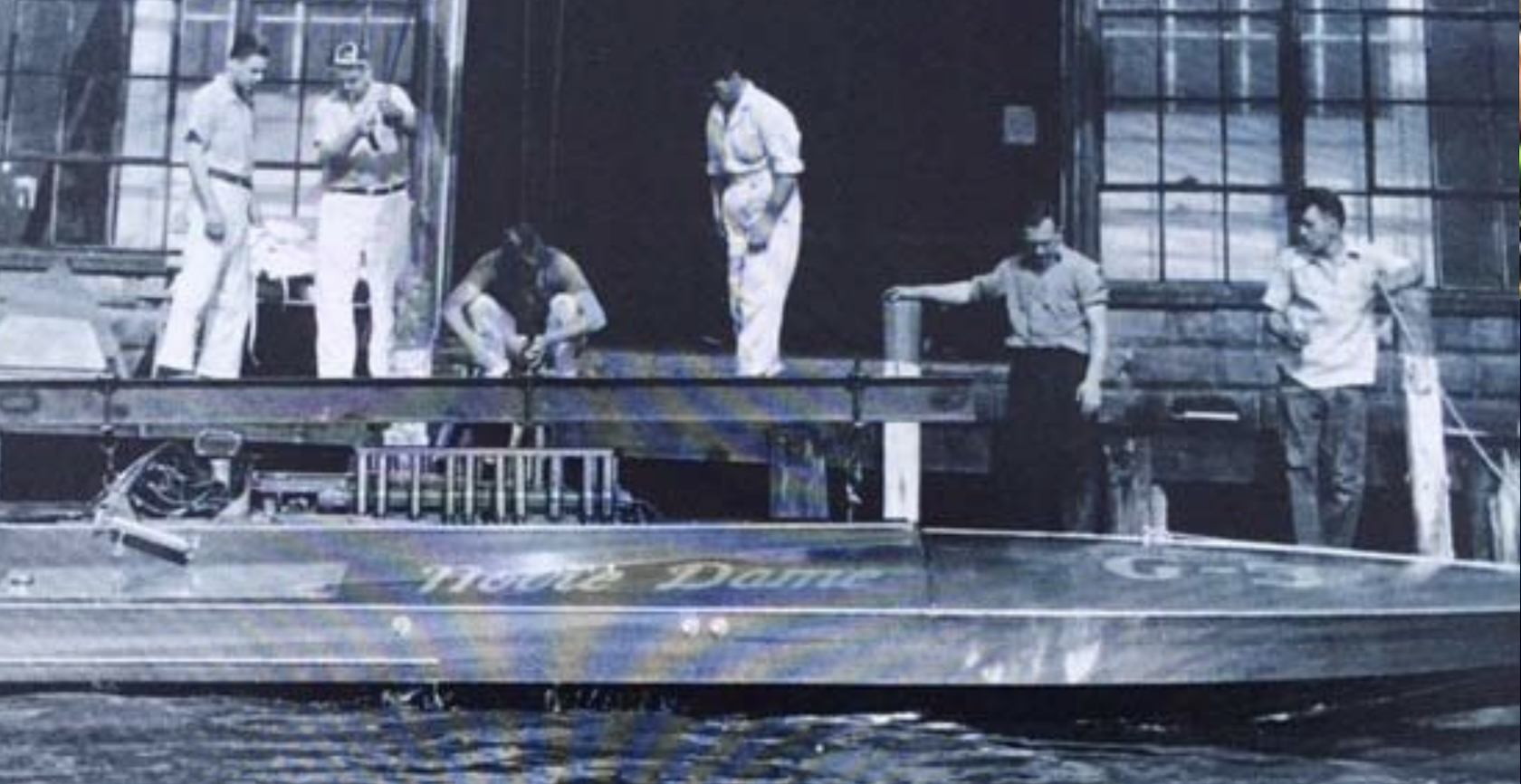
For a number of years while Dan built and raced boats, he continued his education using night school and correspondence classes to study towards his Marine Design Engineering Degree. In September of ’39 Dan was a full-time student at Westlawn School of Yacht Design in Montville, New Jersey, and he often commuted back and forth to Algonac, Michigan as the plans for the new boat progressed. October 25, 1939, saw the construction of the “Notre Dame” begin with boat builder, Walter O. Schmid.
To keep Dan informed of every detail between his trips from school, Walter kept an impeccable journal of the construction progress. Little did anyone realize at that time how valuable that journal would become 55 years later. Dan was back to working full-time on the boat by February 1940. His inspiration for the design of the “Notre Dame” came from his outboard racing days in the mid 30’s and the highly successful outboard hydroplanes of Fred Jacoby. The race boat was essentially a sleek stretched version of a Jacoby hull with a step, 22 feet long with a 7 foot 9 inch beam, and it had a three foot overhang behind the transom. The finished “Notre Dame” was one of the most beautiful Gold Cup boats built for the race course. Like all preceding Notre Dames, this boat carried the blue and white colors of Mendelson’s Alma Mater. A price tag of $50,000 was reported by the press at its first public exhibition test run on the St. Clair River in August of 1940.
The first race of the 1940 season was the Gold Cup which was run off Long Island, New York that year. It was Dan’s third attempt for that prize. He failed to finish because of mechanical problems. At the next race held in Red Bank, New Jersey, the team took second overall, and set a record for the fastest 2.5 mile heat. During the last heat, while trying for another record, Dan threw a blade and tore a large section out of the hull. It was the quick work of the patrol boats’ crews that kept the “Notre Dame” from sinking.
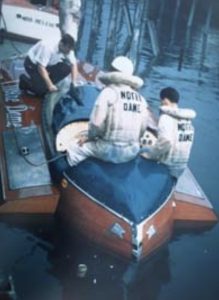
The greatest achievements of that year included winning the President’s Cup on the Potomac River and taking the Notre Dame to Detroit where they set a new world’s water speed record for 12-liter boats at 100.987 MPH in a two-way run. This was a very impressive speed for a conventional hull. By the end of 1940, Herb Mendelson’s “Notre Dame” had become the most publicized race boat of the year. It had set four world speed records. ( 1mile supercharged, 2.5 mile, 15 mile, and 30 mile) All were driven by Dan Arena. The one disappointment he had was not winning the Gold Cup that season.
The war in Europe was raging in early 1941, and many were aware that our neutrality couldn’t last. Detroit was already producing war equipment and supplies for Great Britain and France. Hence, Herb decided that this was not the time to be racing boats, and he asked Dan to move the “Notre Dame” back to Algonac, and prepare it for long time storage. Dan did this and returned home to Oakland, California.
Dan was a First Lieutenant in the Army during WWII working as a Marine Design Engineer on ships, while his younger brother, Gene, was a pilot in the Army Air Corp. By 1946 the brothers were out of the service and married. Gene had one son (me, another Dan), who had been born in 1944. Upon release from the Army, Dan was already planning to design and build another race boat. This time it would be the three-point that he had originally wanted to build for Mr. Mendelson.
Dan knew the horse power for the boat could come from a surplus war plane engine. The hull was completed by mid 1946 with the help of his brother and financial assistance, once again, from his father. Still they had not located a good V-12 Allison engine from the war surplus. Eventually, they pur-
chased an “almost new” P-38 WWII plane to have an engine in time for the season’s racing.
The week before Labor Day (1946) Dan and Gene with Danny Foster, their childhood friend, who had been Dan’s co-pilot in “Golden Gate” I and II headed for Detroit’s Gold Cup Race. Foster had returned from the War just weeks earlier. This was to be Dan Arena’s fourth try for the Gold Cup, and it was with skepticism that they entered. The skepticism grew out of a couple factors. “Golden Gate III” had only been in the water once while it idled down
the Oakland Estuary. As the crane removed the boat from the water to place it back on its trailer it was somehow dropped on ts nose. So in reality, the boat had never been on plane at any speed at the beginning of the Gold Cup. As the race progressed, Dan got used to the boat and he pushed it to move to a little faster each lap. During the final 3rd heat, Dan was losing oil from a cracked line. After two laps Gene told his brother there was no oil pressure, yet Dan pushed on. This was to be the first time the spectators witnessed a 75 foot rooster behind a hydroplane, and saw a new lap record each time around.
With no oil in the last half of the final heat, the engine froze and a rod went through the side of the block. The “Golden Gate III” came to a complete stop in its wake as Guy Lombardo raced past him in “Tempo VI”.
It was never quite clear to me or my family exactly why Dan sold the “Golden Gate III” to Al Fallon and left Danny Foster to drive it right after that race. Whether it was the disappointment of another second place finish at the Gold Cup or not having an engine for the President’s Cup Race the following week, no one really knew. Back home, Dan’s wife was also pregnant with their first child, and all of these factors probably played a part in his decision.
There was speculation that Dan had talked with Herb Mendelson at that race and perhaps there was discussion about the “Notre Dame” which was in “moth balls” at the time. This seemed likely, for after the birth of Dan’s son in 1947, both Dan and Gene returned to Detroit to bring the “Notre Dame”
out of storage for Herb. The boat had been in storage at the Algonac boathouse on the St. Clair River for seven years when Dan and Gene, Walt Schmid, Bert Mackenzie, and his brothers began the total refurbishment of the boat, its engine, and its equipment. The goal was to bring the “Notre Dame” back to its original splendor. However, during its years in storage, the hull had warped making it harder for the driver to handle and keep it moving in a straight line.
Dan and Gene did well throughout the 1947 season with the “Notre Dame” finishing in the upper part of the pack. The Duesenberg W-24 was no longer the dominant power plant with the introduction of the Allison V-12 the year before, and the new three-point hulls were a challenge. Yet the “Notre Dame” still put on a show. Dan and Dad won the Silver Cup that year beating the 2nd place boat, “Miss Great Lakes” which was their old “Golden Gate III”.
Although “Miss Golden Gate III” raced only once before it became “Miss Great Lakes” it went on to win many races until 1953 when it sank in the Detroit River. Dan Arena’s “Miss Golden Gate III” became the benchmark for post-war unlimited hydroplane racing and set the standard for three-point design and Allison power for decades.
 Herb Mendelson sold the “Notre Dame” to Warren Avis (of Avis rental cars) in 1948, and he raced it under the name “Miss Frostie”. Dan and Gene had started their own company to build and race unlimited hydroplanes at this time. So, when Warren Avis sold the old “Notre Dame” to Joe Schoenith Dan was contracted to rebuild and lengthen the hull to house the Allison V-12. The boat was renamed “Gale I” and it raced from 1950 to 1953. Schoenith then leased the boat to Bud Saile who campaigned it as “Miss Wayne” from 1953 to 1955. The best award for this Grand Old Lady was a third place as she finished racing during those last years.
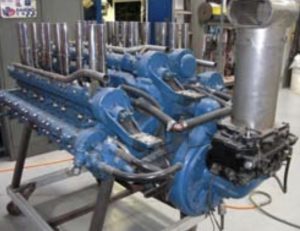
Upon retiring her, she was stripped of her hardware and stored in Joe Schoenith’s race boat yard where the hull burned accidentally in 1957. The fastest pre-War Gold Cup boat was gone. Luckily, the Schoenith family took better care of the Duesenberg W-24 and its extra parts. Even today, the “Notre Dame’s” 1937 Duesenberg power plant is considered by many to be the most elegant marine racing engine ever built.
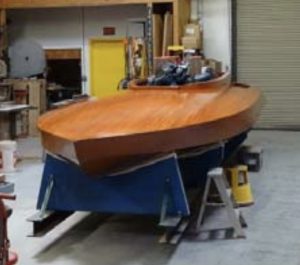
The W-24 eventually found its way to the Alan Furth Estate and it was purchased by Gerard Raney and Alec Giaimo in 1992. After considerable research, the use of the original drawings, the use of Walt Schmid’s detailed journal, and the expertise of Dan and Gene Arena, Gerard Raney began the 24 year project of building an exact running replica of the 1940 “Notre Dame”. It was introduced and shown on July 29, 2016, at the South Shore Boat Show where it won “Best Engine of Show”.