
By Alan Hills, North Carolina Coastal & Piedmont Chapter
After the boat was built, the building team enrolled in the Boat Manufacture and Service program and their project for that term was to turn JS100 into a running boat. All the necessary components were installed, such as fuel and exhaust systems, bilge pump, engine and running gear. At the end of the term, a sea trial was conducted and all the parts, save for the fuel tank and rudder port were removed. One interesting problem that arose during the fit-out was the fact that a strut of the proper dimensions was not available in a stock item. No problem, a strut was built by the team out of carbon fiber! How’s that for ingenuity?
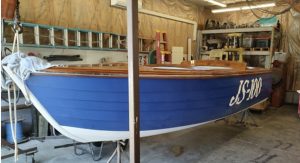 Well, getting back to my saga, I was able to get the made-up strut and a couple of fiberglass exhaust elbows from the college. A couple of more trips to the Piglet got me a rudder, shaft, prop and some exhaust hose. I had to purchase a couple of items from eBay to get all my parts together. I decided I didn’t like the what the steering system was done; Jersey Speed Skiffs have a distinctive vertical steering shaft and flat wheel that I had to have. Luckily, there was a vintage skiff at the Chesapeake Bay show and its owner gave me the name of a shop that would build such a thing. (another advantage of being an ACBS member!). Now all that needed doing was to put it all together.
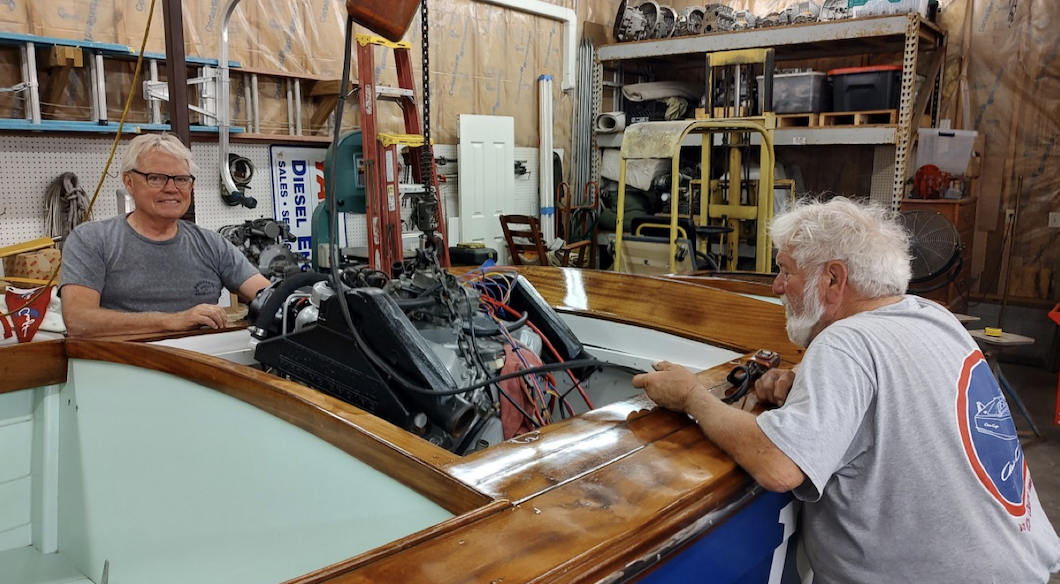
First order of business was to cut the gauge holes in the dash and pre-wire for all the systems. Next came installing the steering system, which wasn’t too hard until it came to hooking up the rudder. My 78-year-old body was not going get that done. Enter Jackson, my grandson with the long, skinny arms. He did a great job! Next up was the engine install. I ran it in my shop for about an hour to check for leaks, etc. That done, it was over to fellow member Jim Hartman’s shop to use his gantry. All went well until we discovered that we could not lift the engine high enough to clear the deck.
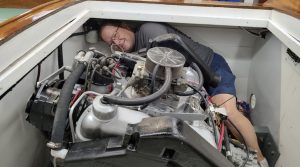 No problem! Just take the boat off the trailer and lower down about a foot. That done, the engine was dropped in and aligned. Now it was time to address the elephant in the room; the exhaust system. The team at the college had installed 4” fiberglass exhaust tubing that was run along the
chine. This worked well for the engine they installed, but presented a problem for my engine, My exhaust system was 3” and had to be run outboard and mated to the 4” tubes in a very confined space. After much cussing, mocking up and more cussing, I finally got it hooked up. During the process of getting the last detail done, I was fortunate to have the help of (younger) chapter members John Peck and John Dougherty.
The next step was to get her out on the water. I was joined by Jim Hartman and after a bit of running at the dock, checking for leaks and so forth, we headed out Lawson Creek. It’s a good half mile to reach the Trent River where we planned to put some power to her and see how she’d do. As I advanced the throttle, we felt a strong shuddering vibration that signaled something was amiss. Also, the engine was running very rich and wouldn’t idle properly, so with sad faces, it was back to the ramp. More problems to deal with! Depending on what I find, another trip to the Piglet might be in order.
Alan’s boat project continues, to read more in the North Carolina Coastal and Piedmont Chapter newsletter, join ACBS!